Manfred (a poem in 4 parts)

by Ruth Sabath Rosenthal
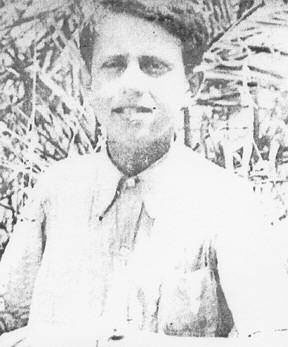
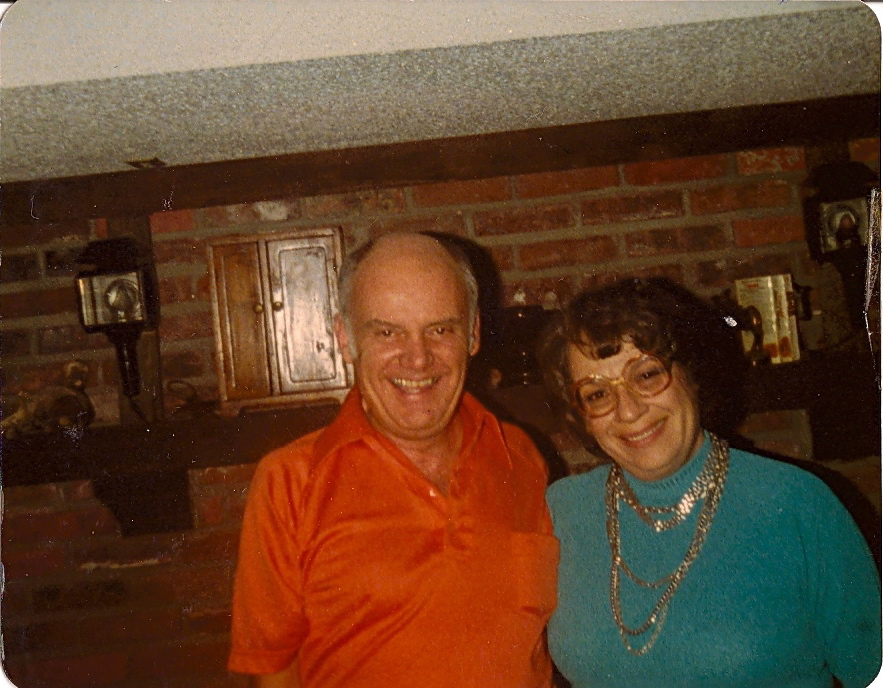
Manfred photo

Manfred


i. Raus! Raus!

soldiers shouting
father shaking me awake
father shaking in fear
soldiers shouting
raus, raus, dreckige Juden!
father yanked from my grasp
me grasping at air
raus, raus, dreckige schweine!
soldiers dragging Jews
out of their homes
into the streets of our village
dogs barking
soldiers shouting
the menfolk separated
from their women and children
menschen! geh da rüber! menschen! geh da rüber!
mütter, weitergehen! kinder, weitergehen!
wide-eyed women and children
catching sight of their fathers, grandfathers, brothers, uncles
being lined up in the town square
me spotting my father
schnell, schnell, Jüdische schweine!
gunfire erupting
soldiers shouting
dogs barking
me shoved onto
one of many waiting military trucks
along with my mother, sister, brother, and neighbors
my ears ringing from the gunshot blasts
tears streaming down mother’s face
me huddling her trembling body
she clutching my wailing sister
gripping the hand of my little brother
wetting his pants
our truck packed
latches locked in place
motor upon motor thundering
we plunge into the dark

Footnotes:

  1. “out, out, filthy Jews!”
  2. “out, out, filthy pigs!”
  3. “men! get over there! men! get over there!”
  4. “mothers, keep moving! children, keep moving!”
  5. “quickly! quickly! Jewish pigs!”


ii. The Dark

is a Yugoslav concentration camp where I go to sleep
hungry and thirsty and cold. Sleep, on a filthy floor,
huddling with my mother, sister, brother — riddled with
lice, rats running rampant. Passing each day, dazed,
just sitting around except for garbage detail and
cleaning soldiers’ latrines and other chores
given us by the Germans guarding us, all of us
wait for what, we don’t know.

Me, trying to be grown-up for my mother, act like
father to my brother and sister. All the time frightened
of doing something that angers the soldiers — living
with that, awake or asleep. And in the dark of night,
what fills my head I can’t even put into words; it keeps
me awake, till I doze off. When I wake, it’s hard
separating what’s real from what isn’t. I feel helpless,
as does everyone around me. I see it in their eyes.

Escape is what grownups whisper any chance they get,
yet I don’t think they believe they can pull it off. But,
when a German victory had the guards celebrating,
I, along with my mother, sister, brother, and a handful
of willing cellmates — do escape — no long-time plan,
just a spontaneous flight: Slivovitz, passed round to
soldiers guarding us, left a drunk guard off guard —
that, the impromptu cue for an exquisite Jewess

to single-handedly lift keys off the snoring soldier
she’d so thoroughly pleasured moments before
he passed out. What brilliance! What bravery!
I’m so proud of us, so relieved, yet frightened
to death. Under cover of darkness, hours and miles
away we are still whispering. “Magical” is the word
describing the escape we can’t stop talking about,
and we hear “magical” escape stories from those,

like us, who’d fled other camps and are hiding with us
deep in the woods. Stories of courage and daring shared
in hushed murmurs. And through that sharing, we learn
that our escape had taken place only days before our camp
(and other camps) were emptied of the fellow Jews left
behind — each one in the dark about where they were
being taken. We fear the worst, as whispers of “death”
camps are coming to us by way of the Partisans

who’d rescued our little band of Jews, and who have
me doing whatever Tito’s generals want. And, though,
living with the Partisans is strange (and, for me, scary)
it’s nowhere as scary as the concentration camp was.
Here, we are well fed and get all the water we want
and my family is safe enough, though I’m not
because of what I do in the darkness of night,
in the denseness of the mountainside.


iii. Mountainside

Always, there is darkness in the wilderness I tiptoe
through, shoeless, machine gun slung over one shoulder
and, strapped across the other, a leather pouch
holding coded messages I deliver encampment to
encampment. Locations I was trained to find

in the dark, even in rain. Focus! Focus! And — focus on
blocking out thoughts of being captured and tortured.
Me, a recruited Partisan Courier being sent into
the wilderness, night after night. The same darkness
my family and I escaped into, before being rescued

by the same people now sending me back there.
“He’s only a boy!” Mother pleaded. “Tall for his age,
yes, but only eleven. Please, please believe me!”
And when she learned I could be promoted to Saboteur,
targeting German soldiers transporting war machinery

through Yugoslavia’s Mosor mountain villages —
the same villages the Partisans live as farmers hiding
families like mine she cried for days, spends hours
week upon week trying to get us to a place where
we can be safe.

Each night, returning to my farmhouse hideout,
the communications I’d been charged with delivered
hours before, miles away, the fear almost freezing me
begins melting away. And in the moments it takes me
to hang up my courier bag and machine gun, I’m ready

for the evening meal of pit-roasted mutton and stone-
ground bread, washed down with goat’s milk. Then,
a foot soak (weekly, a full-body scrub), followed by
deep sleep, swaddled in hand-woven blankets,
on the cement floor of a cellar hidden below

a wooden trap door. And, come summer, when
it’s the end of July, plans for me and my family,
and other escapees, to go to America should be
ready. Imagine! In just a few months, we’ll be
on our way to America! It’s guaranteed we will

find safe haven there, because everyone knows
America is the land of the free, home of the brave.
And we are the bravest people I know!


i.v. Into the Light: Safe Haven, 1944

Thank God for you, Henry Gibbins, ship of dreams
filled with my bedraggled brethren dark and fair,
tall and short — all frail-boned and gaunt —

each of us a survivor reborn in the wake
of conscience, reborn on this buoyant sea revered
for strong currents and changing tides, fresh air

filling the sunken chests and ashen lungs of those
who’d escaped the fires of Auschwitz-Birkenau,
Bergen-Belsen, Buchenwald, Dachau, Treblinka…

Yes, thank God for you, Henry Gibbins —
your sky-crowned decks surrounded by sea-
speckled rail — a far cry from barbed wire!

And during hours of German bombardment,
the shelter of stalwart bulk, mahogany halls,
tier upon tier of canvas hammocks —

warm blankets and soft pillows helping
to smother my nightmares, set in motion
sweet dreams; dining hall, with cornucopias

of vegetables and meats, kaleidoscope
of treats swelling shrunken bellies, smoothing
withered souls; and treasured beyond belief —

glistening white toilets! You are America
to me! The America of my dreams! Home
of the free and brave!
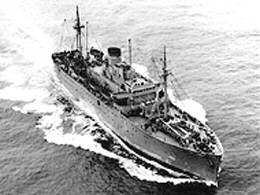
 

The Henry Gibbons

The Henry Gibbons


Note on “Into the Light: Safe Haven, 1944”

The Henry Gibbins, a United States army transport, first launched in 1942 as the Biloxi, was delivered to the Army Transportation Service on February 27, 1943, renamed, and readied for the purpose of transporting 1000 holocaust survivors (982 Jews) to the United States from Naples Italy, on or about July 17, 1944, under an order signed by President Franklin Delano Roosevelt and carried out by his emissary Ruth Gruber and American Repatriation Officer, Captain Lewis J. Korn.

After 17 perilous days, the exodus, named **“Operation Safe Haven,” arrived mid-afternoon August 3, 1944 in New York Harbor — the Statue of Liberty literally rising out of a rainy-day haze.

The sojourn from unimaginable tyranny and enslavement, to peril on the high seas, to eventual safety on dry land, continued, by railroad, to Oswego, New York’s army base, Fort Ontario, which had been converted to a refugee camp.

It was on August 5th, 1944, that the bedraggled group of survivors arrived at the fort, and there, for 18 months, tended their wounds and immersed themselves in the process of healing and preparing for their moves into houses and apartments across America and any countries, world-wide, that proclaimed them welcome.

Today, the site of Fort Ontario serves as a memorial to these survivors. The fort’s administration building, renamed “Safe Haven Museum and Education Center,” houses priceless photographs and documents mapping the extraordinary exodus out of darkness, into the light.

** not to be confused with “Project SAFEHAVEN – tracking Nazi gold” — an operation designed by The Office of Strategic Services (OSS) to root out and neutralize German industrial and commercial power wherever it might be found.


RUTH SABATH ROSENTHAL is a New York poet, well published in literary journals and poetry anthologies throughout the U.S. and also in Canada, France, India, Israel, Italy, Romania, and the U.K. In 2006, Ruth’s poem “on yet another birthday” was nominated for a Pushcart prize. Ruth has authored 4 books of poetry: “Facing Home” (a chapbook),“Facing Home and Beyond,” “little, but by no means small” and “Food: Nature vs Nurture.” These books can be purchased from Amazon.com (USA). For more about Ruth, “google” her and visit her website: www.newyorkcitypoet.com

Fried Potatoes

by Misha Pettman

095

Photo Credit: Misha Pettman


I remember frying sliced potatoes: sweat running down my legs, the bandana with the Texas state flag around your forehead– the one you gave me to remember you by– not stopping the sweat from rolling down your temples, the two of us slicing potatoes and scorching them in hot sauce. Everything was hot. Texas was hot, our bedroom was hot, the food was hot, your temper was hot. I remember that twin bed, you at 6’5″ with your feet dangling on the floor. I loved how tall you were, me at 5’8″ never knowing the feeling of shortness before. I loved your scraggly hair and your scraggly beard and your scraggly southern drawl. I loved your name, David West, like some story-book western outlaw. I remember two-stepping every Saturday at The White Horse, The Careless Smokers covering Conway Twitty and George Jones, you looking only at me, me looking only at you. I remember writing our duets, playing them in barrooms all over the state, living out a kind of musician’s fairytale of love. I remember the first night on the bus and three days later filing for a marriage license. I remember you crying that first night we spent together, me surprised at mattering so much. I remember us feeding the baby goats in the tall grass on that farm you were working, you bringing me the cutest ones. I remember you breaking down the bathroom door because I didn’t tell you I was going to take a bath, ripping the shower curtain down and walking away. I remember driving us to play that show, me refusing to answer you or let you touch me, you trying to run the Hyundai into a ditch, your hands on my throat, if I wanted to play the victim, you would show me what abusive really looks like. I remember that show, you sweet as honey, me, cold as ice, all the girls in love with you, comforting you, asking why you put up with me and my attitude. I remember our first dance on the patio of that tiny bar to the sound of you humming “Waltz Across Texas” in my ear. I remember us waiting for our turn to play outside that dive in Manchaca, nothing but grass for miles, you and me making wishes, not knowing they would never come true. I remember telling you I never loved you and never would, making you that ugly cake for your birthday, you picking out the bare wicks and licking them dry, the wax of the candles melted into the hot, soupy batter, I remember you rubbing me with frozen wash cloths when I cried because it was too hot to sleep. I remember the night you told me to leave, me packing up and you locking me in the closet to keep me from going. I remember lying on the floor of that closet, finding all the little scraps and scribbles of mine you’d saved under a box in the corner and ripping them up, you unlocking the door, lying beside me, squeezing too hard. I remember that June night, the heat still oppressive after sundown, arriving in Texas at your house, my new house, after all those months apart, just three days back in February to remember your face by, hugging you to keep from looking at you—the fantasy I knew best, the man I didn’t know at all. I remember the last night, looking at you and all the things I’d never know again, missing you, missing the way you used to look at me, both of us in tears, both of us knowing we were out of chances.

Photo Credit: Misha Pettman

Photo Credit: Misha Pettman

I wonder which things you remember—you, drunk again, holding me down, scratching me with your toenails, biting me all over, me saying I hated kissing you and you forcing your tongue in my mouth, us wearing our red-checkered shirts that matched the tablecloths at The Broken Spoke and dancing slow to every song, the cowboy all in black, the drummer for the show I snuck out to play without you and your waiting up at home to drag me around the neighborhood, screaming that I was a whore, the tickle fights in the morning before the sun turned the room into an oven, me rubbing you with aloe all night after you tried to prove you didn’t sunburn, you crying on the street corner because you couldn’t afford to take me to dinner, me packing up for New Mexico, you leaving kiss marks all over my windshield, hoping one would survive the rain, me driving back to you, six-hundred miles to spend one night with you, make-believe for the last dance—the last night, just like the first night—us wrapped up together, making promises we’d never keep?

Photo credit: Misha Pettman

I remember. Remember us, frying in the sweaty heat of a central Texas summer. I hope you remember. Remember fried potatoes. Remember I came 2000 miles with everything I owned to live in that daydream with you, remember promises that seemed so easy to believe, once upon a time in the rolling hills of Texas.

Photo credit: Misha Pettman

Photo credit: Misha Pettman


About the Author

Misha Pettman is a published writer and decent bassist living in Nowhere, New Mexico.

In Pursuit

 by Matthew Brennan
 

My training officer and I were leaving the cafe when we got the call: Two-seven-eight … Possible drunk driver coming into town on Route 10, northbound from Farmington. Dark colored sedan, swerving all over the road. Plates end, Victor-Ocean-niner. Approaching the border now.

“Ten-four.” Hammer handed me our coffees. “Get these in the holders. Don’t open the lids yet.”

He pulled out onto the road and accelerated eastward, the patrol car sliding smoothly through the gears, pressing me back into the seat, still holding the coffee cups. I got them tucked down into the cup holders a moment before Hammer braked, then turned right, lights flashing, through a red, and accelerated south on 10 toward Farmington. The traffic mild, he only flipped the lights on when we overtook a car, off again as soon as we’d passed, the long evening shadows rushing up across the windshield.

Every oncoming car that passed us we checked – model, color, plates – looking for a match. At this speed, I soon worried that we had gone too far, had missed him, but then Hammer said, “There he is,” and pulled a quick, wrenching U-turn, taking the front right wheel up over the curb, and raced after him, lights flashing. We caught up to him in almost no time at all.

“Two-seven-eight to dispatch,” Hammer radioed.

Dispatch. Two-seven-eight, go ahead.

“Ten-twenty-three. In pursuit.”

Ten-four.

We took up position on his tail, but the driver gave no indication of pulling over. Hammer flipped the sirens on, still with no effect. I glanced over at our speedometer and realized that he was only driving twenty-five in a forty-five zone; at this speed, the swerving we’d anticipated appeared more like drifting. At first just a touch on the yellow lines, then across partway into the oncoming lane and back, overcompensating and hitting the right-side curb before straightening out again. Through the rear window in our headlights we could see the driver shaking his head violently and running his hand back through his hair, preoccupied and oblivious to our pursuit. By now, Hammer no longer bothered radioing his ID number in to dispatch and waiting for the go ahead – he held the talk button down, giving a running, curse-laden commentary on the situation. Going up onto the right-side curb again, the driver veered sharply away from a telephone pole and into the oncoming lane – “Oh shit! He’s all over the road!” – then up over the left-side curb before bouncing back into his lane, still no faster than twenty-five. All this time, no cars had come from the other direction.

Rounding a bend in the road, the woods gave way to a view into town, a major intersection about half a mile ahead. Lights flashing, another officer, Boz – many of them went by old military nicknames – had blocked southbound traffic with his car perpendicular across half the road. My brother, also a cadet, a year ahead of me in school, was riding with him, the passenger’s side of the car facing us. When our pursuit came into view, Boz pulled out further into the road, positioning his car across both lanes and swiveling his spotlight around in a last effort to get the driver’s attention and make him stop. Against the held-up traffic’s headlights on the other side, I could see my brother silhouetted in the window.

“Boz, get out of there!” Hammer yelled into his radio. “He’s gonna hit you!”

Like a moth to a streetlight, the driver veered toward Boz’s cruiser, even as the cruiser backed up out of the way, and he proceeded to pinball again across the road: veering away from Boz at the last second, overcompensating and bouncing off the right-side curb, then swerving back toward the line of stopped traffic, coming within inches of a white SUV that turned and pulled up onto the curb to avoid the collision.

Back in his lane, the driver was approaching the traffic light, both intersecting roads five lanes wide, the road beyond the light narrowing into meandering switchbacks. He would crash there if he crossed – best-case scenario, injuring only himself. But the light was red: his brake lights lit up, and by habit, by miracle, he slowed to a stop on the line. Hammer leapt out of the cruiser and ran up to the driver’s door, ripping it open then reaching inside to jam the transmission into park, unbuckle the man, and pull him bodily from the car.

While Hammer half-dragged the man over to the grass behind the street corner, I looked ahead noticed two sergeants’ SUVs parked on either side of the intersection, prepared to intercept and blockade if the driver had crossed, if the light had been green. I tried to imagine maneuvering my car in front of another, began to picture alternate outcomes. The street corner quickly filled with other officers and a few civilians, and Hammer came back to the car to get his notepad, anticipating the coming paperwork. “He’s diabetic,” he told me. “Probably would’a been in a coma in another five minutes.”

An ambulance arrived, and one of the paramedics gave the driver a protein bar; an off-duty ER doctor showed up with a large plastic cup of orange juice – my brother and I would later wonder where he got it – and within minutes, the driver had gone from the picture of a complete drunk to a normal guy, a soccer ref who’d lost track of time refereeing an extra game, his snacks forgotten at home. He shook hands with the officers, medics, and doctor, thanking them, then got back in his car and drove home.

“We’re just letting him go?” I said when Hammer returned to the car.

“What would we charge him with?” Hammer said. “Low blood sugar’s not against the law. And he didn’t hit anyone.”

“I don’t know,” I said, “reckless blood sugar?”

FullSizeRender(2)

Hammer laughed and pulled back out onto the road, turning left at the light to return to his zone. I glanced past him to where the other patrol car had been, now gone, and my brother’s face pale in the headlights of the oncoming car.

About the author:

Matthew Brennan is a writer, editor, translator, and blogger from the Pacific northwest. His work has received several awards and fellowships, and more than sixty of his short fictions and poetry translations have been published in journals, including The Citron Review, SmokeLong Quarterly, Emerge Literary Journal, The Los Angeles Review, and Superstition Review. He earned his MFA in fiction at Arizona State University. http://matthewbrennan.net @MatthewBrennan7

Two Years and 20 Miles from Sandy Hook

by Allyson Wuerth

“We take up the task eternal, and the burden, and the lesson, Pioneers! O pioneers!”—W.W

Every writing workshop I’ve ever attended, I’ve been taught this: don’t write about a fresh hurt; let time pass. If it’s too fresh, too close, your words become litters of blind puppies thrown onto the Merritt Parkway. But the thing about Sandy Hook is I will never be far enough away. There will never be enough distance between us.

I am removed from Sandy Hook by only 20 miles and two years. Even though my own two children were safe in their New Haven grammar school that awful day, I sat in the faculty room of my high school watching the news and remembering the shampoo & little boy scent of my own first grader. Longing for him, as if he were already gone. His lisp. His new glasses, the whole messiness of him. His love of reading and his little sister. What had I said to him that morning of December 14, 2012 when I rushed out the door? Even then, I couldn’t remember.

So much of that day is broken into breaths of before and after.

The before breath, where I kept my classroom door opened and unlocked, where I could pop in at my own kids’ school without leaving my driver’s license at the front desk, where I could send my children off to school and there was no question, not a single doubt that they would be safely returned to me.

December 14th 2012, I taught two classes. It was my “easy day.” I didn’t know anything until 12:50 pm, when my 3rd period class ended. All the while 20 children and 6 of their teachers were being shot, I was deeply engrossed in the reading and interpretation of Walt Whitman’s “Pioneers! O Pioneers!” His words so clear, I can hear them rolling through my head calling for action and movement and change. One student spoke up that morning, hesitant as students usually are when interpreting poetry, “Is the speaker talking about us?”

“Whom?” I remember asking.

“Young people,” she responded. “Is he talking about us? Are we the tanfaced children?”

We watched clips from Dead Poets Society, my students mesmerized. Was it the allure of transcendentalism, a philosophy so short-lived in its own time because of its flagrant idealism? America plunged into the Civil War and left Emerson & Thoreau in its wake. And, yet, here in Whitman’s voice, they awakened. Here, in my students who continued watching long into the credits, they lived.

Our principal came over the loud speaker as I was walking to the faculty room. In my small catholic high school, she asked us all to pray, her voice nervous: “. . .there has been a school shooting very near to us in Newtown at an elementary school. A principal had been shot.”

In the faculty room we had our eyes glued to the television. In the 11 years I worked at that school, Sandy Hook was the one time we turned on the television. It was the first time no one spoke.

The newscaster was saying that there may be two shooters. . .only one accounted for. Was there a second shooter out there? Could he drive the 23.6 miles to my children’s school? The thought consumed me, filled me with a heartache, a longing, and a shame I couldn’t explain right then.

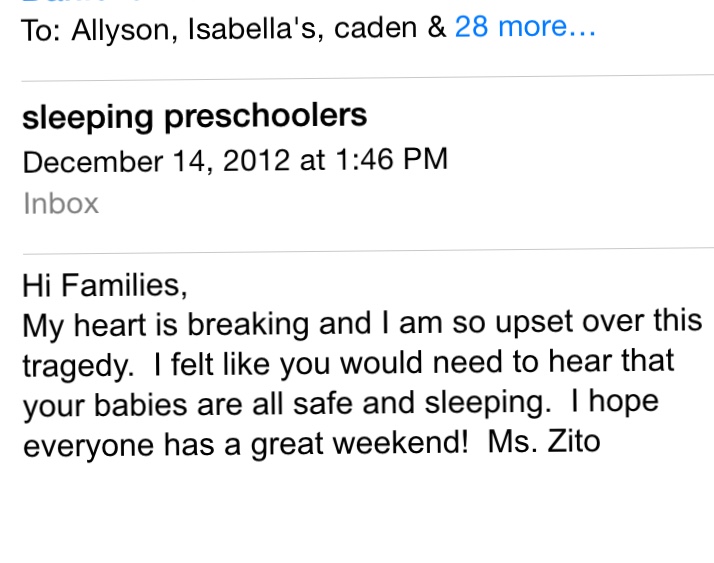
I checked email every few seconds, just in case there were any updates. My daughter’s amazing teacher emailed me.

FullSizeRender(1)

It was what I needed to hear. Because I felt so damn lucky to hear it, to picture Sawyer sleeping on her cot with her lady bug sleeping bag, clutching her pink penguin. When I couldn’t hold it in any longer, I burst into tears, the kind of tears that make you feel like your body is imploding.  A colleague wrapped her arms around me.

My daughter’s classroom was right across the hall from my son’s. This, before December 14, 2012, was always a comfort to me. My son, 6, with his watchful eyes always peering into his little sister’s preschool classroom, my daughter, only then beginning to emerge from her shyness, coming home with stories about Tristan waving to her from the hall.

And then this closeness, those small and few footsteps between their classrooms became a horrible burden to me. What if?

When I picked my children up that day, I sat beside an amazing woman, her daughter a classmate of my son’s. We sat in silence waiting for the pick-up announcement, our hips touching. Finally she said, “I’m such a news junkie, and the first report I saw came through early in the morning. The AP said the shooting was at a New Haven grammar school. The next report said Newtown.” For a moment, we did not breathe.

I picked up my girl first. Buried my nose in her hair. She was 3, and it was her first year of school. And then, my son, who knew something about the day, things he would not mention until they were safely buckled into their car seats.

He knew that somewhere there was a bad man with a gun. Older kids at school had mentioned it. “Was it kindergartners, mom?” he asked.

“I don’t know,” I lied. How could I tell him about the twenty first graders? I didn’t have the language for that conversation then or now.

But he wouldn’t let it go. “It had to be, mom, because they are too small to fight back. First grade or bigger could fight back.”

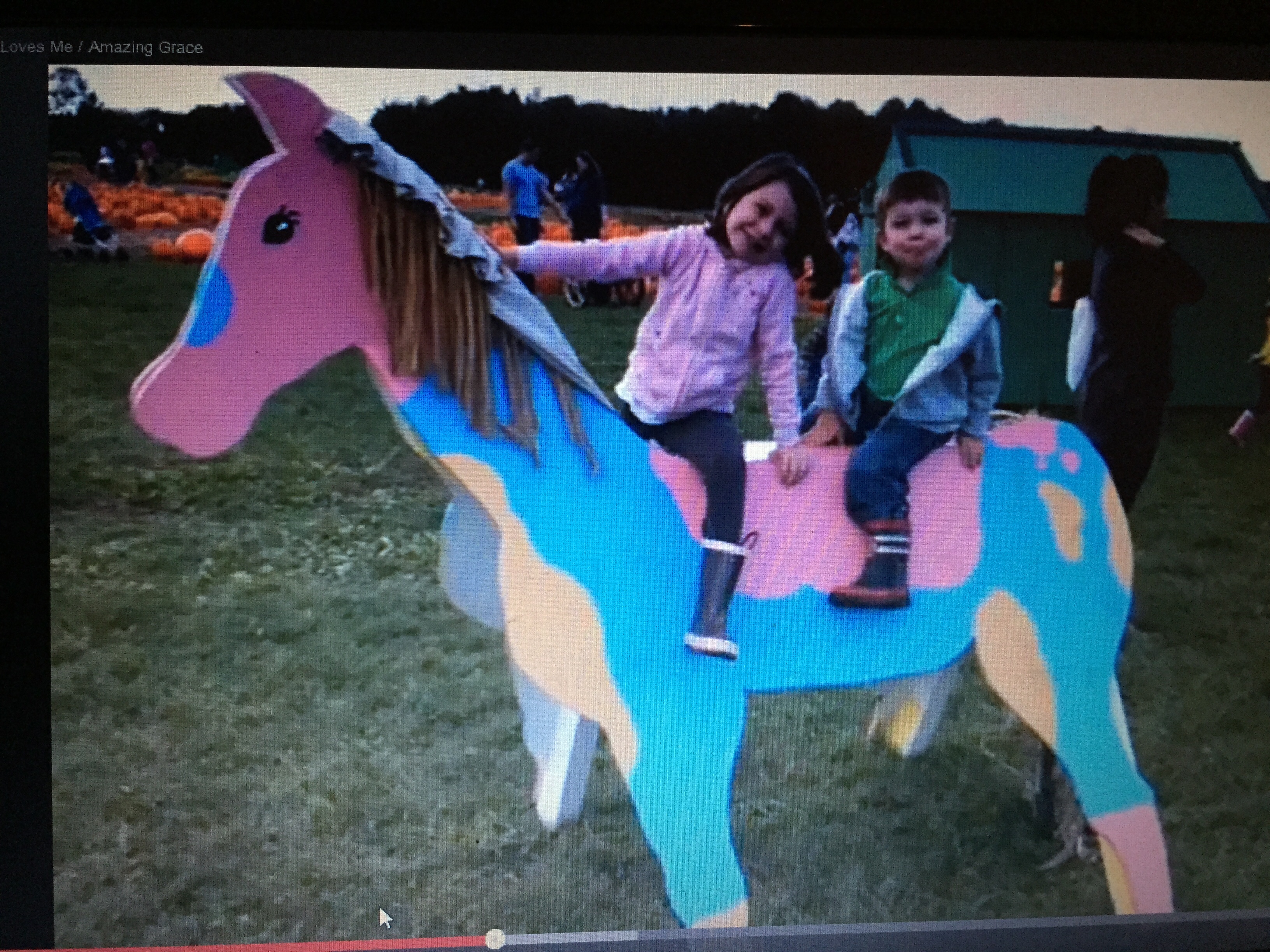
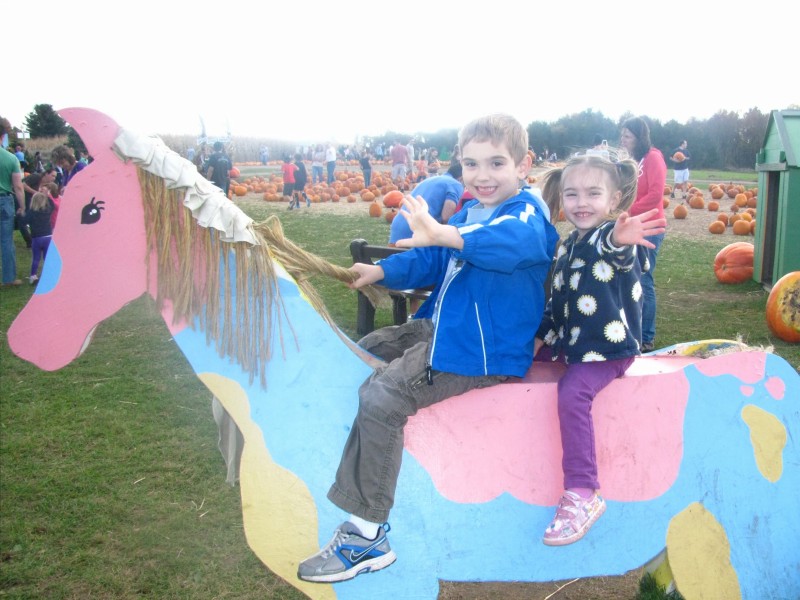
That night and many nights after, I curled up on the couch and watched CNN. I’d never done this before. As the days passed, the names of the victims were released. Tribute videos appeared. During a photo montage for Olivia Engel my heart stumbles over itself. Olivia and her brother at Jones Tree Farm in Shelton. They beam from the “rainbow horse.” She is six. Her brother looks to be the three-year old my daughter is. I have this same picture, only the smiling children on the rainbow horse are my own. It was on the holiday cards we sent out on December 8th. There is no space in which to cage my heart.

Olivia and her brother

Olivia and her brother: Jones Tree Farm 2012


232323232fp83232-uqcshlukaxroqdfv3-;-2-nu=3-73-895-45--2;6489554;23-ot1lsi

My kids: Jones Tree Farm 2012

These are just images. Two children on a horse at a pumpkin farm. I’m sure thousands of Connecticut families have this same photograph, the ground covered in so many pumpkins. Both Tristan and Olivia clutch the braided rope. Did she, too, hunt too long for just the right pumpkin?

Even today, I worry about moving into spaces once occupied by someone else. Of flurries that are the delicate bellwethers of ghosts. Of breaking glass and lost souls. The two of them together on some collision course that no one can stop.

In the weeks that followed Sandy Hook, everything changed. Long lines of parents spilled out the glass doors of my children’s school. A new rule, we had to sign them out one grade-level at a time. This signing in and out of one’s children takes the kind of time parents do not have. We were torn between annoyance and shame. Names were needed. Times. Room numbers. For weeks we waited quietly, complaining only to ourselves and our spouses. This is what we must do. And it is no great sacrifice. But months into this routine, we verbalized its uselessness, some parents going as far as signing out their children under names like Charles Manson or Jeffery Dahmer. No one important notices.

Children are gathered up into their winter coats and shuttled out the doors. Over and over. Every day. It is impossible to keep them safe.


About the Author:

Allyson Wuerth is a co-editor of Tell Us a Story. She is a mom, a wife, a high school English teacher, and a writer. And, right now, she is happy to be just those four things. She has published poetry in several literary magazines. You can read her other two blog posts, The True Story of Why I Hate Math and What we Miss Most by clicking these links.


Solitary Confinement

by Cindy L. Marvin

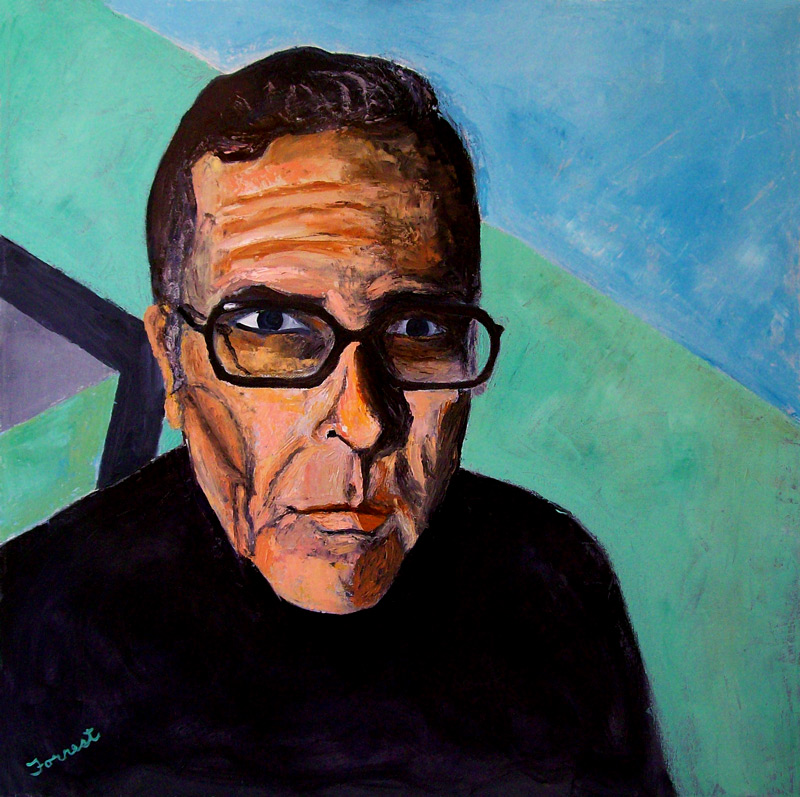
Courtesy of Allen Forrest

Art credit: Allen Forrest


I was lying on a green, plastic covered mattress that made crunchy noises when I moved around. Tan polyester netting was exposed in many areas. When I moved around, flakes of green plastic stuck to my sweaty body and wounds. It smelled like mildew, Jheri Curl hair products, and sweat. I had tried putting my orange jumpsuit down on the mattress and lying on it, but the uniform’s material was stiff and scratchy. It irritated my skin worse than the plastic bed.

To occupy myself, I repeatedly touched an area behind my right ear. It felt wet. A section of my hair was missing. The bald area was no bigger than a quarter and was not bleeding. When I looked at my finger, I saw clear fluid. There was no mirror in my cell, so there was no way for me to look at the injury. I could not look at the wounds on my face either, but I could feel that my eyes, lips, nose, and cheeks were swollen.

Because there was no one to talk to, I lay on my bed and examined my injuries. I counted twenty-seven bruises and three cuts on my arms, legs, and torso. My white body was a canvas of red, black, and purple splatter. I had an interesting bruise on my hipbone that resembled a child’s purple crayon drawing of a butterfly. I searched for other shapes like children look for animals in cloud puffs. With the exception of the butterfly, all my contusions looked like blobs and sponges. I twisted my sore body around on the brittle mattress attempting to find a comfortable position. I closed my eyes. Immediately, the memory of fists, feet, concrete floor, billy clubs, and mace flashed bright and sharp. My eyes sprang open. I flipped over my thin plastic pillow and lay back, eyes open. Eventually, I fell asleep.

I woke up when I heard keys jangling. The sound was exaggerated by the long empty corridor. I tried to speak to the guard who slid my dinner tray under the door. She popped gum and ignored me. I wanted to know what time it was. My meals all arrived cold, so they could be feeding me at any time. The food, served on tan compartmentalized trays, was distinctly breakfast, lunch, or dinner. That was my clock. After dinner, I put an “X” on my homemade calendar to mark off a day.

The lights in solitary were on all the time. I was always locked in my cell except once daily when I was taken out to shower and sometimes exercise in a small outdoor pen. Officers became impatient if I showered too long or stood outside in the cage more than ten minutes. The only thing I had to read was a Bible. It was smaller than my hand, white, and the binding broke, loosening several pages, the first time I opened it. The only other inmate in solitary was in the cell directly across the hall from me. She was an insane woman who screamed and moaned incessantly. Often, it sounded like someone was torturing her. I complained to the guards that she should be in a mental ward.

The second week in solitary confinement, the hours between meals and my shower existed on a clock with a run-down battery. Off and on, I picked up the Bible and tried to read it. Everything I read was scary, confusing. I regularly checked the wound on my head. It was drying up. I only wore panties because of the heat. I spent a great deal of time staring at my limbs and torso. My bruises were fading. The butterfly was dying a putrid greenish yellow death. Many times, I sat staring at my yellow legal pad. I would draw pages full of two dimensional boxes. Most often, I simply lay on my bed, sweating on plastic, staring at nothing.

The walls were made of cinder block that had been repainted so often the bricks’ texture was almost smooth. Previous residents wrote their names, cuss word, and drew pictures on the wall. An inmate wrote, “Burn TPW (Tennessee Prison for Women)” then drew a smiley faced sunshine above her words. Another prisoner wrote “gards is hos.” I scanned the room for misspellings. I read, “dam, hellow, wite, pusy.” To counterbalance, someone wrote, “Culpability,” in beautiful cursive. The letters were two inch high and drawn in thick and dark.

The end of the second week, I watched them take the crazy lady away. I stood at my door and stared out the little window. She was a surprisingly small woman in her late thirties. Her hair was dark and matted, but her features were striking. She had what I called gypsy eyes, light color with dark lashes and brows. Her lips were red, and I knew she was not wearing any make-up. They shackled her, running chain around her waist. Her wrists and ankles looked miniaturized confined in steel. She spit in one of the guard’s faces then started yelling some crazy gibberish, or possibly it was a language totally unfamiliar to me. Four female guards pushed her face down on the concrete hallway floor. Two of them sat on her. I walked away from the window. The crazy lady yelled as they dragged her down the hallway. When I heard the entrance gate to solitary confinement close, I looked out my window. There was red blood on the grey concrete floor where they had slammed her head down. The blood formed a perfect moon shape.

Without the crazy lady screaming and moaning, the only sound was a strange popping and gurgling of the plumbing pipes.

My third week in isolation, I crossed off my nineteenth birthday on my homemade calendar. In spite of extreme exhaustion, I could not sleep. Many dinner trays had come and gone since I had slept. I paced constantly even though I was sweating from heat and humidity. It was July, hot and humid. There was no air-conditioning, no fan. The sink water tasted like iron and smelled like sulfur. I could not drink it. I used it to wet down my body and my hair. Often, I wet my towel and put it around my neck.

For lunch, an officer slid a tray with a fingerprinted bologna sandwich oozing clear mayonnaise out the side, runny applesauce, corn chips, and a carton of what I knew was warm milk under my door. I pushed the tray back into the hall untouched and sat on my bed with my head and shoulders slunk forward. At some point, I looked at the wall to my left. I stared at my shadow on the beige cinderblock. Eventually, I leaned back. My shadow did not follow me. I jerked up and whipped around facing the floor. My breaths came rapid and shallow. I put my head between my legs. I saw my shadow on the concrete floor. It transformed from gray to purple. I squeezed my eyes shut then opened them. The shadow changed. It came to life like an oversized amoeba. I jumped to a standing position on the bed. I heard radio static.

“Is a guard coming down the corridor with a radio? I don’t hear any keys.” I listened intently. I heard arguing voices intermixed with the static. I put my hands over my face and rubbed.

“I’m losing my mind,” I thought.

The noises and moving shadows continued for hours. I leaped from my bed to the floor to standing on the rim of the toilet. When a guard brought my dinner tray, I told her I thought I was going crazy. She asked me if I wanted to kill myself. I said no, but… She left me alone. When I looked at the graffiti on the cinderblock all around me the lines loosened from the walls and danced. When I closed my eyes, I saw red headed beasts with white eyes. I prayed to my grandmother’s God to please help me.

That night, two guards took me out of my cell for a shower. I saw thick dark facial hair on both women. I feared to ask them for help. At the shower, I refused to step into the metal stall. When they attempted to lock me back in my cell, I starting screaming hysterically flailing my arms. At the same time, their walkie-talkies went off, and a prison alarm sounded. They forced me into the cell, locked me in, and quickly headed out of solitary. I kicked at the door and even banged my head on it. Then I crumpled to the floor crying.

Sometime later, I heard screaming, cussing, and keys coming closer and closer. I stood on my bed. I heard the cell next to me being opened and then locked. Then I heard the clang of solitary’s entrance gate.

Several minutes later, someone said, “Blondie. What cell are you in? I saw them bring you back here.”

I jumped off my bed and put my face to the three inch opening at the bottom of the door.

“I’m here, next door.”

My neighbor told me her name was Hawk.

“I heard you got a code red at minimum security. What the hell did you do?”

“I pushed a guard. She was hurting Jolene.”

“Fuck the guards!” yelled Hawk. She banged on her door repeatedly.

When she stopped, I was quiet for a moment then I said, “I was losing my mind back here.”

Hawk slid a stack of magazines over to me. The titles all read Easyriders. I saw sexy, barely dressed women and motorcycles on every cover.

“How did you get these back here?”

Hawk didn’t answer. She laughed loudly.

When Hawk was asleep, I stayed up reading every Easyriders cover to cover. I sat on my bed and read every article and every advertisement. I was mesmerized reading about Harley’s new Softtail, the latest bike alarm systems, a guide to motors, and how to build a chopper.

$(KGrHqNHJE!FEN1l02ggBRG7FkqTFg~~60_35


The next day, Hawk and I lay on the floor talking through the crack. We only got up to go to bathroom. We stayed on our stomachs, backs, or sides with our faces near the tray slot. We even ate our meals lying on the floor. Hawk did most of the talking because she was twenty-eight, a biker chick, and she had many more stories than I did.

The following days, through the three inch space, Hawk filled my ears. She transported me around the United States on the back of a black 1984 Harley Davidson FXSB Lowrider Shovelhead. Hawk took me to dive bars with mean drunks that had knife fights. Then we went to bike rallies. She described Road Kings, Electra Glides, Dyna Glides, Softtails, Deuces, Fat Boys, and Sportsters. She took me to biker clubhouses. She told me endless stories that kept me wide eyed.

When Hawk wasn’t talking, she sang. Her voice was loud, and it filled all the empty spaces in solitary. She only sang Led Zeppelin songs. It seemed she knew them all.

My last day in isolation, they took both of us to the showers at the same time. It was the first time I’d actually seen Hawk. She stepped into the hallway naked with her towel over her arm. She had a strip of white cotton torn from a t-shirt wrapped around her head. It was tied on the left with a tail hanging down. She smiled at me.

“Come on, Suzy Q,” she said.

When she turned around, I saw a three foot high hawk tattooed across her back.

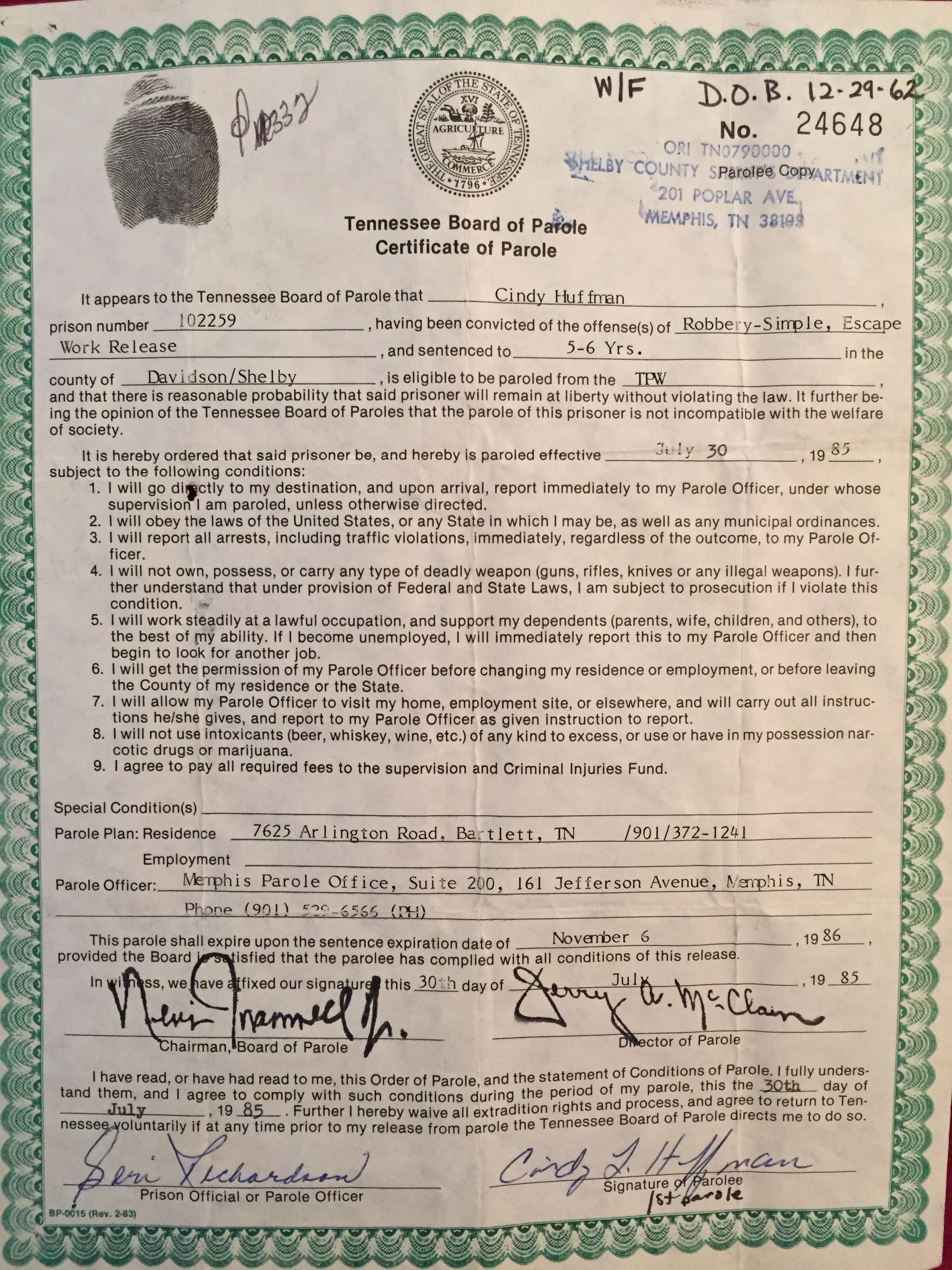
The author's parole paperwork, 1985

The author’s parole paperwork, 1985

About the author
Cindy L. Marvin was released from prison nearly thirty years ago. After her release, she went on to earn her teaching degree and become an English teacher. She is the mother of three boys. 
 About the illustrator
The artist

The artist

Born in Canada and bred in the U.S., Allen Forrest works in many mediums: oil painting, computer graphics, theater, digital music, film, and video. Allen studied acting at Columbia Pictures in Los Angeles, digital media in art and design at Bellevue College, receiving degrees in Web Multimedia Authoring and Digital Video Production.

Forrest has created cover art and illustrations for literary publications: New Plains Review, Pilgrimage Press, The MacGuffin, Blotterature, Gargoyle Magazine, his paintings have been commissioned and are on display in the Bellevue College Foundation’s permanent art collection. Forrest’s expressive drawing and painting style is a mix of avant-garde expressionism and post-Impressionist elements reminiscent of van Gogh creating emotion on canvas.


Flash Fiction Week!

“On Meeting my Dad and then Leaving”

by Mark Haase

Screen Shot 2014-10-29 at 1.41.44 PM

I only met my dad once–in a restaurant, when I was about five. Well, technically, I met him when he came to my house and brought me to the restaurant, but I don’t remember that, nor the ride home,nor much of the meal. All I recall is we ate at a German restaurant in New Orleans–Kolb’s–and I saw a sooty-looking brown rat scurrying across the restaurant floor. While eating my dessert, I said “I don’t think I can finish it” and he said, “That’s fine, just eat until you’re satisfied.”

******

“Insurance”

 by Chuck Lyons
When Bob Ryan was in rehab, he agonized over the insurance, the expense, over who would pay. He had worked for an insurance company, and he knew what could happen. In fact, the form letter denying or approving coverage had gone out over his name. That was before he had been fired for his drinking.
So, he worried.
He went to his classes, his meetings, did the reading and the writing. On Sundays, his wife visited with the kids. On Saturday afternoons, he watched college basketball games on TV, and on Saturday night the whole floor went out to an AA meeting.
But he heard nothing from the insurance company, and he continued to worry.
Then, after three weeks, he got a letter – a neatly typed letter on heavy cream-colored paper. “After a thorough review of your case,” it said, “we are unable to….”, and he knew he had been refused coverage.
“Damn it,” he thought as he scanned down the letter to the name at the bottom – “Robert M. Ryan.” “They were still using the same letter.”
He had, you see, denied himself.

******

About the authors 

Mark Haase is a licensed counselor and marriage & family therapist. He lives in Louisiana with his wife and three children. 

 Chuck Lyons is a retired newspaper editor and a freelance writer whose articles, memoirs, stories, and haiku have appeared in a number of national and international periodicals. He resides in Brighton , near Rochester NY, with his wife Brenda and a beagle named “Gus.”

Clowning Around

by Mitch Kalka


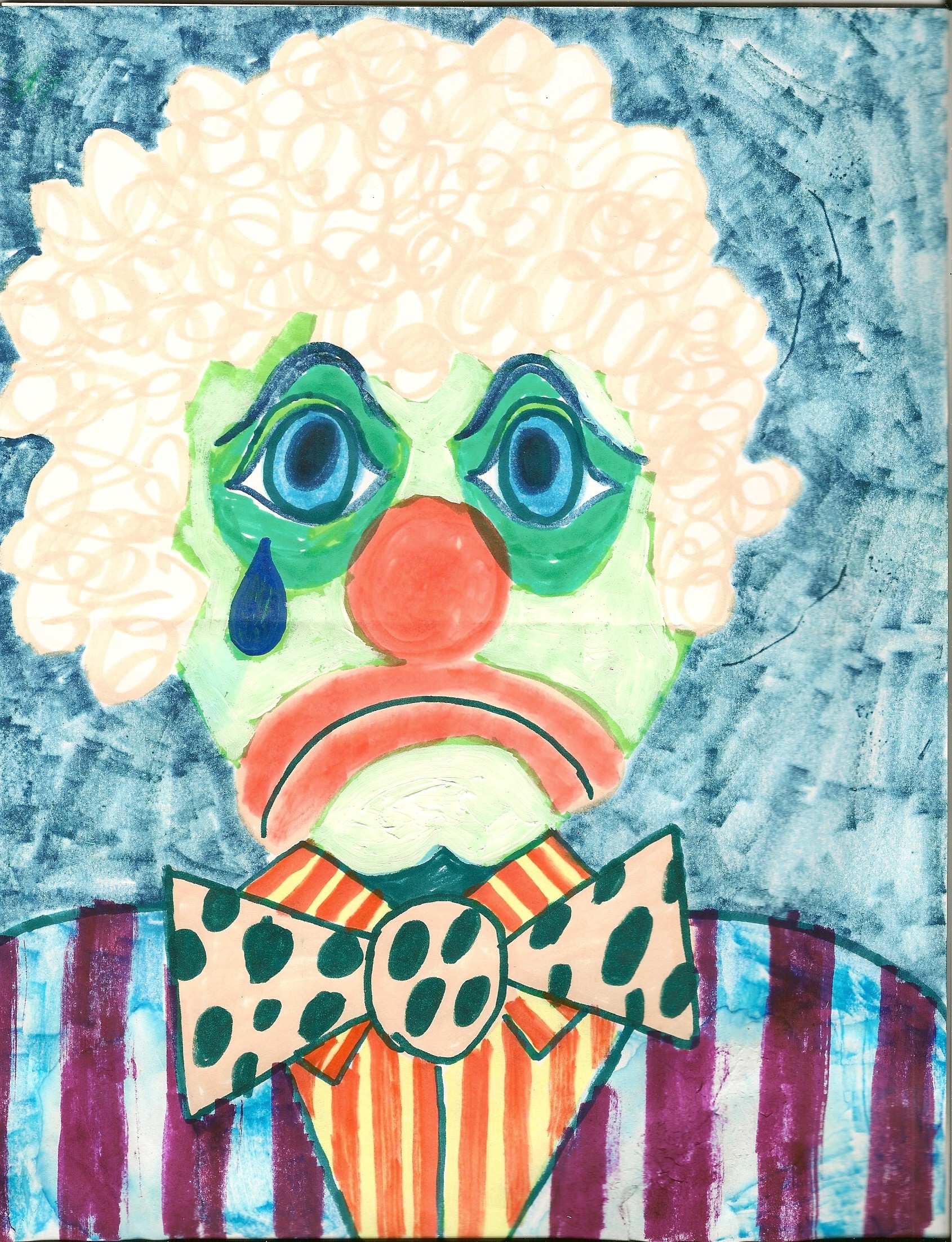
The clown, drawn from the author's memory. . .

The clown, drawn from the author’s memory. . .

I remember when my mom hired a clown for my sixth birthday. He was a sad old man who lived across the street from my grandma. I think my mom knew that I had no interest in clowns, but did it as a favor to the sad old man, who thought he was doing us a favor by supplying his clown charm at such a charitable rate.

I tried to keep my distance from him the entire time, but somewhere near the end, he approached me while my back was turned. He made small talk for a while before getting around to the subject of my grandma. “You know your grandma?” he asked.

I thought it was kind of a stupid question to be asking. Couldn’t one assume, without being too big of an asshole about it, that I knew my own grandma?

“Yeah?” I said.

“I know your grandma too.” he replied, in a way that seemed so sinister at the time.

“You do?” I replied, a look of dread falling over my face.

He smiled and nodded his head. “Yep.”

“Grandma no!” I wailed, tears rolling down my cheeks.

The clown was taken aback by my reaction. “Uhh…”

“Please don’t kill my grandma!” I screamed.

This poor clown. He glanced around in embarrassment. “Easy there, bud. There’s no reason to get upset. I’m not going to hurt your grandma; I know her. I’m her friend. See?” He waved his hands in the air and smiled, which was somehow supposed to prove that he knew her.

“Her name’s Shirley, I live across the street.”

“Don’t hurt my grandma!” I screamed.

He didn’t understand that, in my mind, a clown knowing my grandma meant that my grandma was in serious danger.

“It’s okay, kid.” he said.

“Grandma!”

“Kid, I promise, I won’t kill your grandma. Please just– here.”

He tried to make me a balloon giraffe, which popped on him half way through. His fingers were old and arthritic, and clearly he was no longer capable of doing the same clown tricks he used to.

“I’m sorry.” he said, looking to the ground in both shame and defeat.

You kind of had to feel bad for the guy, especially considering that I made him promise not to kill my grandma. But then, grandmas are important, and their safety is nothing to clown around about.

About the author 

Mitch Kalka is an author and art school dropout. His hobbies include going to the mall, throwing darts, and eating sandwiches.

The Bond

by Yvonne Smith

Screen Shot 2014-10-01 at 8.26.50 AM

I have a hard time referring to them by name. The combination of letters feels thick around my tongue, like I have to push them out through an opening that’s too small. It is easier, in my mind, to refer to them as “The Babies” or the “Big One” and the “Little One.” Even then, it seems like I have to cough it out. I smile, embarrassed, as I flounder the words around. My husband furrows his brow and asks, Are you OK? I reassure him, and everyone else who searches my face and asks, Is everything going to be OK? Like I have the answers. I’m fine . . . everything’s going to be fine. They smile and laugh and go get coffee. They hear what they want to hear—or maybe it’s what I want to hear.

I’ve been blessed with two babies, but both are gravely ill. They came too early; one too small and one in heart failure. I lie in the hospital room at night, in the cool darkness, where the enormity of the situation weighs down on me like a thick, wet blanket. Is this actually happening? I sleep in bits, exhausted, but not really wanting to sleep. The reality shock within moments of waking stuns me and I wish it were all a bad dream. I find myself gasping at the fear; the fear of one or both of them dying. Or . . . worse.

I roll in bed from side to side, the pain fresh in my belly where they’ve taken the babies out. Overwhelming in its severity, yet I persist, reaching for one side rail, then back over for the other. It sears, hot and sharp, flashing white spots blur my vision. But I press on, preferring the physical pain, the momentary relief it provides from the anguish that hovers all around me, like a veil.

On the third night, as I stare out at the city lights across the river, the door to my room slowly opens. I raise myself up on an elbow and watch as a nurse quietly approaches my bed. My heart gallops in my chest and I feel my hands begin to shake. I fear what she might say but also expect it at the same time. She leans down towards me, a clipboard in her hand. The light from the hallway illuminates her silhouette just enough to make out her features; a thin face, glasses, hair pulled back in a bun. She is smiling. I’m confused. I hold my breath, waiting for her to speak.

“NICU phoned,” she whispers, “your baby wants to nurse.”

What? Adrenalin shoots through me and I bolt upright to the side of the bed. A miracle! It’s a miracle! “Really?” I say, disbelieving. My hand is still shaking as I run it through my hair, but with exhilaration this time, not despair. “Should I go upstairs?” I ask, referring to the neonatal intensive care unit. I see her brow twitch as she glances at her clipboard and I know in an instant she’s made a mistake.

“Aren’t you . . . aren’t you Mrs. Thompson?” she asks as she holds the clipboard towards the light, examining it, running her pen up and down, looking for an explanation.

“No.” I lie back down, deflated.

“Oh, oh jeez, I’m so sorry,” she backs out of the room, “so sorry to disturb you.” She pulls the door shut and again I’m enveloped in darkness.

I can hear the faint cries of a baby somewhere on the unit. A healthy baby, able to room-in with her mother. I picture them—baby rooting for the mother’s breast, round head nestled in the crook of her arm. She gazes at her baby, runs a finger along the delicate silk of the infant’s cheek, in awe of her existence. Sobs balloon up inside me and escape in loud bursts. The brush of serenity, of hope, like a feather on my arm, ignites sorrow so raw, I feel like I may truly die. I turn my face into the pillow, pulling it tight against my head and scream and gag and ask, Why? I stay that way for I don’t know how long, until I’m zombie-like, lifeless, empty. When the door opens again a few hours later, the light streaming into the room, I don’t even turn over.

“Mrs. Thompson, your baby is wanting to eat again.”

Really? I lie still, silent. There is a moment’s hesitation before I hear her sharp intake of breath. “So sorry,” she murmurs, the wedge of light disappears as she closes the door.

I get up, click through the light settings to low, then hook myself up to the milking machine. I sit and stare at the putty white paint peeling off the wall where it meets the ceiling. The loud drone of the machine fills the room as it attempts to extract milk from me. I hate it; the whole mechanicalness of it, the lack of production. I feel like a failure, unable to provide the milk that the babies need. I stay that way for 20 minutes then check the collection bottles—nothing. I crawl back into bed, turn off the light and watch as the sun cracks the horizon.

11:00 am. I make my way up to the NICU for visiting hours that are about to begin and phone into the unit from the waiting room. I give my name and the babies’ names, ask if I can come in and see them.

“Not right now,” a rushed voice tells me, “it’s too busy. Give us half an hour. We’ll phone you.”

I wait for an hour. The phone rings and startles me as I’ve dozed off.

“Mrs. Smith?”

“Yes, speaking.”

“You can come in now.”

I enter the unit and I’m hit with the sharp scent of antiseptic and a flurry of activity—alarms beeping, phones ringing, doctors and nurses moving swiftly. The unit is packed full of isolettes, rows and rows of them. I’ve learned that the babies get moved around depending on workload and how stable or unstable a baby is, so I’m not sure where to go. I stand there, trying to get my bearings, fighting to keep down the panic that is creeping into my throat. No one seems to see me. Then, straight ahead a name tag catches my eye. It’s strange to see her name in writing; it makes her real instead of just the Big One. I shudder. At three and a half pounds, she’s not very big.

I move toward her isolette. She is four days old and it’s the first time I’ve seen her show any signs of life. She is crying, her tiny fists clenched, her eyes squeezed tight but she makes no sound—the ventilator tube through her vocal cords silences her cries. I stand there afraid, unsure of what to do. Stranger in a strange land.
Then a voice over my shoulder says, “She’s beautiful, isn’t she?” The smiling face of a nurse is looking at me. She has long brown hair pulled back into a tight pony-tail and a splash of freckles across her cheeks. I nod and tears burn my eyes.

“You can touch her you know, it’s OK, come.” She gently takes my arm. “Just put your hands firm on her; don’t rub.”

I reach into the port hole, first one hand then the other, and place them on her rhubarb-red body. I can feel the heat from her through the palms of my hands and to my amazement, she stops crying. Right before my eyes. I can feel it now—the bond.


I am your mother and you are my child.

unnamed (2)

About the author

Yvonne Smith writes from a small Canadian city where she lives with her husband, their two daughters, and a Rottweiler named Maggie. Her work has appeared in the Society and Beer and Butter Tarts. She is currently working on her first novel.

Broken and Blended

by Julie Rae Gardner

The author's father and his wife Barb

The author’s father and his wife Barb

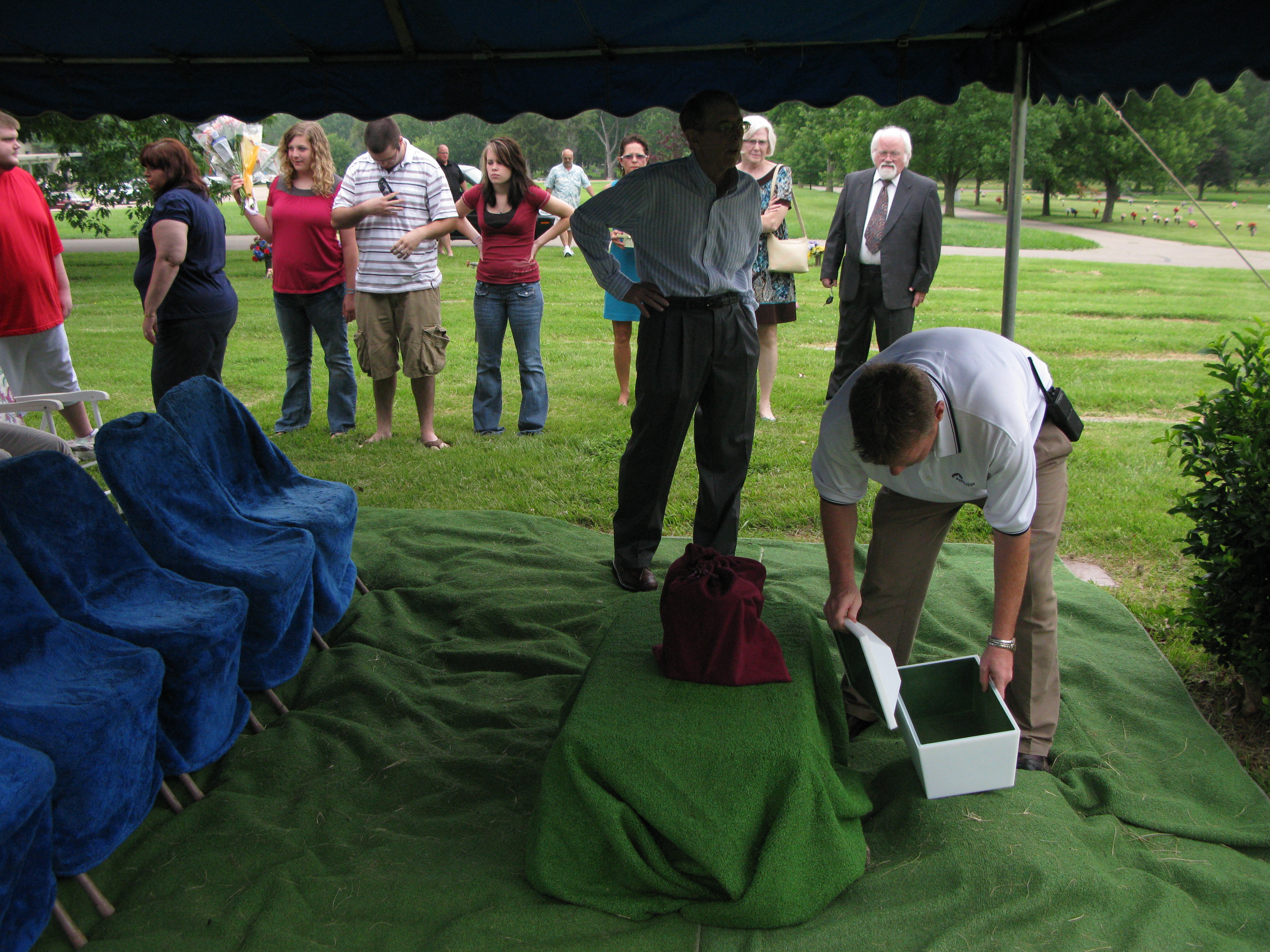
In March, one day after her eighty-fourth birthday, Barb died. The following July, on what would have been Dad and Barb’s thirtieth anniversary, we gathered at the cemetery to celebrate her life and to bury her and my dad’s ashes, something we nine adult children wanted to do when Dad died fourteen years ago. I offered to officiate.

No, I’m not ordained. In my fifties I’m trying to be less aloof in my crazy big family. As a kid I learned to get along by being quiet. Now, I’m trying to speak up. And, I was worried my zealous sister, in the honeymoon stage of being a born again Christian, might try something funny—or not so funny. Recently she attended a funeral of someone she didn’t know because she felt God was calling her to raise people from the dead. I was pretty sure, since Dad and Barb were cremated, resurrection of their bodies on earth wouldn’t happen. Still, I wanted to make sure everything went smoothly and the ceremony reflected Barb’s beliefs. She was spiritual but not a churchgoer. We didn’t know how we’d pull off Barb’s wish to combine her ashes with Dad’s before inurnment. The cemetery manager, who stood upright in the back just outside the tent, made it clear, “You cannot blend their ashes.” We weren’t sure if this was a law or cemetery policy.

Thirty years ago, I didn’t want Mom and Dad to get divorced and I didn’t want to be a member of a crazy blended family. Both happened. Barb and Dad went to a Justice of the Peace then invited us to their celebration. My husband and I left home that morning driving under blue clear skies through the rolling green Flint Hills of Kansas. We drove into gray clouds and blinding rain just outside of Kansas City. When we arrived to the hotel where the wedding reception was being held, the severe weather sirens went off.

Dad was Barb’s third husband. I didn’t believe family rumors: Barb might be a serial husband killer and I knew she couldn’t be a “gold digger” because a divorced tool salesman and father of nine can’t be mined. Before Dad proposed to Barb he took her to meet my oldest sister. My sister drove the car out of the airport. All three sat in the front seat with Barb in the middle. “So what do you think of me?” Barb asked.

“At least you’re not an eighteen year old chick.” That was all the blessings Dad needed.

Barb wasn’t the cause of my parent’s divorce but her marrying Dad meant Mom and Dad’s marriage was over—for good. It took years for me to say, “My parents are divorced.” Just saying it meant I came from a broken home, added to my fear that my husband and I could break.

Outside the hotel the lightning cracked. Thunder boomed. So did Barb. When I arrived to the reception, I headed straight to the beverages. Barb sounded husky, Lauren Bacall-ish, but she looked—well, coarse black hair, colored, toothpick legs, and an impossible five months pregnant. She cackled—a lot. I sipped it all in until Barb’s eyes met mine. She swooped in. Slow, in a long drawn out way, she said, “J-u-l-i-e, I want you to call me Frother, a combination of friend and other mother.”

I called her Barb.

For sixteen years Dad made Barb laugh, something she needed. Once, over a cup of coffee, she told me about the baby who died one week after she gave birth. That same week her first husband walked out. After that, she wasn’t able to have children, worked in real estate and years later married a widower adopting his three children. He died. In her fifties, she met Dad. She cared for him, something he needed. He smoked and drank too much.

After years of threats Mom made Dad choose, “Drinking or us.”

He moved out. When Barb gave him the same ultimatum, shortly after they married, he chose Barb.

Holidays were never the same. No matter whose house we were at, we were all together “for the sake of the kids.” Mom, Dad, all us kids and our families, Barb, her adopted children and their families.

After Dad retired, he and Barb made gifts and furniture in their woodworking shop until Dad cut off three fingers. Barb had to bathe and dress him since he was partially paralyzed on one side from prior polio. Then his strokes started; eventually he couldn’t do yard work or travel. I tried to visit more. At their round oak table in a smoke cloud as we sipped bad coffee, Barb and I had lively conversations about books, politics, feminism, spirituality and whether God cared if people attended church. Dad slipped in, mostly one-liners like “It wasn’t the apple on the tree but the pair on the ground that caused the trouble in the garden,” or Larry Bruce’s “Everyday people are straying away from the Church and going back to God.”

Two months after Mom was diagnosed with a terminal illness, Dad died suddenly. Through our sadness, we joked, “Dad couldn’t stand mom beating him at anything.”

I’ll never forget that cold December day when I arrived to Kansas City hours too late. Entering the dim room, I kept my head down—everything was swirling tile specks, big black wheels. A ghostly white sheet was draped over the body on the silver gurney. I didn’t breathe until I looked fear in the eye. Peaceful. Without pain. Dad looked better dead than alive. I felt relieved for him, for me until guilt about feeling relieved seeped in. Dad died thinking he got away with smoking. He didn’t. Post mortem tests confirmed lung cancer.

Days later, we gathered at Barb’s house. With Dad’s ashes in an urn upon the dark oak mantel, we all sat around the pine tree and shared stories. It was like a big group therapy session. That year, Barb’s frequent winter blues turned into spring, summer and fall’s black grief.

IMG_1721

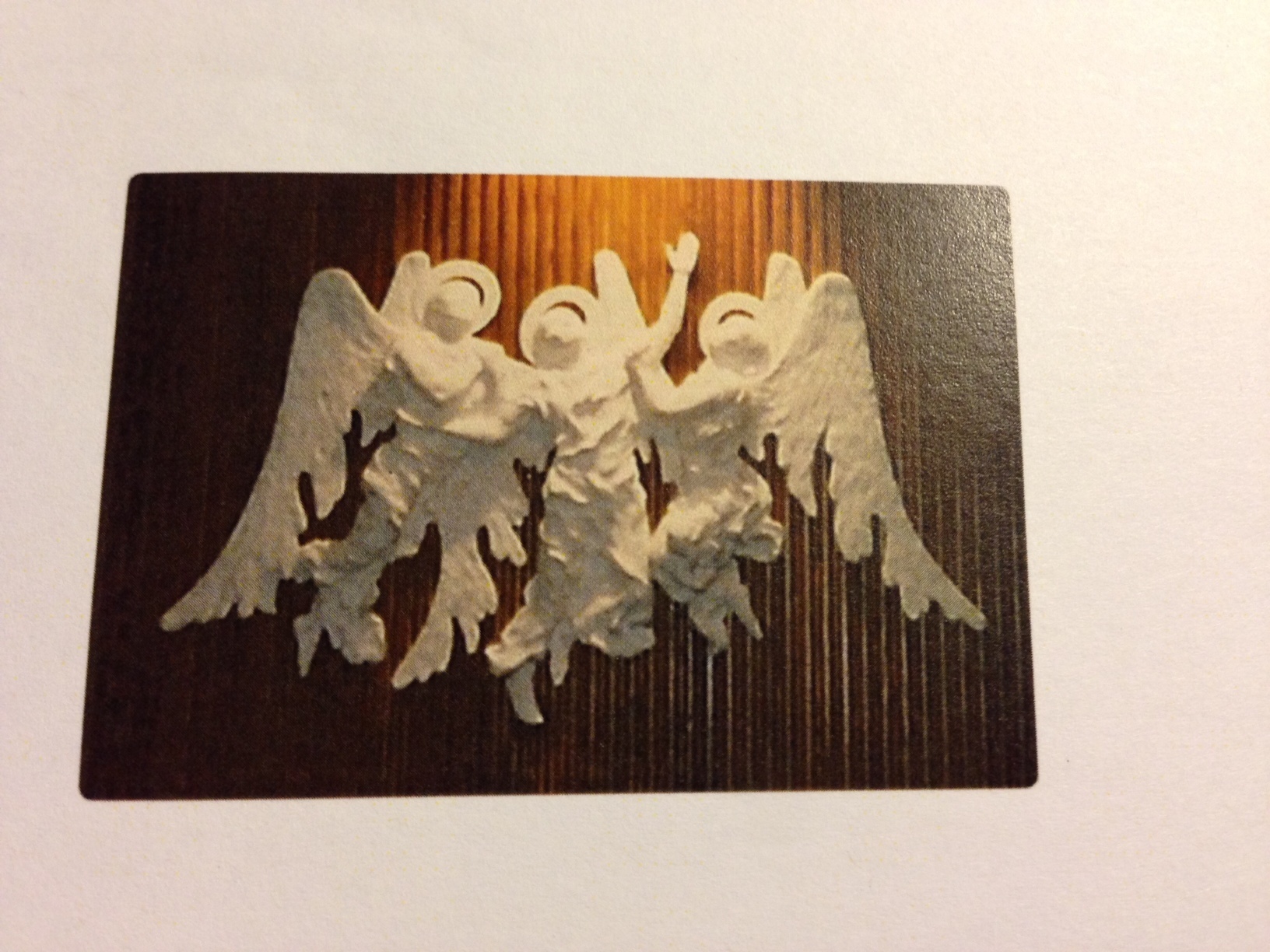
Mom reached out to Barb. Together, they worked with the hospital chaplain to create a warmer place for families to say goodbye to their loved ones before cremation. With memorial funds, an artist created a sculpture. At the dedication the following December, I gazed upon three sculpted angels. To me they were Mom, Dad, and Barb.

The three angels. . .

The three angels. . .

Barb and Mom started traveling together. When I proudly introduced them as, “My mom and my dad’s wife,” people looked at us funny.

Once I asked Mom, “How can you be friends with Barb?”

“I never stopped caring about your father. The drinking killed us, was killing him. I couldn’t take it anymore.” She stared out the window. “If Barb is what it took, she’s a gift.”

As Mom’s health declined, Barb helped to care for her. She even offered a place for Mom’s ashes in her family cemetery plot next to Barb’s mother, second husband, eventually Dad and Barb. On All Saints Day of 1999, Mom died. We had a big funeral dancing our way out of the church. Mom’s wishes. Her final Christmas letter (not the usual cheesy one) was read at the funeral “…I am entering into eternal life. This is not an occasion for sadness…” We cried anyway.

Before Mom’s inurnment, I suggested to Barb, “Maybe Dad’s ashes, which had been sitting upon the mantel for four years, should be inurned.”

That’s when she made her wishes known, “Over my dead body! He won’t go down until I do. He and your Mom might fool around.”

She slammed down her coffee mug and looked at me. “And when I die, mix our ashes together just to make sure.”

ashes

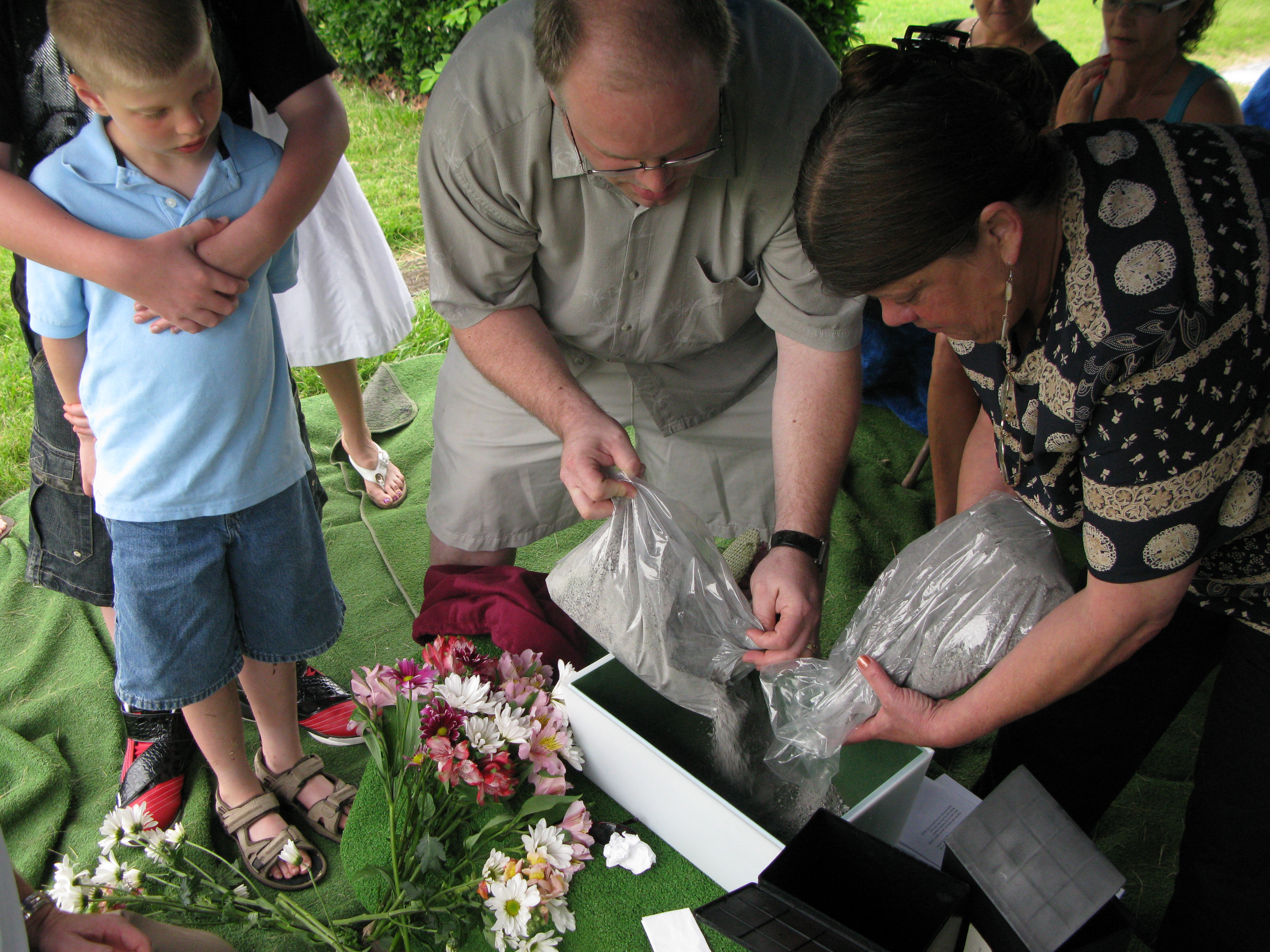
The spreading of ashes

At Mom’s inurnment my born again sister was still a zealous partier. She filled nine Glad bags, one for each kid, with Mom’s ashes. Maybe I should have taken one and scattered Mom over the sea, a place we shared many memorable times, but then it seemed too much like a nickel bag.

Barb came to family gatherings less and less after Mom’s death. Living miles away, I tried to keep in touch with her but she was pulling away. We didn’t know she was letting go of her life, refusing treatment for bladder cancer. The emails stopped, the answering machine was disconnected and the phone didn’t get answered. When I couldn’t bear being out of touch, I called one of her neighbors who told me Barb was often sitting in the garage in her fuzzy pink robe smoking. I sent letters and photos. She did not write back. Her adopted son moved in and was her full-time caregiver until she passed.

I expected everyone to be raw at the cemetery. Siblings threatened me by holding up iPhones with radar images of the approaching storm. I began with a poem from Rilke’s Love Poems to God, not the formal patriarchal, “Heavenly Father” opening. My born again sister, whom I love dearly asked, “When are we going to have the opening prayer?”

Doesn’t she know? The poem is prayer. I was getting peeved. She asked several times before, but didn’t ask again after my brother, an ordained minister read the Gospel. The Gospel saved my sister—from me. We sang. Terribly.

I looked at the cemetery manager. It was time to honor Barb’s wishes. Members of the self-appointed ash committee seized and opened the bags. Unsure of how to mix the two plastic bags of ashes and then fit them back into the two black metal containers, they argued. I’m often overwhelmed when we’re all together. This day was no different. Some siblings knelt before the ashes. Others, like me, looked on in awe. In that rare moment, I felt love—for each of my broken and blended family members. The rain and wind grew stronger.

In the storm of it all, ashes blew into dust.


About the author

Julie Gardner’s life work has been in early childhood education and counseling.  During the past seven years she took many writing courses, completed the Washington University Extension literary fiction certificate program, and trained to become certified as an Amherst Writers and Artists Affiliate.  She leads writing workshops and retreats in the Seattle area, some with homeless and formerly homeless women.  She is currently writing a memoir.

Metal Doors

by Laura Speranza


Photo Credit: Laura Speranza

Photo Credit: Laura Speranza


Clink. The cold metal of the handcuffs pressed into my wrists. I stared down at them, completely dumbfounded. I was expecting a scolding or maybe an increased fine for my transgressions. Being taken into custody was not on my agenda.

Not that I didn’t deserve to be incarcerated. I am an addict in recovery, and in my using days I spent a great deal of time visiting local doctors convincing them of my ‘disabling’ panic attacks which required sedatives or my ‘debilitating’ back pain which necessitated heavy pain killers. My scheme worked because I dressed nicely and spoke well, and had a job and health insurance. Drug addicts didn’t look like me or talk like me, or so I had been told. My offenses were clearly catching up with me though. I was in court that day for bad checks that I wrote to numerous doctors. I missed an ordered work service, and the court’s patience with me had come to an end.

The bailiff led me to the benches towards the side of the court. I had work and children in daycare. I mentally sifted through appropriate excuses that I could use for not showing up at work. I sat patiently through the rest of the cases, noting the particular distaste the (male) judge seemed to have for women.

Photo Credit: Laura Speranza

Photo Credit: Laura Speranza

A young man, who missed work service like I did, also ended up in handcuffs. The bailiff led him to the bench next to me. He looked just as taken aback as I was. I looked at him and down at my cuffs and shrugged.
After the cases were complete, I sidled up to the bailiff’s desk.

“Can I use my phone, just for a minute, please?” I pleaded.

“Just for a minute” he scowled, handing me my purse.

I texted my boss a bullshit excuse about having a child in the emergency room and called my husband to let him know I’d be spending the day in jail and he would have to be home tonight to relieve the sitter. He sounded somewhat amused.

Photo Credit: Laura Speranza

Photo Credit: Laura Speranza

The bailiff led me and the other guy down a corridor and lined us up against the wall. Another bailiff patted down the young man. I swear it looked like he was fighting back tears.

The bailiff leered at me, “You don’t get the same treatment.”

He seemed to relish running his hands over my shoulders, waist and legs. He then led me to a room with a metal door.

“Can I use the restroom?”

“There’s a toilet in here,” he motioned toward the back of the room where a small metal toilet was. Clank. The metal door shut behind me.

The room had dismal brick walls and a cement floor with a wooden bench lining the wall. I eyed the toilet skeptically. What happened if someone walks in? Not to mention the numerous diseases I’m sure were festering on the seat. I would hold it, thank you. I sat down on the bench and shivered. The room was freezing cold; a large air conditioning vent was right above me with icy air blasting out of it. I was wearing a silk wrap dress with high heels. When I got dressed this morning I hadn’t an inkling that I would end up here.

There was nothing in the room. There was no one to talk to, nothing to read, nothing. Wow, I could see how this was an effective form of punishment. As I sat shivering, I contemplated the fact that I was actually worthy of this punishment and worse. Drug addiction had taken me to places I never thought I would go. The constant drive to sate something that can never be satisfied; turned me into somebody I did not recognize. Like when I crawled through my elderly neighbor’s bedroom window while she was gone, ransacking the house for prescription pills. Thinking about it now, it seemed like a lifetime ago. Only by the grace of God and months of tireless work, was I able to I find a reprieve from my disease. I drew my knees up and pulled my dress over them and tried to situate my hands so that the cuffs didn’t dig into my wrists.

After what seemed like forever, which in reality was probably twenty minutes, the bailiff came back and guided us down the corridors beneath the court house. We walked past holding cells packed with men that been detained recently.

In each cell, the men nudged each other and crowded toward the small window, gawking at me as I walked past and saying undoubtedly disgusting things to each other. I slumped and hid my face, wishing I could shrink into the woodwork.

We walked into a waiting area with metal chairs. He sat me down next to a surly woman with wild hair who was shackled to a chair. The nurse was taking her blood pressure and flashing a light into her eyes. A woman behind the desk motioned for me to come over. She shoved various forms at me which I signed. I sat back down and waited for the nurse to examine me.

prison-fence-and-barbed-wire

The nurse finished with the other woman. As she took my blood pressure and medical history, I desperately hoped that nobody was going to shackle me to a chair.

After a bit, a female sheriff called me over to the other counter. She had me stand against the wall, while two large bright lights flipped on and blinded me as she snapped a photo. I walked over to the counter and she put a red bracelet on my arm with my picture on it. I glanced down at the photo; I truly looked like a deer in the headlights.

The sheriff asked me if I was homosexual, bisexual, had gang affiliations, and if there was anybody I needed protection from. I was none of those things, but the question itself scared the daylights out of me.
She led me to a smaller cell. Clank. Another metal door closed behind me. There was one other woman in the cell. She had multiple facial piercings and a perpetual smirk.

“I’m Shana, what are you in for?” she asked.

“Writing bad checks” I didn’t feel like expanding. “You?”

She animatedly recounted a detailed story about being in a Motel 6 to get a face tattoo (yes, a face tattoo) and the room was raided. All eight people in the room were busted for an ounce of methamphetamine, because no one person ‘claimed’ the meth. She did however ‘claim’ her stolen car and bag of marijuana. I nodded sympathetically.

This cell was freezing also. I sat rubbing my hands together while she made a series of calls from the pay phone asking her ex-boyfriend to drop the stolen car charges.

Then, the cell door opened and we were joined by a well dressed woman who looked ill at ease and distinctly out of place. She ignored us and proceeded to make calls on the pay phone trying to get bailed out.

Shana was motioning wildly to her friend, the woman with the crazy hair who was shackled to the chair outside. The other woman finished with her calls and sat down on the bench.

“Whatcha’ in for?” Shana asked her nosily.

“I had an old warrant. They picked me up on disturbing the peace.” She replied, avoiding eye contact and looking at the ground.

“I’m Shana.”

“Sophia.”

I introduced myself also. Then Shana proceeded to tell Sophia her face tattoo story about being a victim to the people who didn’t ‘claim’ their drugs. Sophia wasn’t as good as I was at hiding her revulsion.

At that time, we were joined in the cell by the wild haired woman whose name was Charlie. She and Shana chattered to each other about the ‘bullshit’ charges and how they were going to get out. Shana told Charlie that she had called Jimmy (the ex-boyfriend owner of the stolen car) and told him she would do whatever he wanted if he bailed her out. She emphasized that she did mean anything and proceeded to repeat in detail all of the sexual acts she offered to perform.

Poor Sophia’s jaw dropped and she flushed bright red. I chuckled and maintained my poker face; my ability to not show emotion was serving me well right now.

Charlie walked over to use the toilet, which was right next to me because the cell was so small. Shana followed her, serving look out while she squatted and pulled a small baggie of drugs out of her vagina. I tried to act like I didn’t notice and attempted to tune out the sounds that went with this act. Sophia stared at the wall because she didn’t know where else to look.

We sat for a bit longer, trying to make stilted conversation. Then the cell door opened and the sheriff steered us out. She cuffed each of us to another person; I was cuffed to a very young girl dressed like a boy.

We were then herded into a van where we were to be transported to the woman’s jail. The van was packed with inmates almost sitting on each other’s laps. One of the women who was stumbling and barely coherent, starting throwing up in the back, which caused a couple of the other women to gag. The smell of vomit now permeated the van.

I was crowded next to three women. One of whom was in the hotel room with Shana, and was apparently the alleged owner of the ounce of meth. Shana was sitting across from us, glaring intensely at her. The other two women were already in the orange jail attire and chatted excitedly with each other. They seemed very upbeat considering their circumstances.

The one with her two front teeth rotted out and track marks on her arms, told me she liked my dress. She said I looked like “Beverly Hills.” I smiled and thanked her. This seemed to open her up to telling me about how when she was busted a couple days ago she had a full rig of meth in her pants and she had ‘popped it’ in the cell. She pulled her pants leg up to show me the needle mark and bruise. I wasn’t sure why she was telling this, but I again sympathetically nodded, indicating that I might have done the same.

The other woman was in her fifties with tattoos all over her neck and arms. She asked me why I was in here, and I repeated my bad check story. The owner of the bag of meth started to doze off at this point and her head bobbed forward.

She proceeded to tell me about her bust for heroin and how she had been clean for a year before a recent relapse. Our eyes connected, and I felt a kinship with her. I shared with her that I was an addict too and congratulated her on being able to achieve a year of sobriety. She accomplished something I had not yet been able to and I admired her tenacity. She gazed down, studying her dirty fingernails and softly replied that she lost her sobriety when her daughter was murdered. I had a feeling that I might regret asking about it, but it seemed like she wanted to tell me her story.

Apparently, her 21 year old daughter was working as a nanny for a man who she was (unknown to her) a gang leader. He wanted to have sex with her and she denied him, so he took her and her four year old son to a hotel while he plied her with meth in hopes of getting her to comply. When she didn’t, he beat her senseless then choked her to death with the hair dryer cord. The four year old was witness to the whole thing.

The man then claimed that she committed suicide and hung herself with the hair dryer cord. Despite the bruises all over her body, he was never charged with the murder. The four year old son couldn’t testify because he was so traumatized he hadn’t spoken a word since. She recounted this story without any emotion or inflection in her voice, staring impassively out the van window. I sat silent, not knowing what to say.

We then arrived at the jail and were herded once more out of the van into the building. We were uncuffed and took a seat while we were called into the next room in groups of four. I rubbed my reddened and sore wrists as Shana and the older woman started talking about the bail bonds men that would bail you out if you had sex with them. They claimed they were all ‘tricks’, including a lot of police as well. Shana was talking loudly about how she should give one of the bail bonds men a call.

I couldn’t help but ask her. “Why do that to yourself? Why give your body away like that?”

She turned to me with a hardened expression. “You close your eyes for a minute and it’s done, you know? This country was built on the barter system. They have something I want, and I have something they want.”

When we arrived, we were handed jail attire. As filthy and tattered as the clothing was, I was grateful not to be freezing any more. A few of the women were outfitted in the same striped attire that I was, but the rest were outfitted in orange. Apparently, the striped attire indicated that you had already been sentenced. We were separated out by our uniform and ushered in two different directions. Shana gave me a wave and a lopsided grin, “Good luck doll!” I waved back and off we went.

Sophia and I walked across the courtyard with a couple other women and approached a large brick building with barbed wire around the fences. The sheriff led us into the building towards a room where we were instructed to grab a blanket, sheets, a cup with toothpaste and a toothbrush and a plastic mattress. She told us that this was the only cup we were going to get, so don’t lose it. We then followed her to room with a desk that was in the center of glass walls that housed two levels of beds. The beds were divvied into groups of eight, with a letter designating which ‘pod’ they were.

The women inside the glass walls crowded together, straining to catch a glimpse of us and nudging one another. A large woman with purple hair caught my eye, ominously grinned at me and gave me a little wink. I tried to focus my eyes anywhere but on hers. Sophia looked like she was ready to bolt.

“You two are in pod F. You’re bed 4 and you’re bed 2” the sheriff indicated the pod on the second level and opened the door for us so we could drag our plastic mattresses in. Sophia followed me up the stairs as we tried to ignore all of the prying eyes following us.

I threw my mattress on what was meant to be a bed, but was really just a metal rack. I tossed the threadbare blanket down and crawled onto it. As soon as Sophia and I put our things down, a couple of women walked in who were inhabitants of pod F. A woman with a strange amount of facial hair introduced herself as Julie; her heavy set friend was Deb.

Julie and Deb flopped down on their beds and proceeded to chat about a fight that had happened earlier that day.

“They keep telling us that we’re too wild. We’re always getting our privileges taken away because they keep busting us for fighting and drugs.” Deb explained to me.

More nodding on my part. “Welcome to our little home! How long you in for?” Julie asked.

I debated telling her the truth. I sensed that they might not be very welcoming to somebody that was lucky enough to be departing in a day. “Umm, you know. Just a day…” I answered hesitantly.

“Lucky dog!” crowed Deb. “I would hate you, except I’m finally out of here the day after tomorrow. What are ya’ here for?”

“Writing bad checks” I answered. I wished in that moment, as I had several other times that day, that my conviction had been for something a bit more menacing.

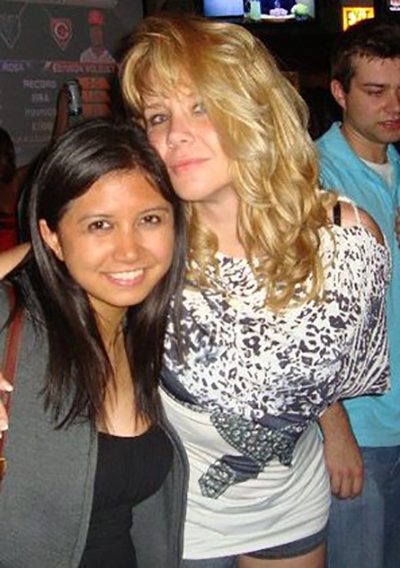
The author is on the right

The author is on the right

At that time a loud horn blared through the room. All of the women scrambled to get on to their beds and the clatter and noise subsided. I looked curiously at Deb. “What is that?”

“Shift change. You can’t get off your bunk, don’t talk either. When they call your last name, answer with your first name.” she instructed.

The women seemed to take this so seriously, that I couldn’t help but wonder why. “What happens if you’re not on your bed?” I inquired.

“They take a privilege away from all of us!” she glowered at me, clearly unhappy by my inquiry.

I nodded in compliance and followed the other women’s lead by answering the male guard with my first name. He seemed inordinately happy with his position, strolling through the room with a swagger and a sneer.

“Asshole.” Julie grumbled after he passed. After he left the room, she turned to Deb. “Can you believe that shit with him and Cora?”

“Fucking, sick pig.” They continued to gossip about how the guard apparently enjoyed regular oral sex with an inmate named Cora in exchange for privileges. When I asked how he didn’t get caught, they laughed heartily and ribbed each other at my hilarious joke. Sophia caught my eye, and then rolled over on her cot.

I folded up the sheet to try to create a semblance of a pillow. I stretched out and tried to get comfortable while I closed my eyes for a moment. This place was truly another world. Whatever all of these women were convicted of, did they really deserve to be treated like this? It was shocking to think that the justice system and those that upheld it seemed more deviant than the convicts. Some of these women were so accustomed to being used and discarded; they seemed to feel that was their role in the world.

At that point, the piggish male guard came back. “Number 4, you’re out of here! Get your stuff, let’s go.”

I tried not to appear too happy, but I inwardly breathed a large sigh of relief. I was told earlier that I may be released early due to overcrowding. I gathered my plastic mattress and accessories, gave Sophia a small hug and wished the other women good luck as they glared at me.

I followed him downstairs, placed my mattress and bedding on the shelf, and changed back into my clothes. My belongings were returned to me and my red bracelet with mug shot was cut off of my wrist. The large metal door clanked, this time with me on the other side.

I walked outside of the building and turned around one last time to look at the drab brick building with barbed wire. I turned my face towards the sunshine and let it warm me while I thankfully said a prayer for the women I left behind.

 About the author

Laura Speranza is an aspiring writer and autism advocate. Her work can be found on Booksie and the Den of Amateur Authors; as well as autism sites such as Autism Awareness. She has a blog about parenting with autism and is working on an autobiographical novel.