Can’t Dance

by Carol Sanford

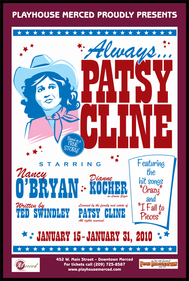
alwaysposter-thumb-190x281-30540


“Sir, would you be willing to come on stage during the play?”

The director of Always…Patsy Cline stands over me and my husband, Glenn, where we’re contentedly touching elbows in our front row center seats. A familiar tune lightens the air in the theater as Patsy’s voice slips from my head into my heart. The set waits, curtain open, for two actresses who’ll carry the whole show.

Glenn hardly pauses before answering, “Only if I don’t have to dance.”

“It’s not necessary to know how,” the director says. She nods a thank you and heads backstage.

I wait a few seconds before leaning over to whisper, “She expects you to go up there.”

No response.

My husband is no dancer. Picture us, the couple who patiently waits for the band’s slowest number to scurry to the dance floor, where we find ourselves incapable of grace. His shoes graze mine, my back soon aches from his tight embrace so I decide to lead, then we stumble around for a while, and end up in a corner rocking back and forth, laughing. We’ve been doing this for twenty five years.

No way, I can’t believe he plans to go up there, embarrassing himself (and me). When asked if he wants to try something new, he’ll often say, “Why not? Can’t dance.” But he’s never foolhardy. So what’s happening here?

apc

I glance at his profile as the lights and music fade: Shhh, play’s starting.


A lamp in the kitchen quarter of the set signals early morning. Out comes Louise Seger, still sleepy, an ultra brassy and sensuous woman. She turns the knob on her radio and hears Patsy’s rendition of “Back in Baby’s Arms” then phones the DJ to find out who’s singing. Smitten for good, Louise sets out to be Patsy’s number one fan.

Louise’s bawdy Texas drawl and exaggerated behavior disappoint me. Then the two women meet for the first time in a bar where Patsy performs, and Always…Patsy Cline takes off. The actress playing Patsy has Patsy’s voice and mannerisms down. What a heartbreaker when she croons “I Fall to Pieces”! Glenn and I reach for each other’s hand, and finally get caught up in the plot.

As intermission nears, I remember what’s probably coming next. Sure enough, with the sudden first bars of “San Antonio Rose” Louise swings her hips, circumvents a few bar tables, sashays to center stage and descends to grab my husband out of the audience. It happens fast. Without a by-your-leave he’s up and gone to the pounding beat. I feel bare.

On stage my husband and Louise whirl with such abandon my jaw unhinges. Is he grinning? He’s managing some kind of funky box-step, appearing to lead and stomping his feet like a Texan. Dear God! Am I embarrassed or in awe? I think it’s awe.

Then it’s over and he’s sitting at my side. Calm, smiling.

“Wow,” I say to him. “Wow. You were great.”

During intermission we don’t speak about his performance or the fact that this Louise character is way over the top.

“Look,” I say, showing him the playbook as lights dim for Act Two. “ We’re going to hear ‘Crazy’ and ‘She’s Got You’, my favorites.” Ex-favorites?

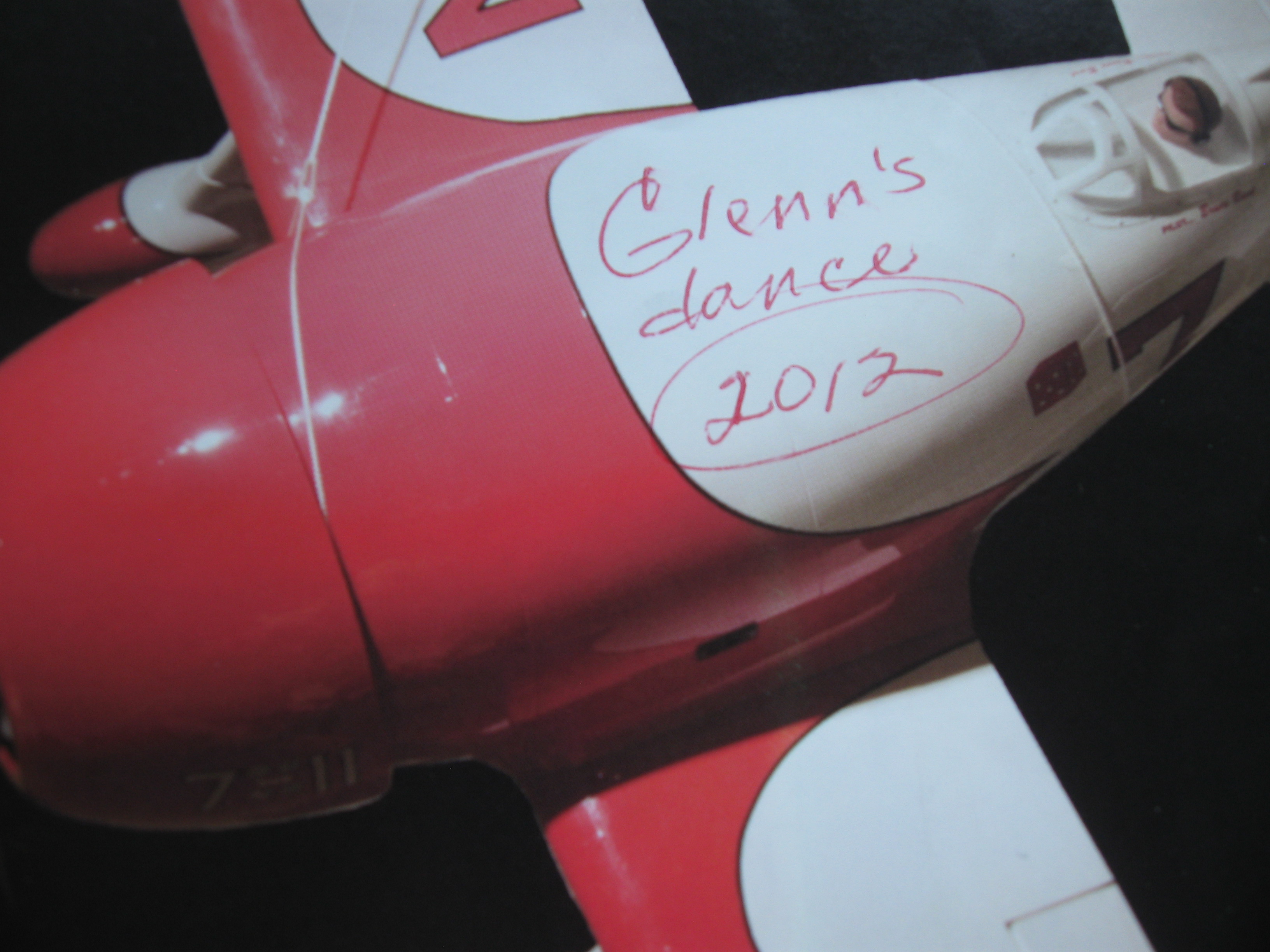
IMG_2958

In the second half of the play, Patsy’s fame skyrockets. We enjoy song after song, big hits. We know how the story ends but don’t want it to happen. When word comes that Patsy’s plane crashed, Louise, face blanching, sits in her kitchen and weeps actual tears. We’re close enough to see them, and I think I like her after all.

Segue to Patsy dressed in an angel-gauzy gown and standing on a platform in order to leave us with a medley of songs we haven’t already heard. Pretty hokey. But when she closes with a rousing “Bill Bailey” we all clap and yelp like crazed teens. Long live Patsy! Always!

As we herd out of the theater, a young man crowding past says “Way to go!” and Glenn thanks him.

“Good job,” a guy Glenn’s age tells him, and another somewhere behind us adds his congratulations. I inch forward in the narrow hallway behind my celeb, pretending no astonishment. My fingers lightly grasp his coat tail. Don’t I know this man, from his balding head to his pre-hammer toes?

“Did you realize what you were in for?” I ask as we drive out of the parking lot. “How did you find the nerve to go up there?”

“Nerve?” he says. “What was there to be nervous about? It was fun.”

Then he tells me, “I wasn’t going to get that chance again.”

And then, circling slow-time through me is the question I don’t want to ask: Darlin’, oh darlin’, why don’t you dance with me like that?


About the author

Retired from teaching, Carol Sanford writes from her home in central Michigan, where she lives with her husband.  Carol has been publishing poems since the 1980s.  Her essays have appeared in Creative Nonfiction and Fourth Genre published an excerpt from her memoir manuscript. More recent work can be found online at Ragazine, New Verse News, and The Zodiac Review. In fall 2014, Andrea Badgley’s “American Vignettes” blog project will include an essay by Carol.

I Am Old

by Gerald Francis Burke

I sat there in the partial shade, under the palm tree, thinking, dozing a bit, watching the birds and hearing the hawk across the wash calling out plaintively, as my daughter (the one with red hair) came out of the house, crossed the lawn and said Dad, it’s time you came in for lunch now. My son-in-law and I had wondered why the hawk was crying, and we thought it might be that a chick had fallen from the nest.

Maybe just a few minutes more, I said. I’m remembering so many things, good and bad, from the past. That’s all old people have to think about, they have no future, only the past and the present.

I think so much now of the past, of being a dumb kid growing up, thinking I knew it all, and later in life, knowing I knew so little. I remember high school and then college. It was in college that I met that girl, the one that stuck with me through thick and thin, good and bad, for over 70 years. I remember our first kiss, and how my heart thumped in my chest. And I remember the last time I kissed her as she lay dying from a stroke, unresponsive and unknowing, and I told her that I loved her and I would always be there for her.

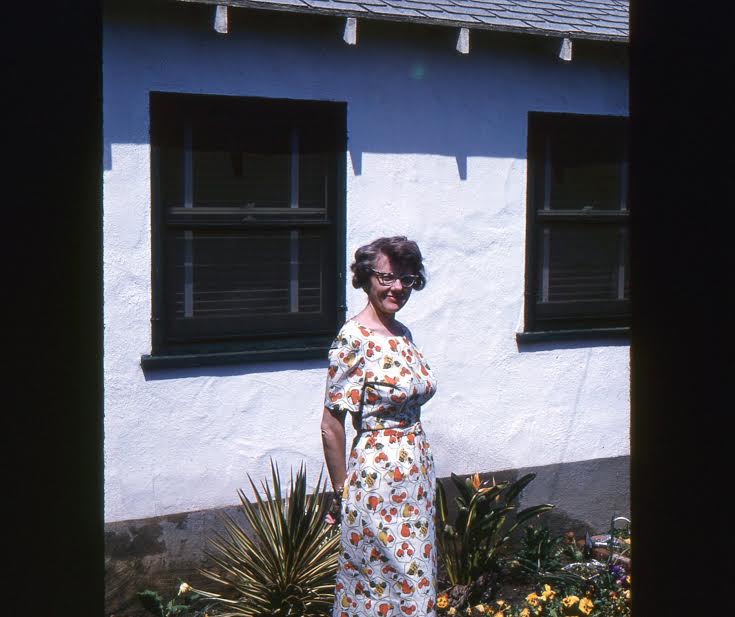
"Mary, outside the first little home we bought."

“Mary, outside the first little home we bought.”

There are all the memories of our first years together, of first jobs and first paychecks. Then of leaving to go into the army, of getting leave to come home after finishing OCS, now an officer and a gentleman, and how that second baby, a daughter (the one with the auburn hair) cried all night long because there was a strange man in the house. Then overseas, to England, across the Channel to France and on into Germany, and how the letters from home almost never caught up with us.

At war’s end I remember being glad to see the sight of America again. And there were ten million of us, trained to be soldiers, un-needed now, and no civilian jobs for us.

But I did find a job, and we moved out of the little rented house and bought one, unfinished but livable, on a half-acre. That girl, now a woman with two children, said of the little house and the half acre, you can plant a lawn over there, and some fruit trees over there, and a vegetable garden over here, and I’ll make curtains for these windows, and then, later, we can add two more bedrooms and another bath.

"The home we left behind after my wife, Mary, suffered a stroke."

“The home we left behind”

We did all those things, and another baby boy came along and a baby girl (the one with the red hair) and then another baby boy. I got a job, and I learned to be an accounting clerk, and a shipping clerk, and an order filler, and a warehouseman, and a seed packet filler, and then a plant superintendent, and a branch manager, and after many years, a vice president and western regional manager. The girl, now a grown woman, kept the house, made the meals, raised the children, made do when the wages were small, and better when the salary became good. And we did build those other bedrooms and another bath, and the garden produced, and the fruit trees bore fruit, and the kids went to school, and grew up and went to college, and went on with their own lives.

Our town grew, and our little half acre became part of a desirable property for an auto sales establishment, and we sold it for much more than we paid for it. We bought a bigger, newer home– palatial to us, in a new, upscale part of town, now with only three of the children (including the girl with the red hair) still with us.

The woman went back to college and got her degree in music so she could become a piano teacher. And she said she would be happy if she got two or three students, but at peak she had over 30 students and was teaching every afternoon, six days a week, and sometimes makeup lessons on Sunday.

I remember too, our days of camping, first with a couple of shelter-halves I had from the army, then with a small tent, then with a bigger tent. Then as the children began to leave home, camping in our first motorhome, finally coming down to a fitted van that had all the amenities, when no one but the last child was left at home.

I remember the children in school, in high school then in college, then little by little getting married and presenting us with grandchildren, Tom, David, then the girl with the auburn hair producing Brian, Cathy, Jenny, David, and finally the youngest coming up with Emma and Isaac, and then great–grandchildren began to arrive as the woman and I grew older and older.

I think of memories of retiring, of suddenly realizing that I no longer needed to get up at six am each day, do my morning run, and after a shower, eating breakfast with that lady and then my daily commute to the job. Retirement took some getting used to, but I soon settled in to a routine. I sometimes got breakfast for the woman, planned on gardening chores, and I started to write again, with some success, and I got dinner so the woman could sit down to eat as she finished with her last student.

We would talk about our day, and she would tell me about her last student and how good he was, and how bad another one was, he just won’t count, she said. We discussed upcoming joint projects, and trips we might make in our RV, since I was now writing a camping column for newspapers. And we planned our trips to England, to Ireland, to France, to Germany and to Italy, and a couple of trips we finally made to Hawaii.

I recalled that the house didn’t really seem empty after all the children were gone. They stayed in touch, wrote letters, and enclosed pictures at first, then emails and attached pictures.

I don’t remember death ever entering my mind, but the woman, I think, knew her health was failing and that her time might be coming to a close, and it was.

I remember on a Sunday after returning from a camping trip she said she hadn’t slept well and her stomach was upset. Around midnight, as we lay sleeping, I heard her mumble something, and I woke up and asked her what was wrong, and she said I’ve had a stroke, I can’t move my left leg or left arm. Now began a routine of many trips, in and out of hospitals, to doctors, in and out of rehabilitation facilities, to using wheelchairs and an arm crutch, of a parade of caregivers, some good, some not, who spelled me as the primary caregiver.

After a year or so, I remember the two daughters said you have to move closer to one of us so we can help. So we did, and bought a small house in a retirement center, and I can remember how sad it was to leave the home we loved, our many friends and neighbors, to live in another place, close to a daughter (the one with the red hair). I remember a new set of doctors, hospitals, nurses, and rehab facilities nearby, and a new set of caregivers. I remember the many trips to the hospital when my wife fell and broke her hip, and then a careless caregiver let her fall and she broke five ribs. There are memories of the woman slowly losing touch with life, of a last visit to the rehab center by our oldest daughter (the one with the auburn hair) and her husband, and that she cried as she called me to say they were on their way home, and that her Mom hadn’t been responsive, and didn’t seem to know they were there.

I remember the phone call that day from the facility and the nurse said she died today at 12:30 pm, and I’m so sorry. And I was sad too. The great love of my life was gone. I cried, and a little of me died that day, too.

Now I am an old man waiting for my last day to come, living with a daughter (the one with the red hair) and her husband, both of them very kind to me. They feed me and house me, and I feel grateful to them, but sad.

As I sit there under the palm tree, I hear again the plaintive cry of the hawk in the oak trees nearby, and my daughter says, Dad, it’s time for your lunch, and she helps me up off the blue outdoor chair and holds my hand as we walk across the lawn.

About the author

Gerald Burke is a published, freelance writer of fiction, non-fiction, horticulture, travel, memoirs, and family related articles.

In the Middle

by Mary Ann Cooper

The author's siblings

The author’s siblings

I can’t imagine being an only child. What’s it like not being surrounded by a crowd? Never having to vie for attention, whether it’s a subtle tap on the shoulder or a desperate shout of “Look at ME!” How can you have a game of tag? Instead of racing downstairs on Christmas morning, do you casually stroll, knowing that everything under the tree is for you? Do you only play solitaire and not war? Do you go everywhere with your parents, or have real babysitters, instead of your brothers or sisters? What’s it like to wear something that someone else hasn’t worn before?

I grew up with three older siblings and four younger ones – yup, that’s eight of us. Six boys and two girls, with me wedged in the middle, fourth child and second girl. We were all tall and skinny, our blue eyes and freckles identifying our connection. The size of a small party, everyone in our neighborhood knew us. We played, we fought and always leaned on each other for support and attention.

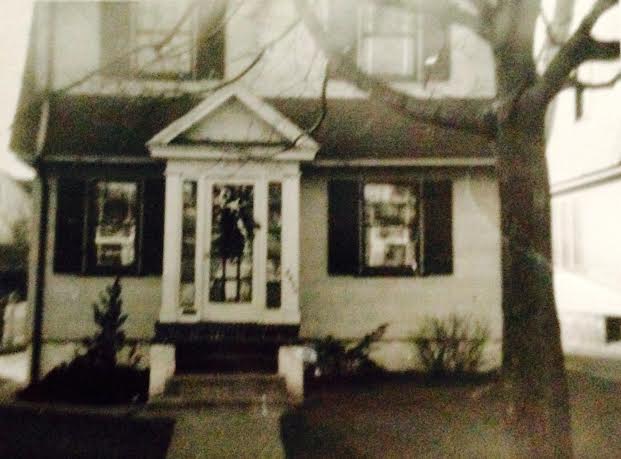
Sardined into a small house in Queens, New York, we took up every inch of it. It was a small Dutch colonial, sandwiched between others that were identical, a cement ribbon of driveway separating us. Each house had a brick stoop facing a stamp-sized lawn, scraggly shrubs hugging the foundation. A small vestibule opened into our living room, which led to the dining room and a small kitchen. The upstairs held three bedrooms and one bathroom, which was in constant use. It was a tiny bathroom, with faded white walls and a confetti of black and white subway tiles dotting the floor. Thin towels hung next to a chipped radiator, which sizzled and hissed like a subway grate.

The author's childhood home

The author’s childhood home

The bedrooms weren’t much bigger than the bathroom, the largest one housing four boys. Walking up the stairs to the second floor, it was easy to find the boys’ room, with its permanent odor of dirty socks floating above the landing. It was a wild place in there: clothing flung about, random belts and shoes littering the scuffed floor. A gnawed wooden crib stood against the wall where baby Brian slept, flanked by Bobby’s single bed. My other brothers, Kevin and Timmy, spent their nights in a wobbly double, placed under a window.

Next door to this cave, my sister and I shared the smallest room, our bed nearly spilling into the hallway, allowing me to lie in bed and close the door at the same time. A tired maple dresser hugged the wall, festooned with a gray doily running across the top. This tiny room was where my sister found refuge from being the oldest and a girl. Many nights, lying in our little bed, she confided in me.

“I hate it here. Someday I’m going to marry a rich guy and never have any children.”

“Can I come?” I always asked.

My parents occupied the last room, its walls papered with pink roses and green leaves, yellowed pieces of it curling up in the corners. Dark and mysterious, the metal blinds were usually slanted shut and the air was always filled with the mingled smells of Old Spice and Evening In Paris.

It wasn’t spacious up there, but every night, we all had a pillow to put our heads on.

In my self-absorbed child’s world, I had no idea of the stretch it was for my parents to keep our sizeable group afloat. But I knew they never planned for, nor wanted a large family.

“What’re you doing with all those kids, anyway?” our neighbor Mrs. Glennon once called over to my mother from her tiny backyard, chatting back and forth while hanging laundry. Our clothesline, with its wooden clothespins standing at attention, sagged with the weight of our belongings and the ever-present collection of diapers. I was ten at the time, and there were six children in our house.

Hearing the question, my mother stopped working and put her hands on her hips. And being the polite woman she was, she told the truth.

“Well, Helen, we’re just following our church’s rules. And that means no birth control.” My mother’s response quieted our nosy neighbor, but it didn’t help our situation much; two more babies, Jeff and Kerry, appeared after that.

My mother became pregnant with my sister Dianne on her honeymoon, and thus began her seventeen-year cycle of having children. I see me standing next to her, looking up at her brown hair that’s been wrestled into a French twist, her cornflower eyes above her smile. She’s always dressed in tired elastic maternity pants, topped by something shapeless and flowery. Her pregnancies usually occurred every two years, but sometimes my parent’s rhythm clicked, allowing my mother to venture into real clothing for short periods of time.

But whether my mother was pregnant or not, tired or ecstatic, my father loved her more than life itself. Both the same age, he had married his childhood friend, and called himself “Mr. Lucky.” For many years, Mr. Lucky worked two jobs during the week – one as the manager of a department store and the other as an elevator operator. Weekends, he made extra money tending bar at Herby’s, a local hangout on our corner. We didn’t see a lot of my father – he was busy making sure his family was taken care of. His reward for all that hard work? Coming home to my mother.

I imagine feeding this brood was a constant challenge for my mother and father, especially with limited income and growing children. Food appeared and was promptly eaten. No seconds. No leftovers. Our church provided us with our Thanksgiving and Christmas turkeys, and each week the parish school delivered leftover milk and bread to our home. We weren’t the poorest family in the parish, but we were somewhere on that list.

My father got a paycheck every Friday, which was convenient, because by Thursday night we had run out of money. Weather permitting, most Friday evenings we all sat waiting for him to return from the city. Perched on our scratchy stoop, we climbed its steps and side pillars like hawks hunting for prey. Eventually, my father appeared at the top of the street, newspaper folded under one arm, a brown bag filled with paper boxes of chicken chow mein in the other. At our house, dinners were fancy on Fridays.

Our meals were noisy and quick. Sitting at the long wooden dining room table, we were shoulder to shoulder, my parents at each head and a highchair somewhere in between. Everyone was protective of what was put in front of them; today, many of my brothers still carry the habit of eating with one arm cradling their plate. It was implicit: This is mine; don’t touch it. Once, I was foolish enough to leave my seat during dinner for a bathroom break, learning my lesson when I returned to an empty plate.

“I thought you were done!” my brother pleaded to me.

Keeping all of us clothed was as big an issue for my parents as feeding us was. The school provided us with free uniforms, which helped dramatically. But for after-school and weekend clothing, hand-me-downs were the rule. My brothers shared a revolving wardrobe, clothes going from one to the other, with some of the pieces growing old with us, becoming part of the family. But since there were five years between my sister and me, hand-me-downs were a problem.

Until Barbara Medford moved in up the block.

A year older and a lot richer than I was, Barbara had an extensive wardrobe. And every few months, her mother walked down the street to our house, carrying shopping bags filled with clothing that Barbara had outgrown. Coats and shoes and everything in between had been neatly packed into those bags for me.   Standing silent, watching my mother thank Mrs. Medford, I wanted to grab the bags right out of her hands. Finally taking my goodies upstairs, I arranged each piece on my bed, admiring and petting my treasures for most of the day.

No one but my family knew that I was wearing Barbara’s hand-me-downs. But apparently Barbara did. One afternoon while playing hopscotch with the other eight year olds in the neighborhood, Barbara stopped and pointed at my faded top with tiny pink flowers on it.

“That’s my old shirt,” she said with a catlike smile. The other girls stood quiet, watching.

I felt my cheeks get hot; I wanted to run home. Instead, I stayed and looked Barbara in the eye.

“My mother made me wear this shirt. I hate it.”

I avoided her after that, and the Medfords eventually moved away. The pressure was gone, but so were the clothes.

Besides the hand-me-down’s, the family’s other source of clothing came from my mother’s monthly treks to the rummage sales that took place at the local synagogues. The clothing was inexpensive, and usually of high quality. Everyone benefitted from these monthly wardrobe harvests; besides providing clothes for all of the children, it was also the source of my father’s suits. Leaving early in the morning with one of her older children, my mother stood in line, ensuring she had a first look at the day’s offerings. Hours later, after carting her bargains home in cardboard boxes, she began her sorting process, many of us standing around her.

Occasionally, some of the shorts, tops and pajamas that were doled out to me had tiny labels with names sewn into them.

“Who’s Susan Fisher?” I asked one day, pointing to a label.

“Susan Fisher owned that shirt before you,” my mother said.   “She probably went to camp, and had to have her name on all of her clothing.”

I stared at my mother.

“What’s camp?”

The labels never really bothered me, it was the tops and dresses that did. When I wore a garment and perspired, it seemed to activate the camper’s old perspiration; mixed together, it smelled toxic. When I was older and in high school, the stench usually emerged right after lunch. Nervously clamping my arms down, I wondered if the people around me could smell it also. And from that point on, no matter how many answers I knew, my arm wasn’t going up.

“It’s embarrassing!” I told my mother.

“I know, I know,” she said. “Just keep in motion.”

About the author

Mary Ann Cooper is a writer concentrating on memoir and personal essays.  She has recently been published in Salon, Halfway Down The Stairs, Brain, Child Magazine and Literary Brushstrokes.

She is presently at work on her memoir, “The Hollis Ten,” a group of stories about growing up in a family of eight children in Queens, New York.  Today, she is comfortable in crowds and still never leaves her plate unattended.     

Mary Ann resides in Westport, Connecticut.

My Dead Roommate

by Jonathan Levy

The rental, Chicago.

The rental, Chicago.

I had never been to Chicago until the day I showed up in a U-Haul with all my stuff. Before then, I was at a one-year theater program in Blue Lake, California, where Billy the Clown, the founder and self-titled Chief Goof-Officer of CircEsteem, a nonprofit youth circus in Chicago, came to audition students for a job. Several classmates and I got the job and formed the first CircEnsemble. Our role was to teach, chaperone, perform, tutor, do administrative stuff—basically, we were jacks-of-all-trades who would help ease the burden on the growing, lightly staffed organization.

It was the summer of 2007 when I drove the U-Haul to the 4-bedroom house near the corner of Hollywood and Broadway off Lake Shore Drive’s northernmost exit. My two roommates also went to the theater program in California. Wade, a young, bulky guy, attended the program the year before I did and drove a motorcycle. Debbie was a yoga enthusiast with short, curly hair who was also my next-door neighbor in California. I was 23 and exploring a career in theater, though deep down I knew that law school was inevitable. The owners of the house were two Polish brothers, both named Jerry. (They were friends who had hit on a pair of sisters at a bar and later married them.). Wade got the Jerrys to give us a discount because we were “artists.” The price was a steal, especially when split among four people.

The fourth bedroom was unoccupied, so we sought another roommate on Craigslist. We didn’t want just anybody, so we made our artistic endeavors and clownish tendencies clear in our post. After numerous bogus responses, we finally heard from a real-sounding, possibly even cool person named Shayna. She had just moved back to Chicago and was living in a cramped studio apartment and looking for a job. We arranged for a visit.

Shayna was short, almost dwarf sized, with pale white skin and jet black hair. She was a former Wiccan, she would later tell me, and though she’d given that up, she still wore all black. It was a pleasant visit, and she decided to move in with us after her other option fell through. She soon found a job as an executive assistant.

Shayna joined us the beginning of October, and things were great at first. Wade, Debbie, and I all got along with her. She got to meet our other friends in the CircEnsemble, too. She thought one of them, Pete, whose wardrobe consisted mostly of Hot Topic, was hot and told me so with a sheepish grin—she was 26 and he was 19—but it wasn’t reciprocated.

Though Shayna was amiable, we soon found that she was reclusive. I tried to include her:

“We’re gonna go to juggling night, wanna come?”

“Aw, I wish I could, but I have a raid planned for tonight.”

“A raid?”

It’s an online gaming thing.”

“Any chance you can reschedule? Pete’s gonna be there.”

“Dah! No. I wish you would’ve told me earlier so I could plan for it.”

“Sorry. We don’t really plan anything ahead of time.”

So that’s how things were for the rest of October. We all got along, but Shayna never became part of the group. She spent most of her time in her room with the door closed.

###

This is how we paid rent each month: rather than hand the Jerrys four separate checks, we alternated paying the full amount, and the other roommates reimbursed. November was my month. I paid, and my roommates, including Shayna, reimbursed me. A few days later, she told us she was leaving for California to take care of her grandfather because her grandmother had just died. It would be for only a couple weeks. She took her desktop computer and some clothes with her, but left lots of other clothes, boxes of random stuff, and her Xbox and PlayStation 2.

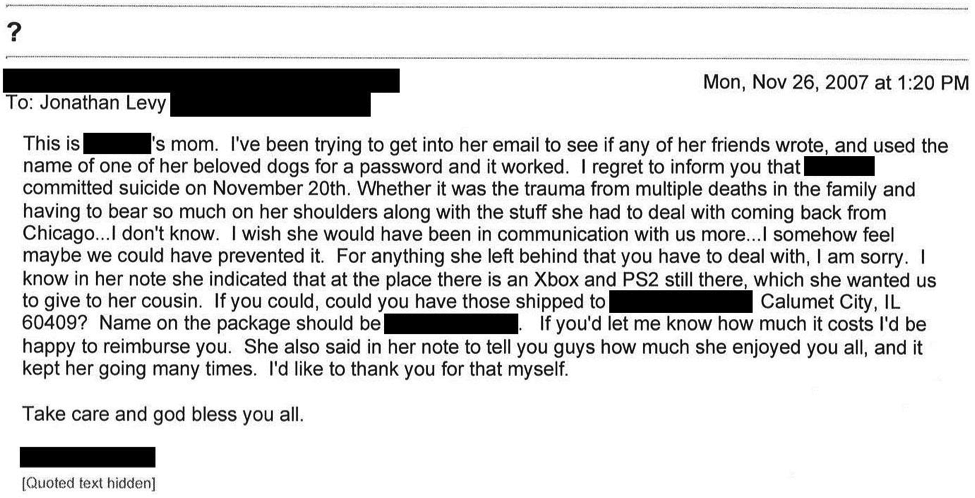
Two weeks later, I called to see how she was doing, but she didn’t answer or call back. Soon after, I got a notice from the bank that Shayna had stopped payment on the rent check she gave me. So I called again, but she still didn’t respond. I emailed her the day before Thanksgiving, told her I knew she was going through a rough time and taking off lots of time from work, asked her when she would return, reminded her that Wade would need to be reimbursed for December rent. No response. I tried again on the 24th. Subject: “?” Text: “When are you coming back to Chicago?” Still nothing. Another email the next day. I told her we would seek another roommate and clear the room of her stuff if we didn’t hear back by the 30th, and that I hoped there was some silly reason she hadn’t responded to a single call or email. Then I received this:

Untitled

We were all, of course, stunned. Pete was the most hurt. When I told him, he looked away, and I could hear his nasal breaths. None of us had any idea that Shayna was at risk for suicide.

We took stock of what Shayna had left: clothes, gaming systems, etc. (Pete would later alter one of her sequined black shirts into a vest for himself.) We intended to mail the gaming systems to her mother as requested, but I figured why stop there? It would be awkward—I wouldn’t know what to say—but I felt it was the right thing to do, and even a bit heroic. Calumet City was less than an hour away. I would take all of Shayna’s remaining stuff home.

I looked up the address on whitepages.com and found the corresponding phone number. I called.

“Hello?”

“Hello. Is this Mrs. _______?”

“Yes, who’s this?”

“My name is Jon. I was one of Shayna’s roommates in Chicago. I don’t know what to say. I’m so sorry. I was going to mail you her Xbox and PlayStation 2, but we figured, you live so close, we could drive everything of hers to you, including books and clothes and everything else, and then you wouldn’t have to worry about shipping.”

“Why don’t you talk to Shayna about that? That’d make more sense. She’s right here.”

Holy-shit-holy-shit-holy-shit!

“I’d love to.”

Shayna did her best to avoid me. First she wouldn’t come to the phone because she was lying down. Then after I tried her cell, she texted me to say she was out of minutes. Finally, when I told her to use someone else’s phone, she gave in and called from hers, and I answered.

“Hi there.”

“Hey.”

“So you’re alive.”

“Yeah.”

“That was good. Really good.”

“Look, I didn’t mean—”

“No I’m just saying it was a good fake. We all believed it. Well done.”

She told me the rest of her story. Allegedly, this is what happened: She went to New York after her grandfather’s death to take care of her grandmother. (Never mind that she had said it was her grandmother’s death in California when she had taken off in early November.). Overwhelmed, she attempted suicide and committed herself to a hospital. After hospital bills, she had only $50 to her name. She went back to Calumet City to visit her parents and make amends—she hadn’t talked to them in two years. She fabricated the email because she wanted to start all over. Now she was about to take a bus to California to visit her aunt and move there indefinitely.

We talked about money. She said of course she would pay, as soon as she got a job in California. We all knew we would never see a dime, and we never did.

###

Shortly after Shayna had left in November, Pete moved into the basement. Then in January, a friend of a friend moved into Shayna’s room, and we were five.

I Googled Shayna once about a year ago, and again as I wrote this story. She’s married, lives in Chicago, and works as a freelancer. She cost me about $200 that winter in 2007, but gave me this story to tell forever. I say it was worth it.

About the author

Jonathan Levy is a law-school graduate living for the time being in Arlington, VA with his wife and two dogs. He joined the writing world late last year, and so far the staff and readers of Boston Literary Magazine and Pure Slush have made him feel so grateful and lucky.


Treatment: Cycles Three & Four

by Adam Rose

The author's CT scan

The author’s CT scan

It’s been two days since my third round of chemotherapy. I needed two Ativan on my way to treatment in hopes that they would keep me calm enough for Roxanne and Mark to insert the tube into a vein. Turns out it was a two person job even with the dopey drug running through my system. The Ativan made my body slow down and my mind fuzz over like frost on a windshield. I squeezed Mark’s hand to pump up the reluctant vessels while focusing on the painting of a rodeo clown leaping over a bull. Roxanne struggled to find a vein that was relaxed enough for the needle.

Mark distracted me with a story of his time on Jeopardy!. He won forty thousand dollars, and afterwards decided he had enough of life as a lawyer. He returned to school and became a nurse. Mark was in his early fifties; he had a dyed beard and curly brown hair. He always knew exactly what to say to mom and Beatrice when they sat at the foot of my bed during the injections. He charmed them with anecdotes involving his time spent in Germany and England. The poisons rushed through my body as they listened to stories about room temperature cask-conditioned beers served with the perfect amount of foam.

*          *          *

My oncologist, Dr. Fisher, was not going to be seeing us for the fourth round. Paige, the nurse practitioner, was to hold our meeting before treatment started. I joked with Beatrice, saying that Paige could be her “sister” wife if we lived in Utah and practiced polygamy (we were on a major Big Love kick at the time). Paige reminded me of Parker Posey. She wore open toed shoes with silver rings on the middle toes. When we weren’t focused on the business of cancer, she would say how jealous she was of our past in southern California.

She looked straight at the computer screen, and in a medically monotone manner said I had tumors in more places than the L-3 vertebrate. There were “trouble spots” in my ribs, further up the spine, and on one of my hips. I didn’t want to know where anything else was–it did me no good knowing where every fucking “trouble spot” was located. It felt like someone giving me the location of every landmine buried in an open field while being plunked down in the center.


*          *          *

Round four began. It was time to commence treatment with mom and Beatrice hanging with their Cosmos and Vogues. Mark injected the first and only red colored chemical into my body. It was thicker than Jell-O as it plunged into my arm. I felt a light burn rush up my forearm, but this one was nowhere near as bad as the last of the four. ABVD are the initials of the four different chemical cocktails pumped into my body every two weeks. The D is the last and takes the longest because of how much it hurts going in. They have it an ominous dark colored bag because it hates direct sunlight. Mark laid a bag of ice on my arm to settle the flare up of red veins mapping out the constellation of my cardiovascular system. I clenched my jaw as tears blurred Beatrice into a blonde watercolor.

Tuesday night I felt horrible: emotionally, physically, mentally wasted. I could barely move. It was a challenge eating dinner, Mom’s chicken and dumplings. I took an early evening nap that had me sweating uncontrollably. The smell of toxins rising from my pores while my intestines twisted into violent knots prevented any sound slumber. Later, I found myself inconsolably weeping in my wife’s arms. Beatrice reminded me that Mark warned us about the steroid pill. He said it might make me extremely emotional for a while. I went back to bed at quarter of seven. I had the most vivid dreams of the chemo endowing me with multiple super-powered abilities — super strength, teleportation, invulnerability, ESP, and something akin to the Force — but the powers all came and went one after the other. The cancer stayed.

Wednesday morning came and I woke with major stomach cramps and a feeling of being hit by a semi- truck. The nausea was coming in waves and the waves became worse and worse throughout the day. The highlight of the day was hitting Bedrock Comics and picking up a decent haul of books for myself. I was able to hold down a turkey sub after that, but later suffered with more nausea and severe acid reflux. My face became inexplicably flushed thus freaking Beatrice out enough to call Mark at the treatment center. He said as along as I wasn’t having any major shortness of breath then everything was okay.

Thursday rounded the corner and last night was rough. My folks acted like I was already out of the woods, but I knew I was still deep in the forest with a dull machete. I didn’t want to be a downer so I tried not to remind them that things were not okay. My mom “joked” with me that morning about sleeping in till nine. I knew it was a joke but I was frustrated- I didn’t want to be a patient anymore- I wanted to feel healthy more than anything. I was tired of feeling like shit and the fracture in my lower back was a constant reminder of all the baloney I was forced to deal with. Everybody around me was healthy and I was not- I wanted my life back. I was terrified.

*          *          *

Don’t worry.

Beatrice went to the emergency room without me Friday afternoon because of a tingling numbness in her right cheek and hand. She had called for a doctor’s appointment, and they could not see her for two weeks. They suggested she go to the ER immediately to play it safe. Beatrice insisted I stay home and treat it like a routine doctor’s appointment. I felt like a shitty husband. Rationally I knew she had a point when taking my back pain into account, but I despised not doing the right thing in this scenario.

The day was already hectic to begin with. Duck eggs nestled next to the pool hatched so we spent the early afternoon scooping baby ducklings out of the pool with a pool skimmer and placing them in a kiddie pool until we collected them all. Eight of the nine ducklings made it safely under the fence and down to the pond with their mama duck. One of them seemed to have suffered an injury in the transfer and didn’t look like it could walk. I already rescued one wayward duckling a second time from the confines of the pool. He was compelled to return to the chlorine; his egg must have been closest to the edge of the pool. Hopefully they all live happily by the pond behind the fence. We intended to check on them when Beatrice returned. I hoped it was carpal tunnel or some simple non-threatening explanation for her numbness. She called and said they wanted to give her a CAT scan. I’d already experienced a CAT scan, PET scan, bone scan, X-ray, MRI, and would spend the final month of treatment being bombarded with radiation on a daily basis. Geiger counters loved me, and I didn’t want them to know Beatrice existed.

*                 *                   *

The following poem may or may not depict the aforementioned rounds of chemotherapy:

Cycle Three


Nurse Mark sets the brochure for cyborgs on my lap:

Insert a port between the patient’s shoulder and neck,

Creating a direct line to the river vein.

I refuse.


He plunges the syringe filled with red Jell-O

Into my right arm until the veins glow,

And I think of the games children play,

Raking the soil of the skin until

Red welts grow and flourish.


My eyes water. My Mother and newlywed bride

Look away and read Time.


He says some veins have collapsed,

And I think of children trapped in a burning house.

An ice pack masks the pain,

And I still refuse the port.


The chemo moves on to the “vampire bag”

Blood brown and

Shielded from sunlight.


I grind my teeth for hours, my bones ache, my muscles wail,

I’m covered in sweat,

And stinking of chemicals.

The steroids arrive in pill form.

Protocol requires the same warning:

Side effects include an overwhelming

Sense of dread.


Two weeks till round four of twelve.

Seconds crawl

I lie in bed with my wife

And we see the beach.

Our children run from the waves

And into the arms of their mother.

They stroll away;

The three of them

Holding hands

Waves washing the beach

Now, always, forever

And I am not there.

 About the author

Adam Rose lives in Los Angeles with his amazing wife and two children. He’s been in remission for six years. He’s currently working on a recently finished novel as well as a soon to be released All Ages graphic novel.  

Happy Birthday to Us!

by the TUAS Editors

It’s hard to believe but yes, we’ve been sharing your true stories for a whole year. Happy 1st Birthday to Tell Us A Story! And thanks for sending us your stories.

first-birthday copy

To celebrate, the editors of Tell Us A Story decided to sit down and chat about their experiences running the blog this year. Pull up a chair and have some cake with us, won’t you?

 Allyson: So where did you get this brilliant idea to start a true story blog?

Amanda: I don’t know if it was brilliant but…I got tenure last spring [nota bene: Amanda teaches film studies at East Carolina University] and as a reward to myself I wanted to start pursuing some non-academic writing projects. Once I didn’t have to worry about fattening my tenure file, I felt this freedom to do a wider range of writing. I love hearing people tell stories so I thought creating a venue for storytelling would be rewarding. 

So why did you agree to do this with me?

Well, I was also looking for some outlet for my creative energy. I haven’t written anything since I was got pregnant with Tristan back in 2006. I really wanted to get back to that.

You haven’t done any writing for your job as a high school English teacher?

Not really. I wanted something that was more creative, more in the realm of what I like to write. I thought the blog was a good idea.

So, if you had to pick one story that epitomized what Tell Us A Story is, or what it’s trying to do, what would you pick? What story made you say “That’s why I’m doing this. This is what I had in mind”?

You know what? I have two picks. And I say this not because I think these were the best stories we published all year but because I feel like they illustrate what our blog does really well. The first one is “Houston Insomnia” by Stephanie Dickinson (first published November 22, 2013). The series of stories in this piece  — about living in Houston, teaching in a special needs school, and doing all these drugs — Stephanie just describes it all in such a vivid, beautiful way. And then Coral created those images to go with the piece — I felt like her art really enhanced the experience of the story.

mirror

Image by Coral Staley

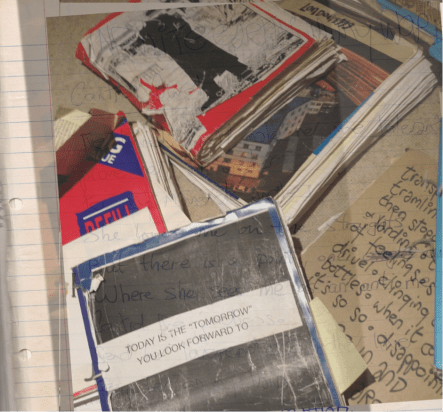
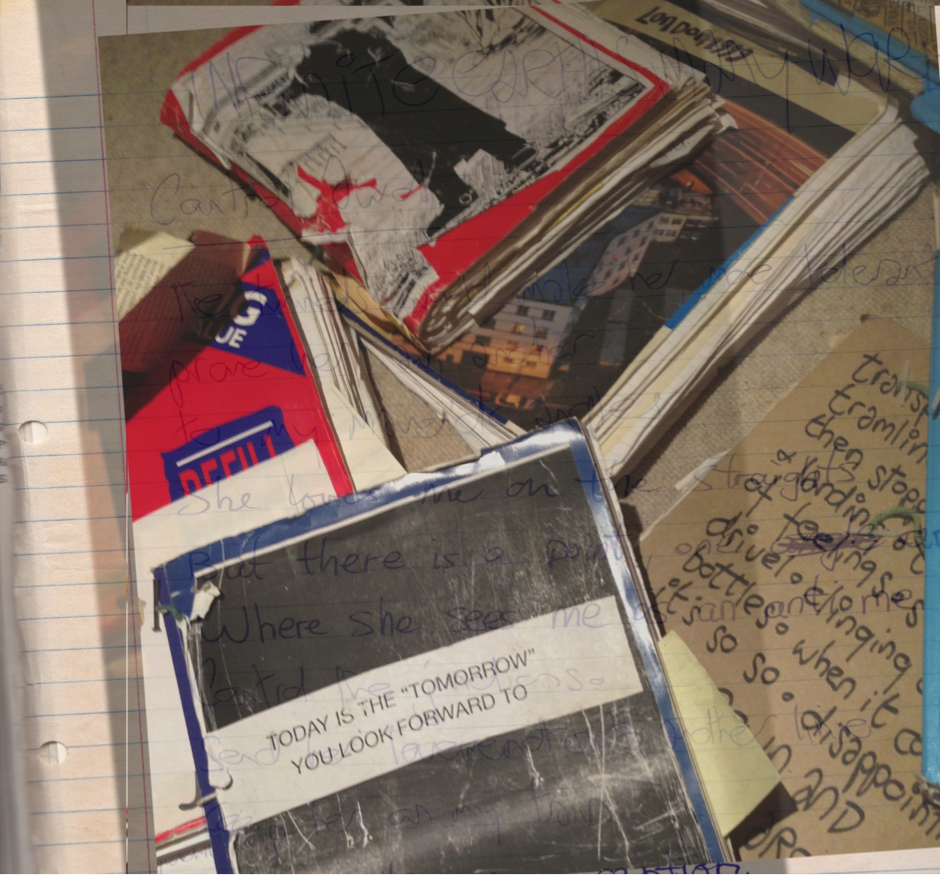
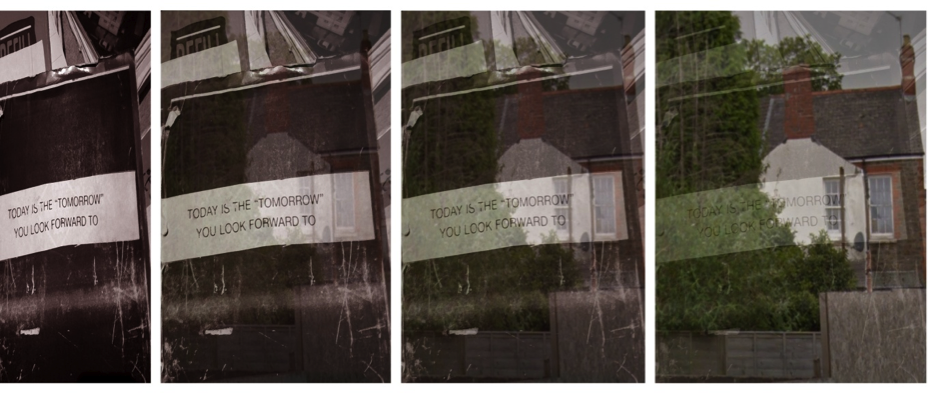
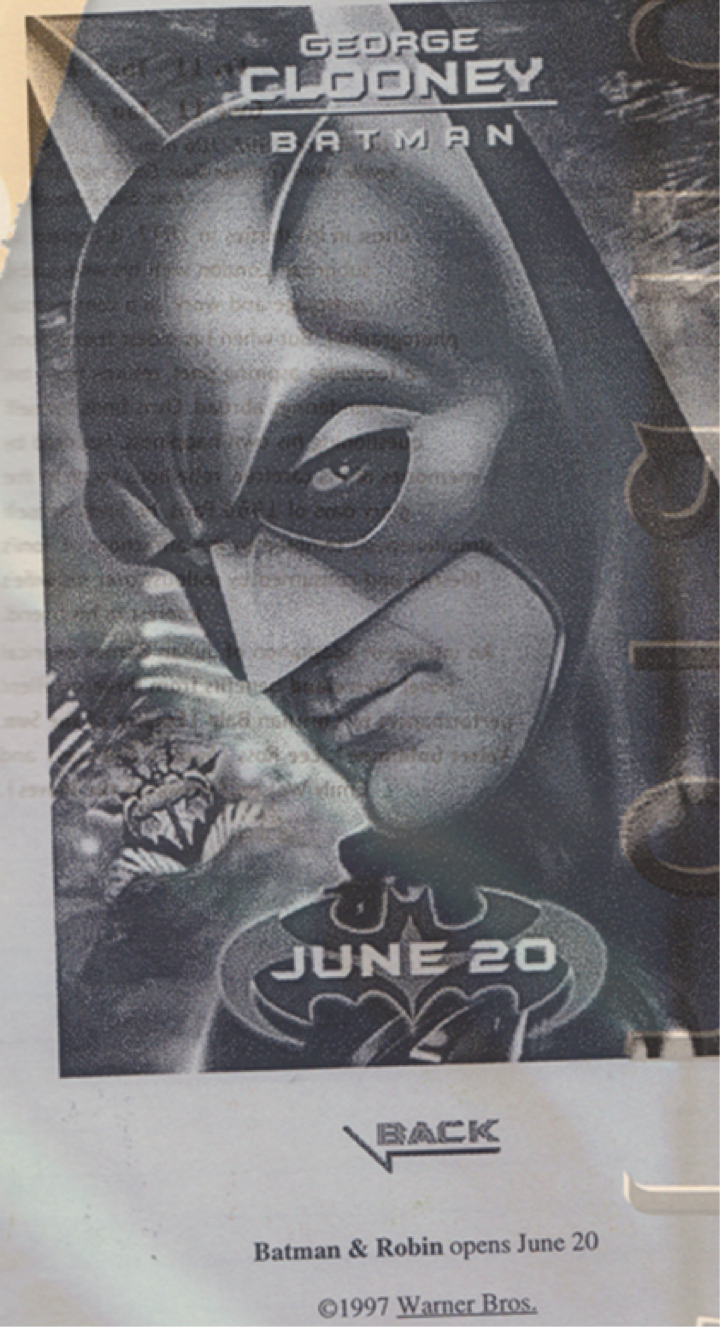
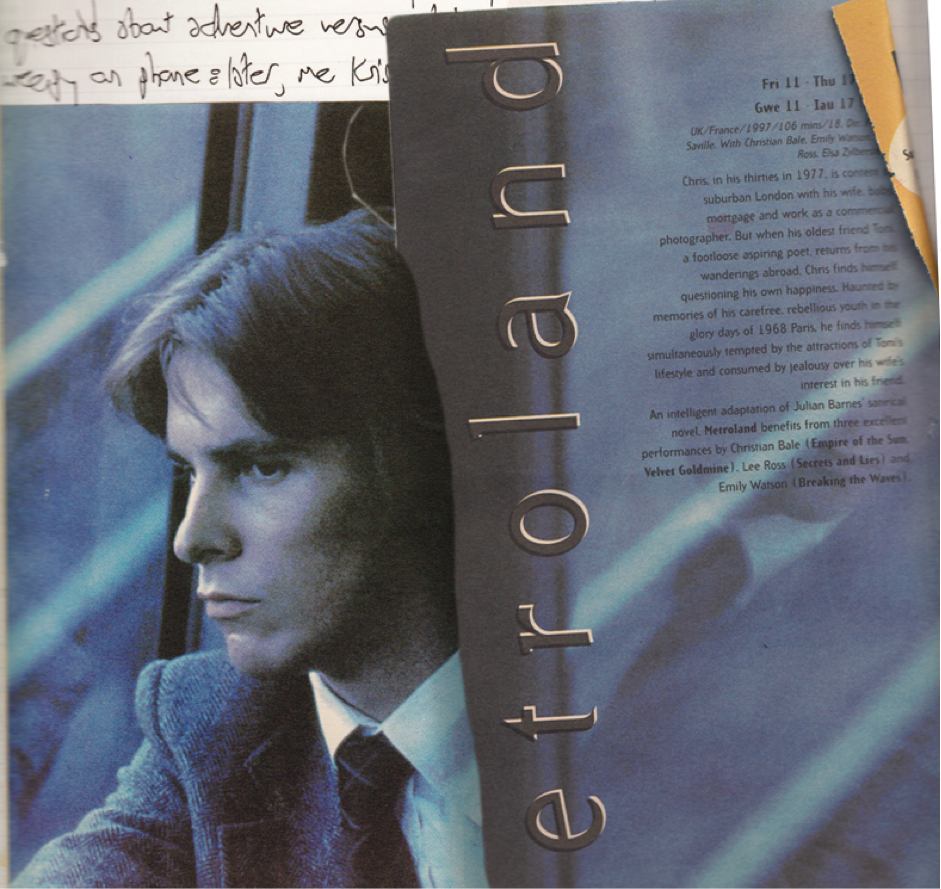
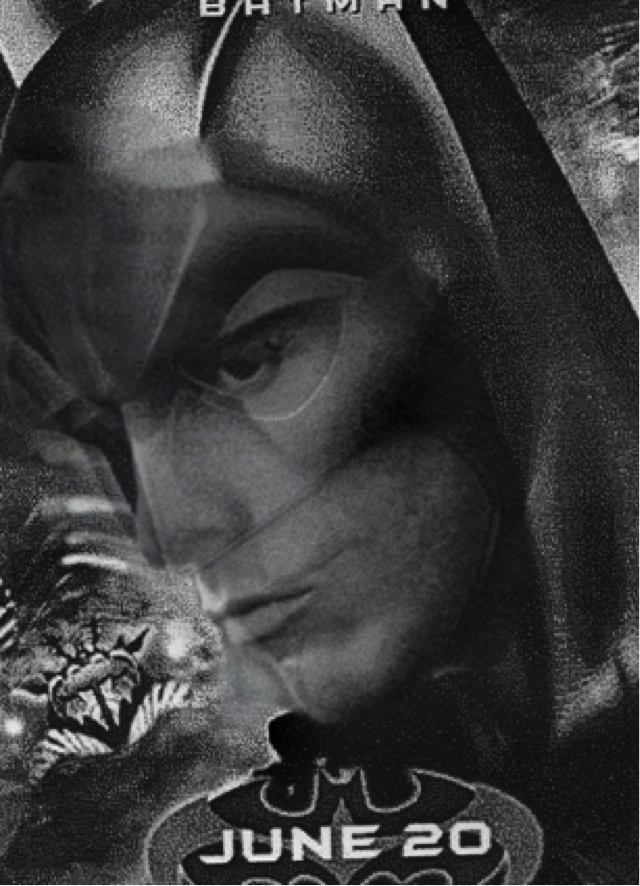
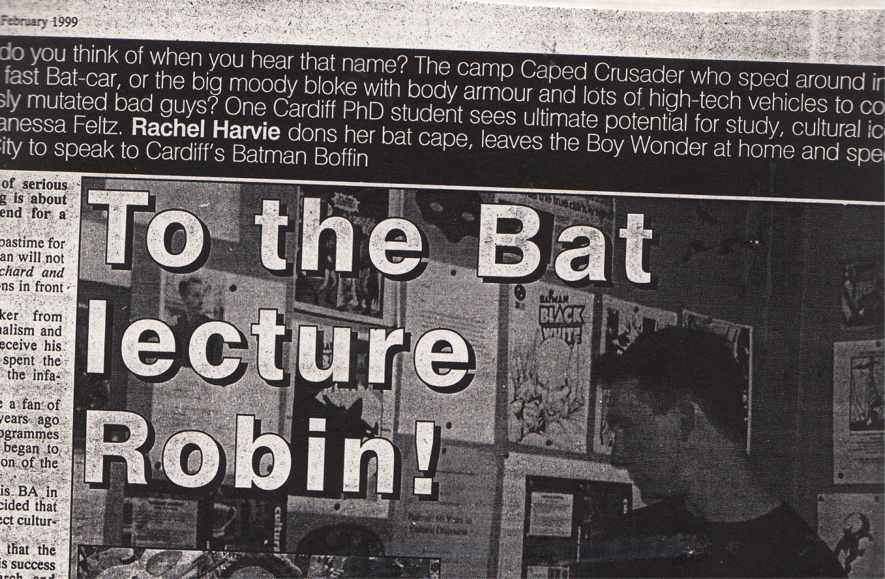
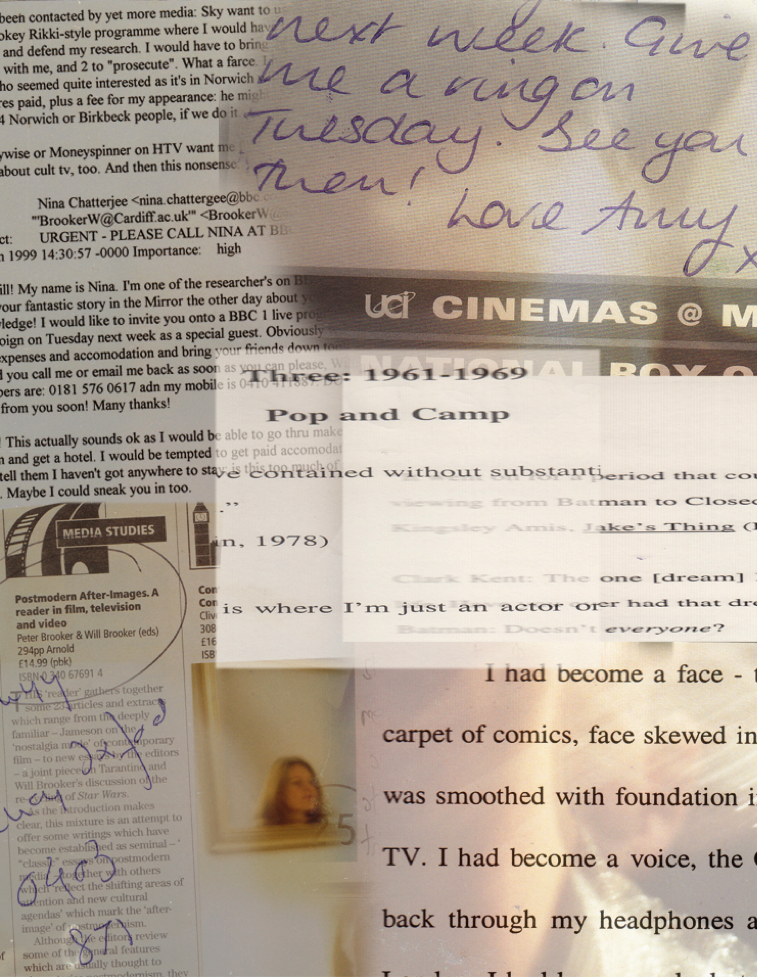
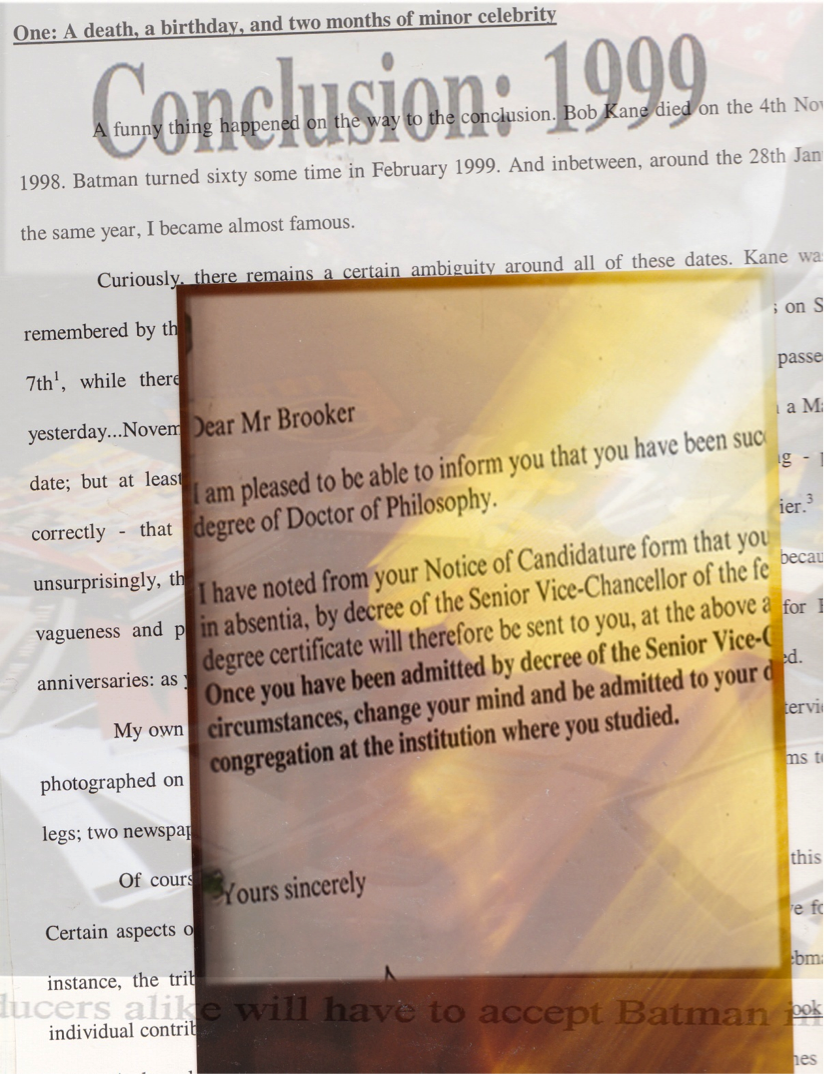
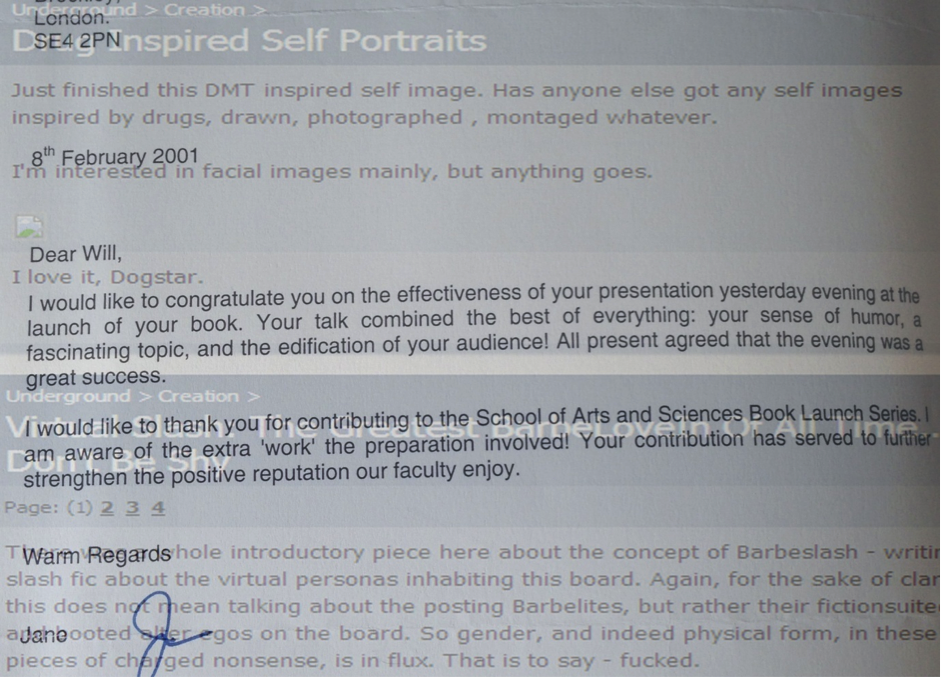
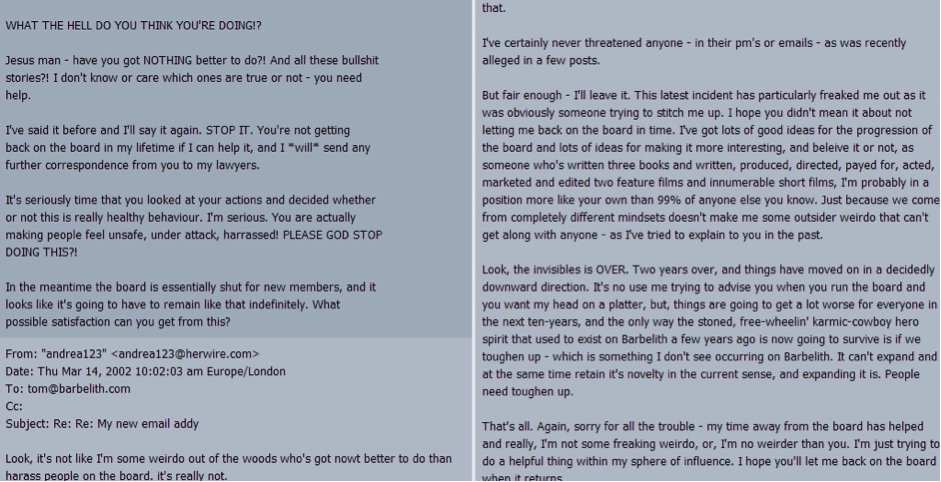
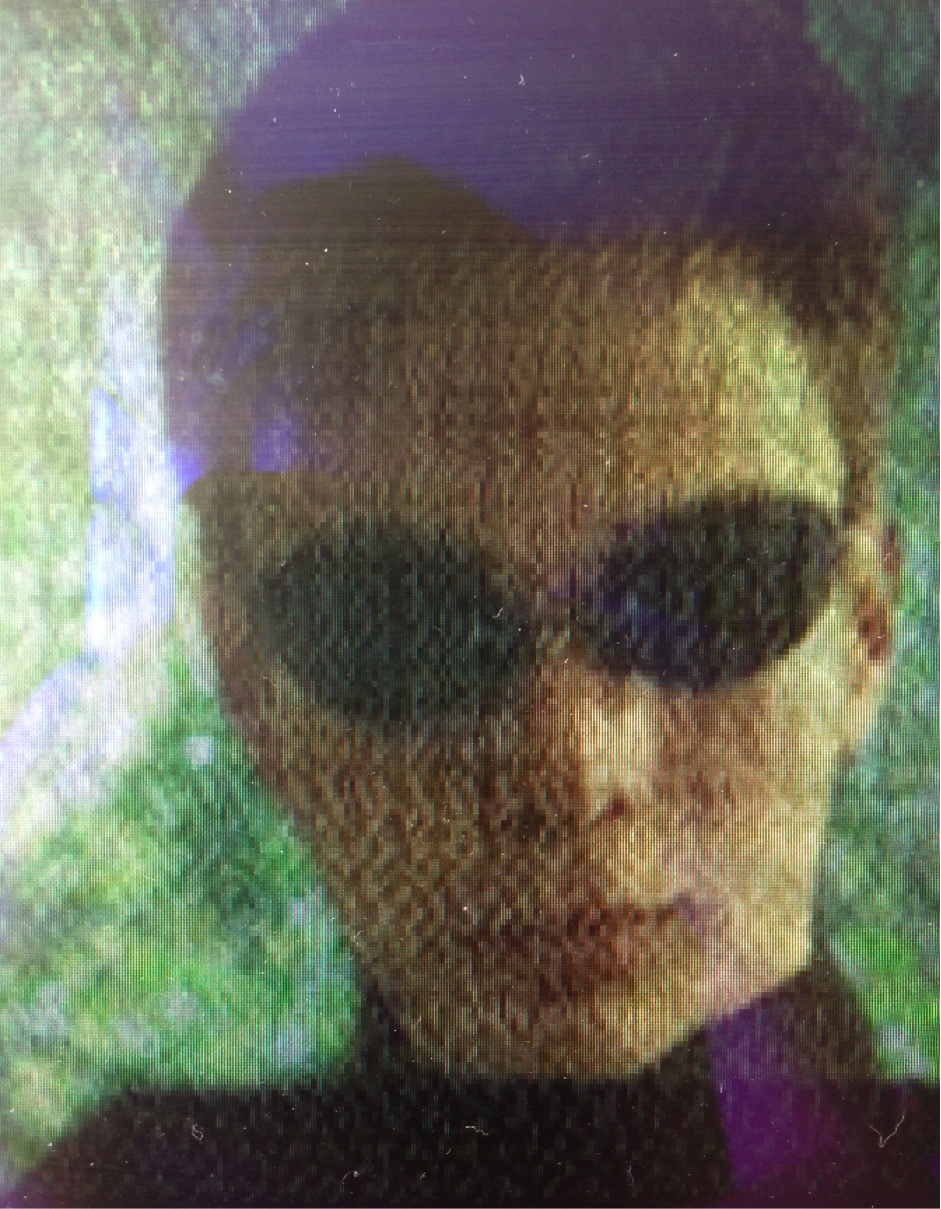
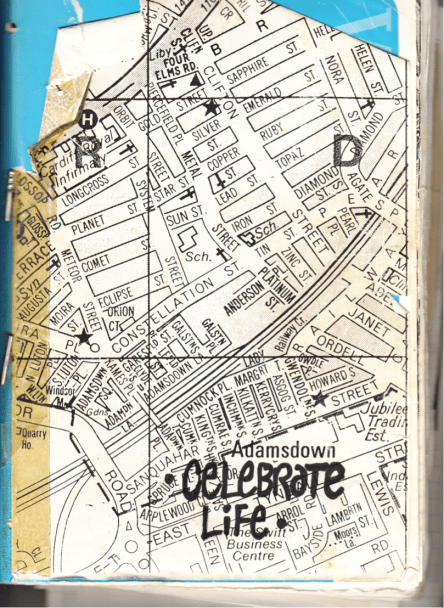
My other pick is “Who I Was and How I Came to Be” by Will Brooker (first published March 26th 2014).  Will really worked with the archival materials — he saved all of these clippings and scraps of paper and wove them into his prose. They images weren’t just tacked on, they were clearly part of the narrative. Blogs are really flexible in terms of visuals and so I’m glad he exploited that.

Untitled11

Will Brooker’s accompanying photograph

So those two stories are examples of something that I think Tell Us A Story has done really well. What about you?

I would say that I really loved “That Easter” by Leonore Wilson (first published September 4, 2013). I loved the dreamlike quality of it and the message within it was beautiful. That’s the sort of writing I’ve always enjoyed. 

Screen Shot 2014-05-13 at 9.54.18 PM

That was a lot like a poem, I can see why you were drawn to it [nota bene: Allyson has an MFA in poetry].

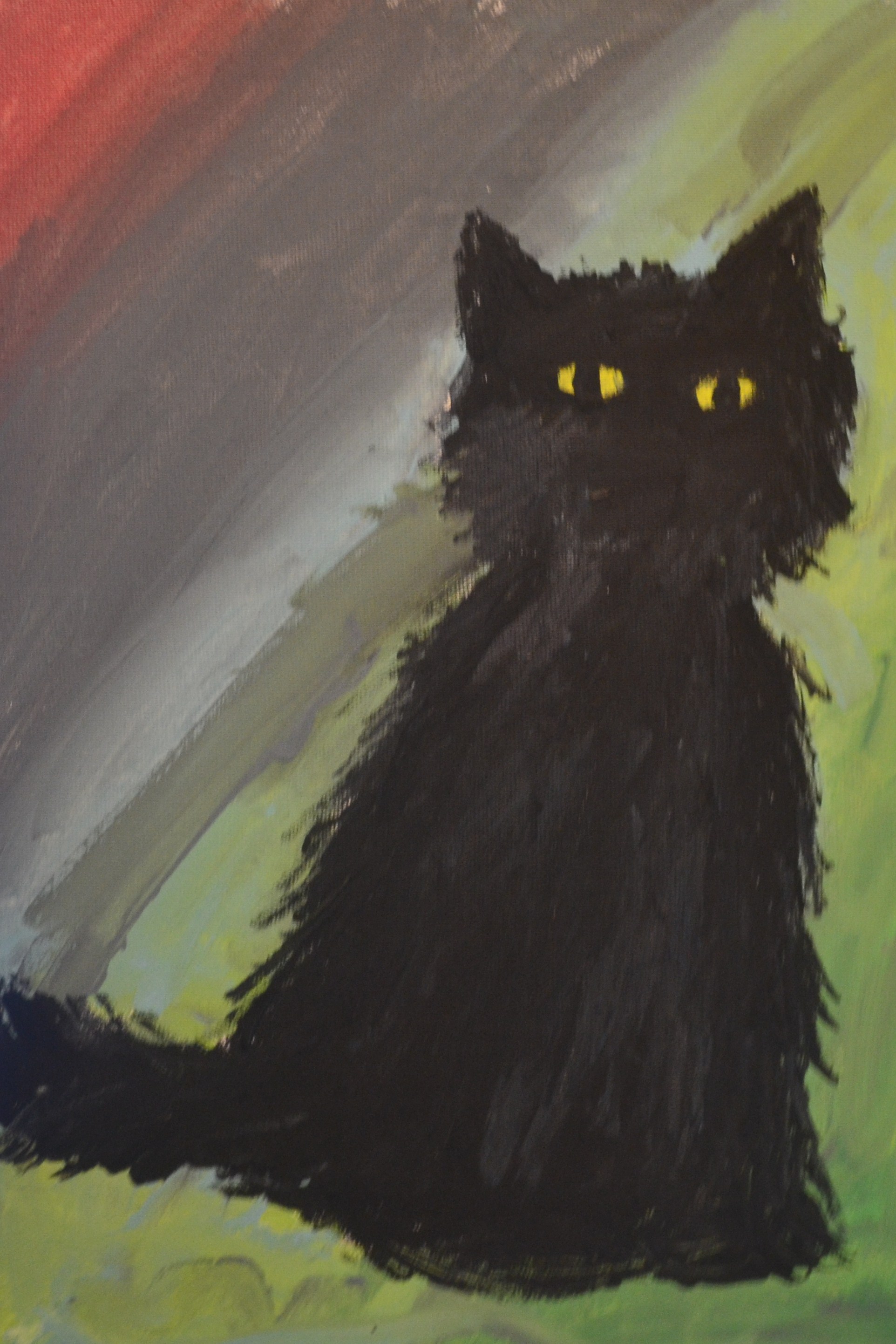
Yeah, very poetic prose. My second pick is one we didn’t totally agree on and that’s “Blacky” by Holly Gross (first published September 18, 2013). That story brought me to tears. There’s this girl who grew up in less than ideal circumstances — clearly she’s in a family with some kind of abuse and they’re struggling with money — and because they can’t afford to go to the vet, she has to watch her cat die, and the maggots…

You’re really macabre, Allyson.

I am. It’s kind of like the cat version of “The Ones Who Walk Away From Omelas” by y Ursula Le Guin. You should read it, it’s really good. Also those paintings of Blacky were great.

The author's daughter, 9, paints the Blacky of her mother's memories.

The author’s daughter, 9, paints the Blacky of her mother’s memories.

I did like that her daughters based their paintings on their mother’s memories of the cat. That’s a nice idea — the transmission of memories…

I was also really excited to publish “Chapter 50 from Country” by Shelby Stephenson (first published February 26th 2014).The writing was great but I also liked the fact that Shelby is from an older generation, and the perspective that brings. His generation is not a generation of blogging and online journals so I like that we have his work featured here. Also, as someone who has lived in North Carolina for the last 7 years, the poem felt very familiar to me — it’s very much a North Carolina text.

Photo of Shelby and Linda by Jan G. Hensley

Photo of Shelby and Linda by Jan G. Hensley

I find that very interesting — we’ve had a lot of success with stories that have focused on particular regions of the country, or specific locations within those regions.

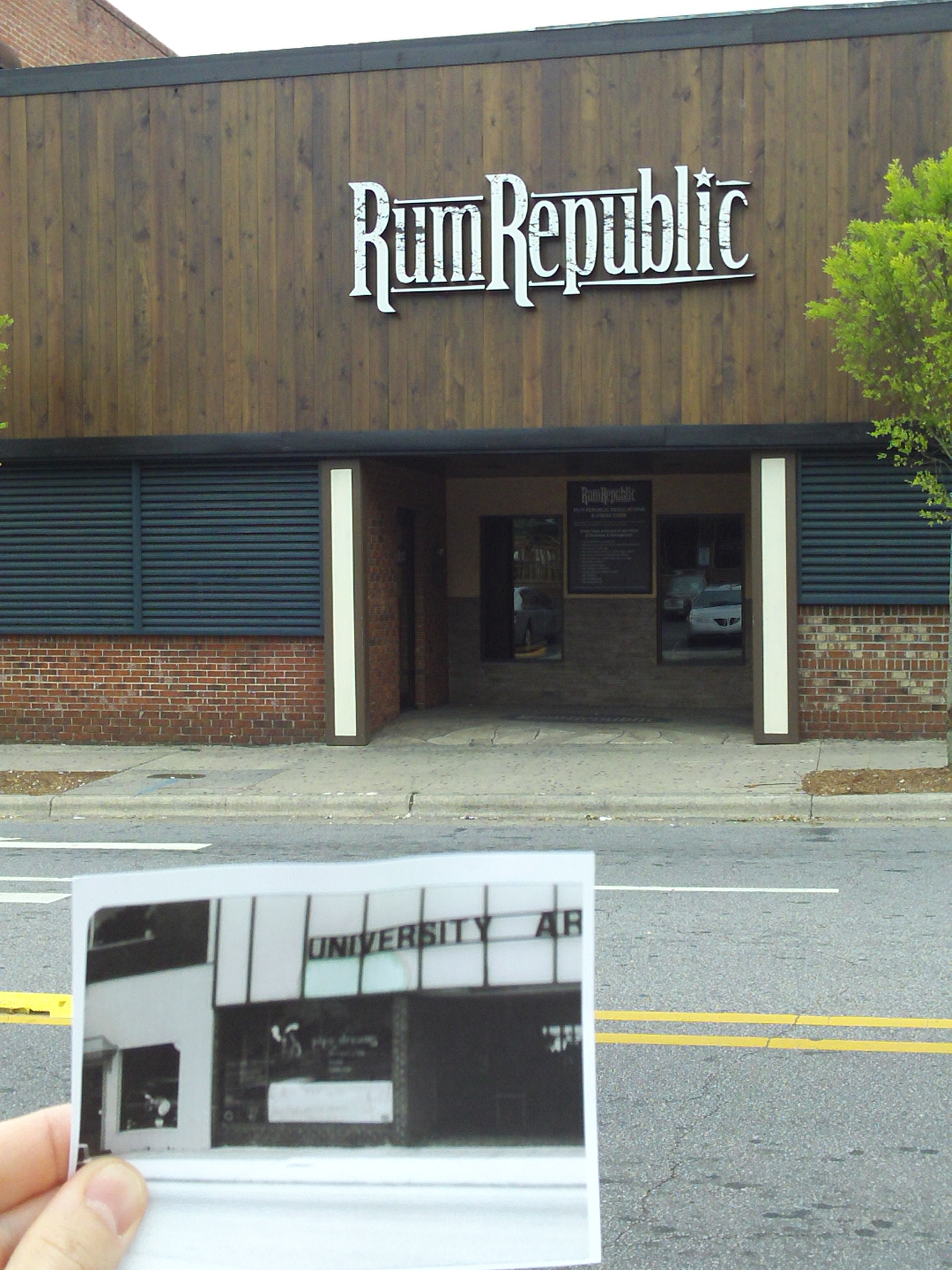
Right, like “Pipe Dream” by Randall Martoccia (first published July 17 2013), which is about a head shop in our town, remains our most read story. The stories from my high school (here and here) and yours (here) also generated a lot of traffic. I think we’re still figuring out what niche we’re filling–and that may be what it is that we’re doing, telling highly local stories.

This undergraduate haunt stands where Pipe Dreams once nestled itself into downtown Greenville, NC society.

This undergraduate haunt stands where Pipe Dreams once nestled itself into downtown Greenville, NC society.

What about the stories that surprisingly did not do well?

You mean like all of them???

For me, a story like “Meeting Frank” by Shari Barnett (first published October 9, 2013) never got its just desserts.

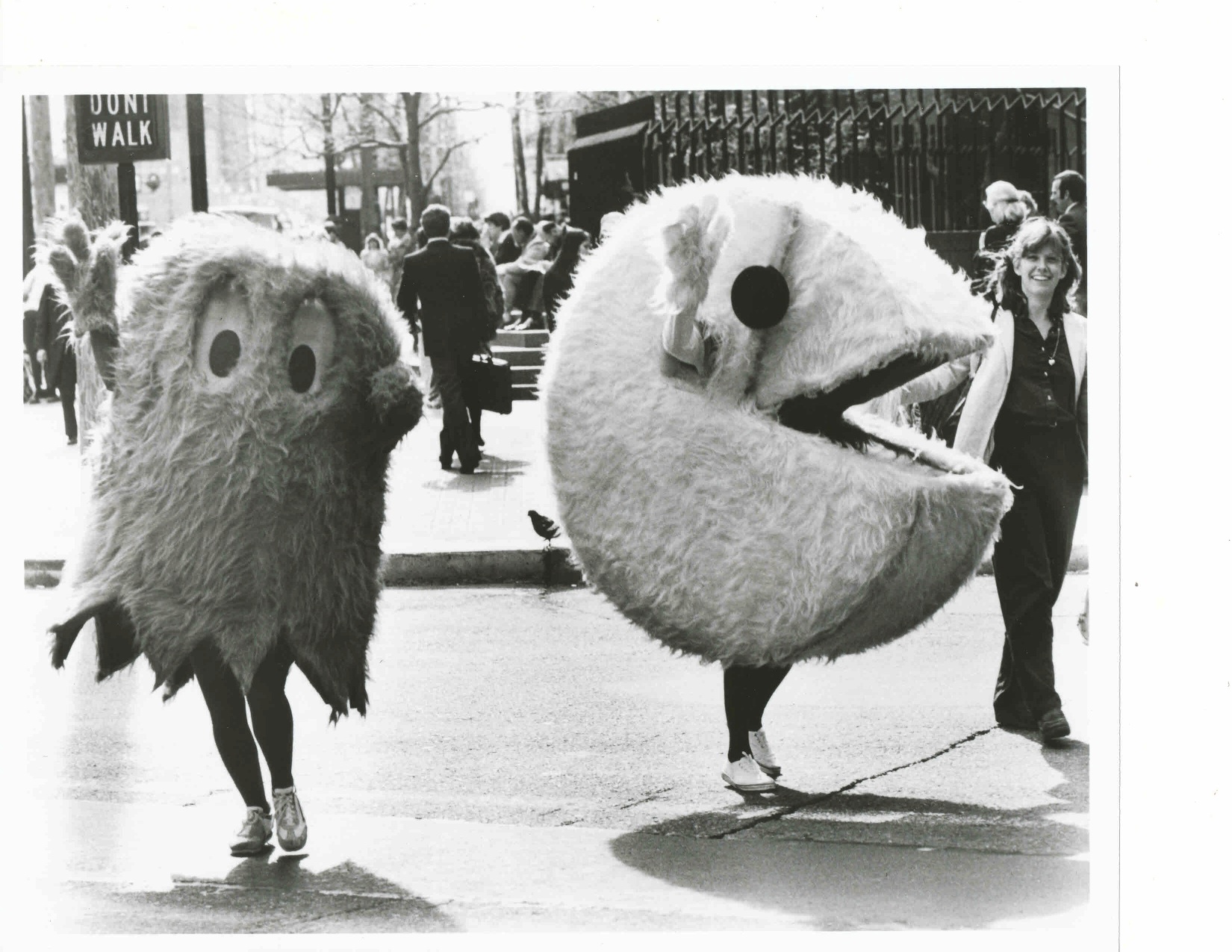
Yes, I agree! That story was fucking amazing. That story had Pac Man, Frank Sinatra and that photo she gave us? That should have been 1,000 hits right there.

The author, in the famous costume.

Shari Barnett and friend in PacMan and Ghost costumes, early 80s

It’s the story of a career woman in the 1980s, in this new industry of video games. I was really disappointed that more people didn’t read it. Even Mark [Allyson’s husband] said “That’s the kind of story that’s going to go viral.”

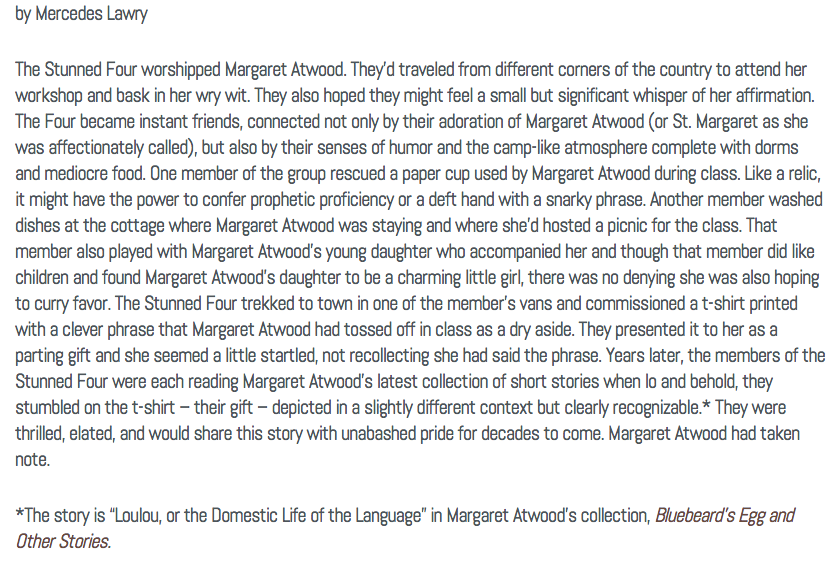
I would have thought so, too. Another piece I loved but didn’t get a lot of traffic was “Margaret Atwood and the Stunned Four” by Mercedes Lawry (first published on September 11, 2013) for our “Flash (Non)Fiction Week.”

Yesssss. That was one of our lowest read weeks!

People wanted nothing to do with that week.

I know, and I thought the Margaret Atwood story was amazing.

It really demonstrates how great flash fiction (or non fiction) can be. The final line — “Margaret Atwood had taken note” — just gets me every time I read it. As English majors in college, I think this story really resonated with both of us. It’s this perfect, fangirl response to an author you idolize. I can relate to everything she describes — I would have done — would do — all of those things.

Screen Shot 2014-05-14 at 8.38.20 AM

Read this story, damn it!!!


Okay, so last question: what would you like to see us doing with this blog in our second year?

You know, I’d like to maybe see us shift formats a bit, and start offering up more content but less frequently? More like a literary journal?

We actually have enough content to do 4 individual issues a year, but that means changing what is currently our brand: a single true story every week. When we get together this summer, we’ll have to brainstorm ideas for possible ways to change our publication schedule.

What about you? What would you like to see in the next year?

Obviously I’d like to increase our readership. I’d like wider circulation — beyond our social media circles –because that will also bring in a more diverse pool of submissions. For instance, I’d really like to start reading submissions from outside of the U.S. But to do that, we need to extend our circulation.

Yeah, I’d like to see that, too.

Honestly, my biggest goal is to get enough good submissions to keep us up and running through another year. So, Allyson, have you enjoyed yourself this year?

I have! I really enjoyed reading people’s stories, from so many different walks of life, from different places, different socioeconomic backgrounds. It’s been interesting.

Yeah, after reading through all of the submissions we get  [nota bene: we typically accept only 20% of work submitted to the blog] , I find it interesting to see what folks think of as a story worth writing down and sending in, what makes someone say “Yeah, I need to share this with someone else.”

***

A NOTE ABOUT SUMMER SUBMISSIONS:

Although we won’t be publishing a new true story until August 6th — we are going to take the summer off to catch up on submissions, relax with our families and friends, and plan for the next year — we will be open for submissions ALL SUMMER LONG!

If you have a true story you’d like to share — or if you would like interview someone you know who has a great story — please send submissions as an editable attachment (no PDFs please!!!), along with images, and a 100 word (or less) biographical statement to tellusastoryblog@gmail.com.  Put “TUAS Submission” in the subject line. Please submit only one submission at a time (unless you are sending poetry).

All submissions must be less than 2000 words and must be based on something that actually happened to you (not to your friend or your cousin or your high school math teacher). We are also interested in very short stories (flash [non]fiction), experimental stories, poems, or plays as long as they are true. When possible, we’d like you to send us a scanned photograph or document that correlates with your story, because those kinds of details are nice.

About the authors

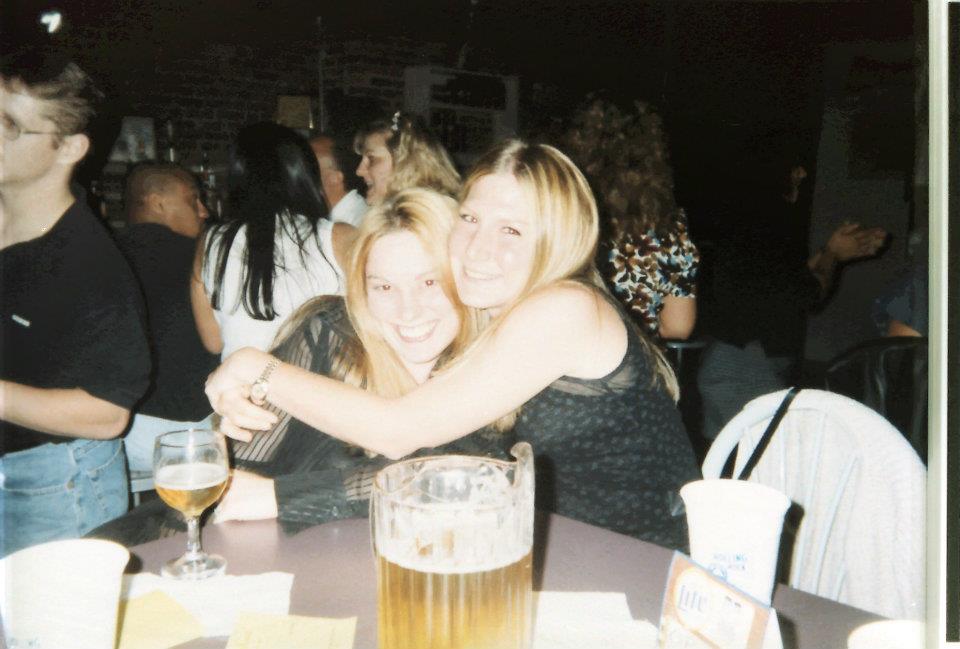
The editors, way back in 1999.

The editors, way back in 1999.

Allyson Wuerth and Amanda Ann Klein met during their first week of graduate school at the University of Pittsburgh when Amanda noticed that, during a teaching assistant training session, Allyson was not busy scribbling notes like all of the other students, but writing her grocery list. Amanda was excited to see that Allyson was planning to buy hummus and soon a lifelong friendship was formed.


More Tales from STHS: Assholes Raised by Assholes

Note: all names, other than those of the interviewees, have been changed for this story.

by Amanda Ann Klein

RAIL_1030_PAB

Let me start this way: I’m an asshole.

I don’t mean that I’m a bad person. I compost and tell my daughter she can marry a girl if she wants to and I always give money to my local NPR affiliate. But I’m still an asshole because, whether you trip up the steps or fart or mispronounce a word you really shouldn’t mispronounce, I’m going to make fun of you. I also like to catalogue these indignities and bring them up later, so that a new group of people can laugh at the stupid shit you did, too.

But for a long time, I didn’t know I was an asshole. I thought I was just someone with a really great sense of humor, a person who could laugh at herself and others—especially others—when the situation required it. I assumed this behavior was normal, even healthy, because everyone I went to school with was like this too. We made fun of each other constantly. We assigned cruel nicknames to those who did stupid shit and used those names with impunity until someone else did stupider shit, and then we’d all make fun of that for a while. In this way, our bullying resembled a really shitty game of tag: the only way to get people to stop calling you by an unpleasant nickname was to give someone else an even more unpleasant nickname.

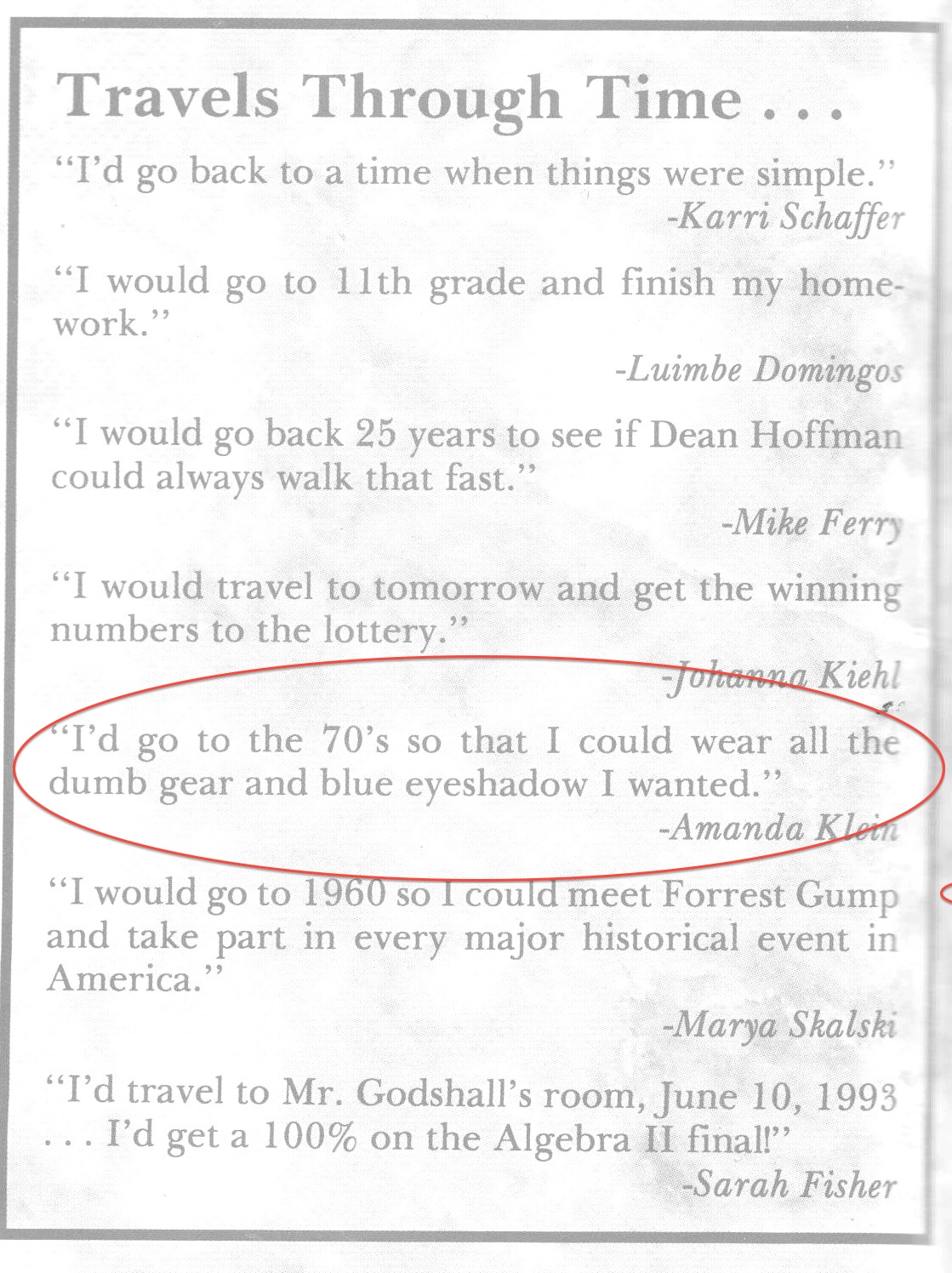
All of my friends in high school, at one time or another, had been given a nickname, because everyone in high school has to be given a name that is not their own. Among them were “Big Draws,” “Fat Rob,” “Half Pint,” and “Dumb Gear.” That last name was mine. I earned it because I wore something that somebody thought looked “dumb” to school one day. I was given a worse name once, too, one that made my stomach cave in on itself whenever someone said it, but I won’t talk about that name here. After all, even assholes can get hurt feelings.

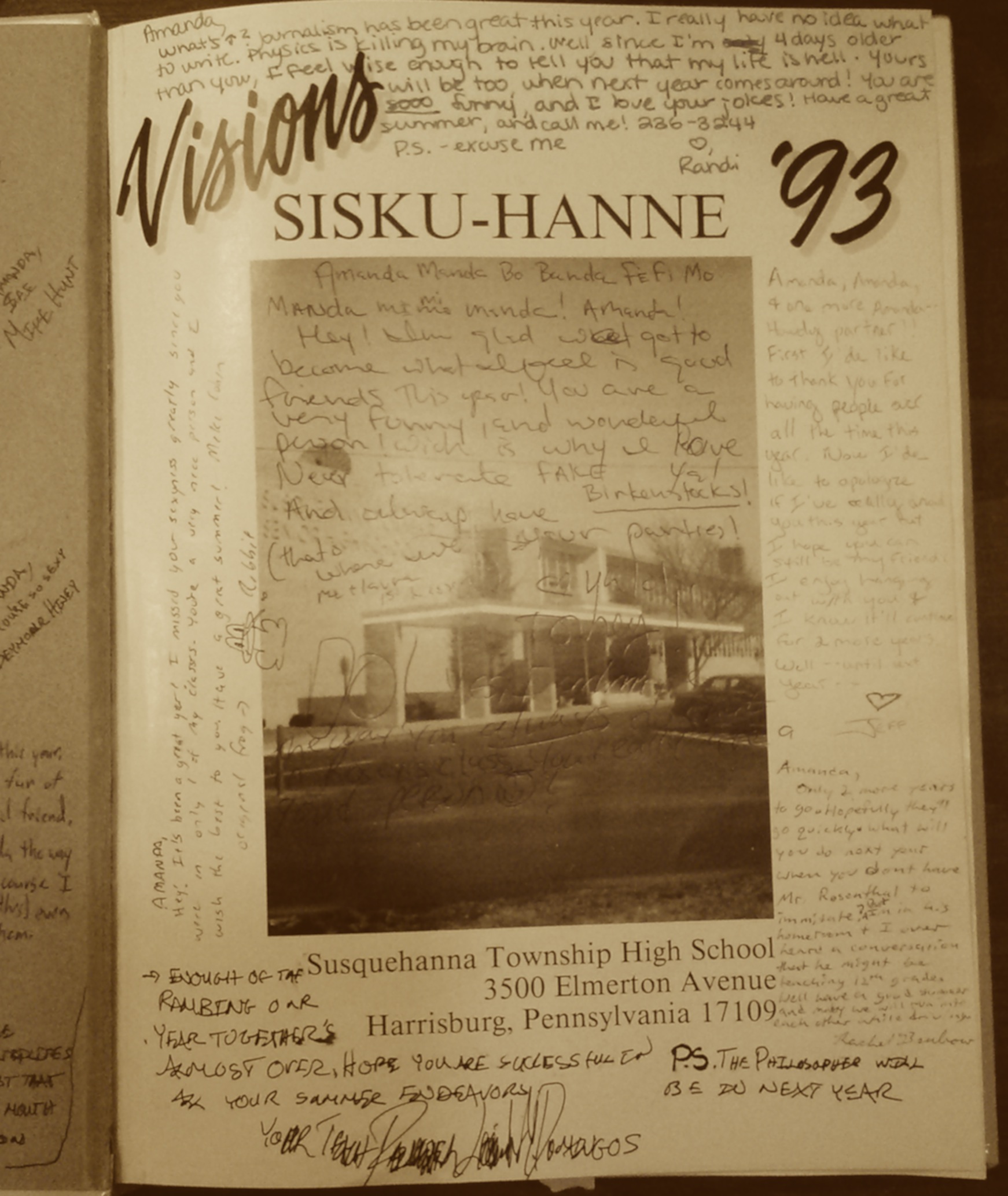
or the yearbook seniors were asked what they would do if they could travel through time. Note how I have internalized my nickname.

For the yearbook seniors were asked what they would do if they could travel through time. Note how I have internalized my nickname.

Our high school teachers thought we were assholes, too. At the time, I erroneously chalked up their distaste to jealousy. We were smart, we were going places. We felt entitled to all of the good things the world promised to give to young, upwardly mobile teenagers. But those teachers? They had to stay in central Pennsylvania forever teaching assholes like us. This is what we told ourselves, though the truth is that we were just assholes.

For example, we had a Spanish teacher in my high school, Mrs. Smith, who walked with a limp. At the time, I had no idea why she limped. It never occurred to me to ask. What I did do, though, is laugh whenever my classmates gave her a hard time, which was pretty much all the time. This was partly her fault, of course—Mrs. Smith had a bad perm and spoke too softly. You have to be loud to teach high school. You have to be strong or the assholes will tear you apart. We tore Mrs. Smith apart:

Liz Rose Triscari (far right) pictured with fellow class of 95 grads, Dani Liebman Healey and Charlie Heller.

Liz Rose Triscari (far right) pictured with fellow class of 95 grads, Dani Liebman Healey and Charlie Heller.

Liz: “[Mrs. Smith] always tripped over trash cans and we assholes laughed about it. But she had some disability so that was a dick move in hindsight.”

Luimbe Domingos, pictured here with Dani Liebman.

Luimbe Domingos, pictured here with Dani Liebman.

Luimbe: “[Mrs. Smith] had polio as a child, so she was permanently crippled. People would move the trashcan where she wouldn’t expect it and she would trip over it. She caught on and would check the trash can every day before coming into class.”

Matt Rover, Kara Garcia, and yours truly.

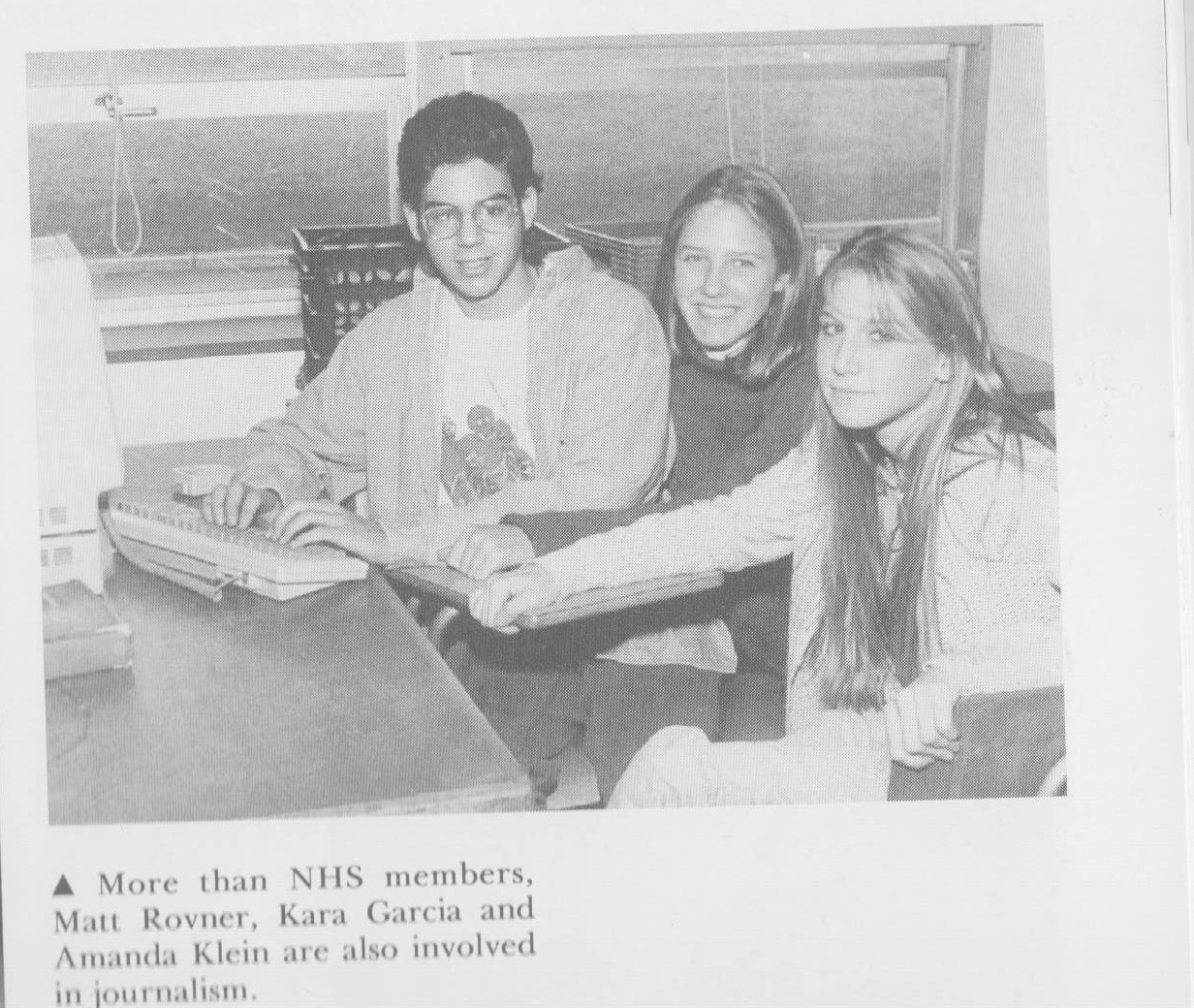
Matt Rovner, Kara Garcia, and yours truly.

Matt: “Jim and some other kids in Spanish class, with great gusto and great regularity, would belt out the word ‘dick’ while Mrs. Smith was trying to teach. At one point, Mrs. Smith told us that she would be absent because she was donating bone marrow to her sister who had leukemia. She had barely finished the words when ‘bone marrow dick’ was broadcast across the room. While I feel terrible for Mrs. Smith now, I am a little ashamed to admit that this still makes me laugh. Another time in Spanish class, Jim brought in a universal remote control and kept turning the television on while Mrs. Smith was trying to teach. We couldn’t stop laughing. I still don’t know why she didn’t murder us.”

***

As someone who now teaches for a living, I can’t imagine what it must have been like teaching assholes like us. I’ve had students fall asleep during my lectures, watch YouTube videos, chat with their neighbors, roll their eyes, suck their teeth, and, on just a few occasions, question my authority. But in my 14 years of teaching I’ve never had a classroom filled entirely with assholes. But that’s what my high school teachers faced on a daily basis.

I recently spoke with a former high school classmate, Joey Laws (Class of ’95), about being an asshole in high school. He had a lot to say:

Joey Laws, second from the bottom, all dressed up for senior prom.

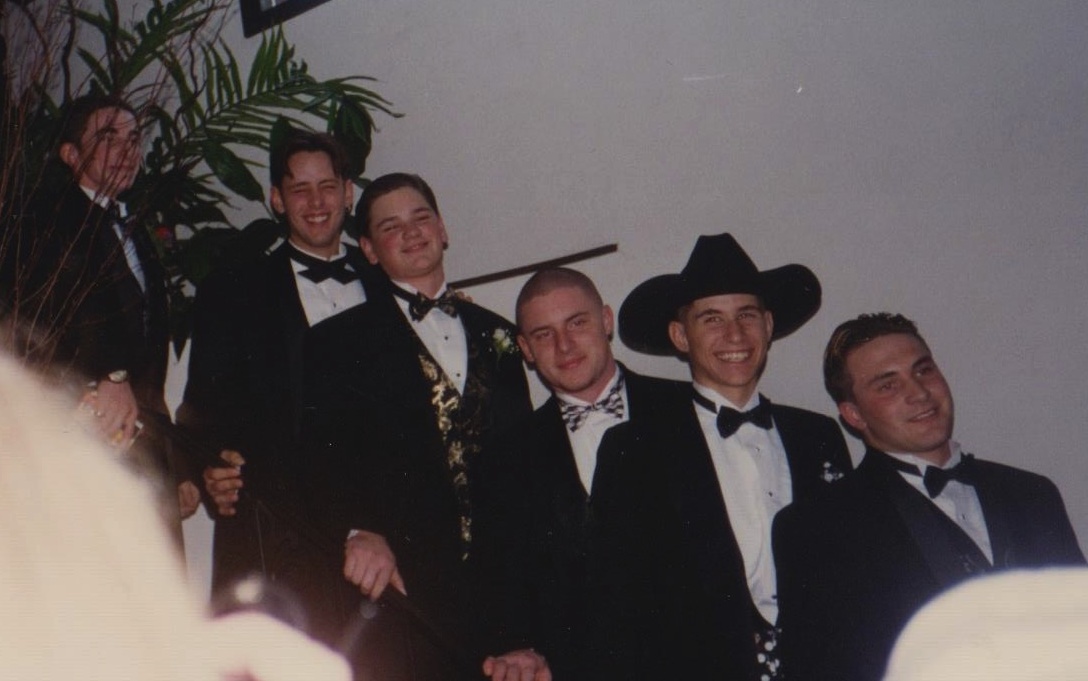
Joey Laws, second from the bottom, all dressed up for senior prom.

Joey: We got away with murder. We got away with things that no other classes got away with. When I tell people about our high school, they think I’m lying.

Me: Or we’re exaggerating.

Joey: I remember Mrs. Miller [the social studies teacher] reported us to…what was that called…it was like a system where you could report people for substance abuse? And they told her to leave us alone.

Me: Ha!

Joey: Because you know, she told them about how we were drinking beer and stuff, and they told her, “Look, these are the good kids. They’re not getting in trouble. Leave them alone…”

Me: …they’re just assholes.

Joey: So you’re interested in the Mr. Brown story?

Me: Yeah, I thought that would be another good example of how we were assholes in high school.

Joey: So, Brown was one of my favorite teachers and math was one of my favorite subjects… But yeah, there were a couple things we did to him. I was taking this new elective that he had started called “Discrete Math.”

Me: I remember that, yes!

Joey: And you know, he treated the guys in his classes differently from how he treated the girls. He didn’t make no bones about that.

Me: Yes, he was sexist for sure.

Joey: So the people in that class were [here Joey lists a group of male students]…One day in Discrete Math, Brown got up to make some copies. And we thought it would be funny to pivot everything in the room by 90 degrees. We moved all the desks…

Me: [laughing]

Joey: That’s funny, right?

Me: Yes!

Joey: We had played pranks on him before…we used to go in and change the grades in his grade book…remember he would give us those pop quizzes in Calculus? Well we would just change the grades. It was so easy to turn a “0” into a “10.”

Me: And wait, would he ever notice?

Joey: I think we did get in trouble for it once and then we stopped. But I think we made it kind of blatant so he would notice…

Me: Like you really wanted to get caught?

Joey: Yeah. ‘Cause we thought it was funny, just like moving the desks would be funny. Because, you know, we were his boys.

Me: Right, you were his boys.

Joey: We almost failed that class. He was irate with us after that. It wasn’t just like a passing rage. He wouldn’t talk to us after that.

Me: So when he came into the room, what did he do?

Joey: When he came into the room he slammed the copies down on his desk and he like, cursed at us. And then he just stormed out. We didn’t see him again for the rest of the period. He wouldn’t speak to me after that.

Me: Ever?

Joey: No. I don’t remember ever having another conversation with him.

Me: Really? But you were his favorite student. After all that, he was done with you?

Joey: Yeah, it was really sad. I even tried to look him up on Facebook because I wanted to let him know that his calculus class helped me get though engineering in college…

Me: You know everyone said that about him—that the first years of college math were easy because of his class. He was a good teacher. A misogynist, but a good teacher.

Joey: Yeah, well he never spoke to me again. And he really crushed us on the final, he gave us a really hard final that semester. You know, we took that class because we thought it would be an easy A. “Oh Brown’s gonna teach us some cool math stuff but we’re really just here to fool around…”

Me: Right…

Joey: But at some point it just, it just got to him…

Me: That seems to be the pattern in all these stories from our classmates: we would push it and push it and push it until our teachers were like “Fuck it, we’re done with you people…”

Joey: We used to mess with Walters [the physics teacher] a lot too. We had him his first year of being a teacher. Part of his long-term plan for teaching was to use the same test in all of his classes. And he was so silly. At first, he would just have them up on his desk! And we were like “Holy shit, there’s the test!” So we would sneak one out and make a copy.

Me: When were you able to steal the exams?

Joey: In between classes, or we’d go up there during lunch. I mean, he wasn’t even trying to hide it. And then it became, like a game, to see if he could catch us. He knew we were tying to steal his tests. So then he started locking them in his desk drawer. And somehow, I don’t remember how, we got the key to the drawer…

Me: Of course you did…

Joey: And he would tell us that he knew how many copies he had made, so that we couldn’t steal one. So we just unlocked his desk, grabbed a copy, snuck downstairs and made a copy, and then stuck the test back in his desk.

Me: Holy hell.

Joey: Again, at the time, we thought that even if we got caught, we wouldn’t get in trouble because it was like a challenge…

Me: I vaguely remember that, and you always did well on the exams…

Joey: Everybody did well. Remember we used to study together?

Me: I don’t remember seeing a stolen test though.

Joey: We weren’t telling people we had the test. We would just present the problems. And then you all would say, “Wow, you guys really knew what was going to be on the test!” But after we stole the key to his desk, he hit his limit. He made it so we couldn’t cheat, challenge over.

***

It’s true. Pushing our high school teachers to their breaking points was a specialty of my graduating class. My favorite example of this happened during in the spring of 1995, my senior year. At that point the faculty at STHS must have been counting the days until graduation. My gym class that semester was composed primarily of fellow seniors who were enrolled in the same classes I was taking: AP Biology, AP Calculus, AP English, etc. This—and the fact that many of us lacked simple hand-eye coordination—led our gym teacher, Ms. Jones, to refer to our class as “Honors Gym.” She didn’t mean it as a compliment.

In addition to being filled with smart kids, Honors Gym also happened to be one of the finest collections of assholes in the school. Ms. Jones would drill us in the basics of volleyball (“bump, set, spike!”) and basketball (“a girl has to touch the ball before you can shoot!”), and we would try, I think, to follow her instructions. But mostly we made fun of each other’s lack of athletic ability or recited lines from our favorite movies and TV shows. Gym wasn’t going to get us into our reach school. We were just biding our time until graduation.

Eventually, Ms. Jones gave up trying to teach us how to play real sports and allowed us to do whatever we wanted. So naturally we spent the remaining weeks of the semester playing four-square, Honors gym-style. We developed elaborate rules of play—such as requiring players to touch their bellybuttons or to laugh like Nelson from The Simpsons before touching the ball— that were complicated and expanded each week, turning our four-square matches into masochistic exercises of mental and physical stamina.

I can only imagine how Ms. Jones felt as she watched us play Honors four-square, delighting ourselves with our own cleverness. I’m sure the irony must have registered—that we refused to learn the rules to games she wanted us to play, only to invent our own, far more complicated four-square rules, which we slavishly followed as if our reach school admissions depended on it.

Ms. Jones tolerated our four-square shenanigans for several weeks until one day during class somebody said or did something that pushed her over the edge. It’s worth noting here that Ms. Jones had never been what you would call an even-tempered woman. She was the field hockey coach, and, as we lost nearly every game we played, I was accustomed to being called lazy and useless. But the Honors Gym rant was different; it wasn’t intended to motivate us to try harder or do better. This rant was intended to let us know that we were assholes. Ms. Jones sat us down on the smelly mats in a room we all called “the small gym” (though I’m sure it had a proper name), and delivered an expletive-fueled lecture. The only line I can remember—because it imprinted on my teenage mind like a groove in an old record—is, “You’re all assholes and your parents raised you to be assholes.”

The losing-est field hockey team that ever was.

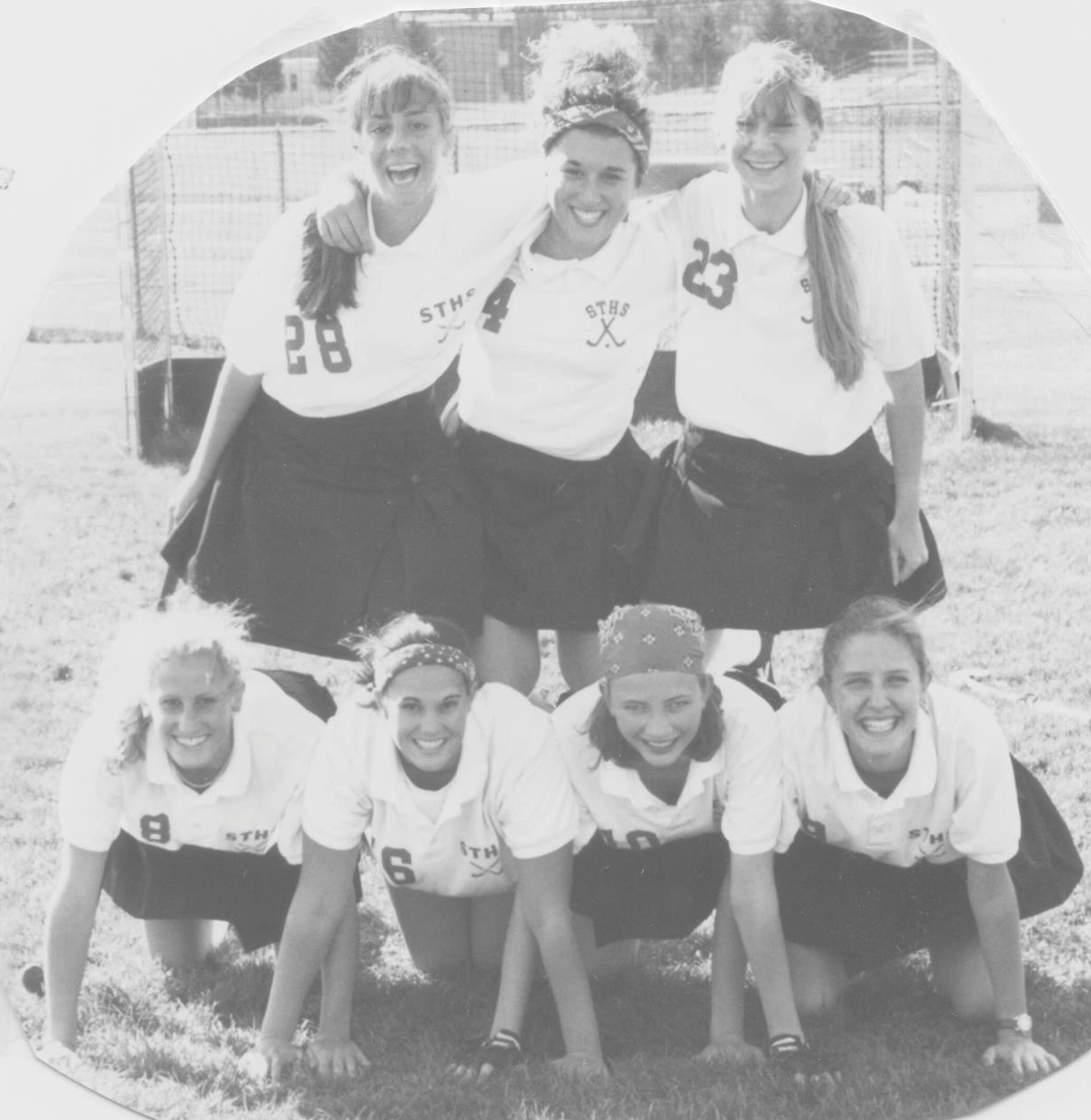
The losing-est field hockey team that ever was.

As I sat there in the gym clothes that I had not taken home for a washing since the fall, my thighs sticking to the vinyl mats that had also probably not been washed since the fall, part of me felt shamed and wondered, briefly, if we were as bad as she said we were. I’d like to say that Ms. Jones’ angry rant in the small gym finally made me realize that turning everything into a joke was a bad way to go through life. I’d like to say that it snapped me out of my cocoon of teenage privilege, out of the assumption that I could do whatever I wanted to do or be anything I wanted to be because I was young and smart and my parents were footing the bill for my very expensive college education. I’d like to say Ms. Jones’ lecture taught me to respect authority, to play by the rules, and to accept that sometimes we have to do things in life that we don’t enjoy or that we’re not good at. But instead, I found Ms. Jones’ outrage delightful. I was giddy with power—the power to cause an adult to call me an asshole, and mean it.

Of course, that sense of entitlement and fearlessness that fueled my asshole tendencies in high school was eventually chipped away–bit by bit–by the bottomless well of self doubt and loathing that is a career in academia. But even now, when I know that I’m not special, when I know that I am, in fact, just like everyone else, I’m glad that I’m still an asshole. It’s the one trait I’ve managed to hold on to since high school.

What Ms. Jones couldn’t recognize back in 1995 is that learning to be an adult is not about getting serious, accepting the rules, or learning to eat the multiple bowls of shit that life places in front of you with a big shit-eating grin. Adulthood, for me at least, has been about learning to laugh, harder and longer, at the indignities life gives us. And that’s precisely what assholes like me do best.

About the interviewee

Joey today, with his wife, Becky, and children, Jake and Maddy.

Joey today, with his wife, Becky, and children, Jake and Maddy.

Major (Joey) Laws is Deputy Chief of TITAN Operations, USSTRATCOM Joint Functional Component Command for Intelligence, Surveillance, and Reconnaissance (JFCC-ISR) at Joint Base Bolling, Washington DC. In this role, he supports the Commander, United States Strategic Command by leading the synchronization and integration of global TITAN planning efforts and the resolution of critical TITAN requirements. Major Laws received his commission from the Air Force Reserve Officer Training Corps, with a Bachelor of Science in Electrical Engineering from West Virginia University. He is married to Rebecca Morgan of Tucson, Arizona. They have two children, Madeline and Jake.

Also, special thanks to Liz Rose Triscari, Luimbe Domingos, and Matt Rovner for providing anecdotes about Mrs. Smith. You are fantastic assholes.

If you’d like to read the first edition of “Tales from STHS: Tammy’s Story” click here.

Tales from STHS: Tammy’s Story

Note: all names, other than those of the interviewees, have been changed for this story.

RAIL_1030_PAB

During my sophomore year at Susquehanna Township High School (STHS) I was required to take a class called Environmental Studies. It was a general education course, one that included a mixed bag of students, and, as in all Gen Ed courses, no one was particularly excited to be there, especially our teacher, Mr. Smith. He had a ponytail at a time when no other male teachers had ponytails, and his classroom was filled with the corpses of taxidermied wildlife from the surrounding Pennsylvania forests, all of which had been stuffed by Mr. Smith himself. He was proud of that.

I imagine that Environmental Studies was proposed by the Susquehanna Township school board in an attempt to make us more “environmentally aware”—this was right around the time I first started hearing about concepts like Earth Day, diapers sitting in landfills, and the “hole in the ozone layer”– but that’s not what this Environmental Studies class was about. This class was about whatever Mr. Smith wanted it to be about. One day we watched a National Geographic documentary about the horrors of baby seal hunting. The documentary featured soft, furry baby seals, their wet black eyes blinking in the Arctic sun, getting their heads bashed in by masked men who wanted their precious fur.

The message of the documentary—that clubbing baby seals for their fur is barbaric—was lost on us. That’s because right after we watched those baby seals get their heads flattened, Mr. Smith paused the tape and rewound it so we could watch it all again. “Look at that!” I remember him calling out, his voice edged with excitement, “Bam! Bam! Bam!” It was clear that Mr. Smith enjoyed this brutality, that, perhaps, he might like to have a baby seal in the classroom to add to the dead-eyed gray squirrels and Allegheny woodrats that peeked down at us from shelves above our heads.

Mr. Smith also once told our class that he once spent an entire semester teaching his students incorrect information. He didn’t reveal his treachery until end of the semester, after the students had studied these false lessons and taken exams on them. When we asked Mr. Smith why he would waste his student’s time and his own time, told us he wanted to teach his students to never blindly trust authority figures. Today I find Mr. Smith’s fake lesson almost admirable, a kind of anarchic lunatic protest against the drudgery of teaching Environmental Studies to a bunch of bored surburban high school students. But at the time it was a total mindfuck — we had no idea if we should believe anything he tried to teach us after that. Were we being misled about the lifecycle of the May fly? Were prairie dogs *actually* “good eatin'”? (nota bene: “Are prairie dogs good eatin” was, in fact, a true/false question on the final exam that semester).

I also remember engaging in lively debates over politics with my History teacher/track coach, Mr. Brown, a man who actually seemed at home in the dreaded short-sleeved button-down shirt-and-tie combo favored by so many male high school teachers. He was a Republican blowhard and a neoconservative before the term ever existed. I don’t remember learning a thing about history in his class but I do remember learning how to argue endlessly with cranky neoconservatives, a skillset that has certainly served me well in life. Below, some of my classmates relate their favorite anecdotes about Mr. Brown:

Dani: “I remember asking Mr. Brown for directions to Franklin and Marshall College for an Indigo Girls concert…he said we would turn into hippie lesbians if we went to the show.”

Liz: “I remember the Indigo Girls incident. If I recall he asked why we would want to go see ‘a bunch of lesbians.’”

Molly: “I was recently thinking about Mr Brown’s History class, he would tell us to read page 146, then go have meetings with sports guys who were sitting in the back of the classroom waiting for him. He would also get very angry and try to talk himself down by counting backwards from 10 or walking into the hallway to punch a locker! His class was usually amusing”

Kara: “Mr. Brown told us he was as conservative as he was because his parents were hippies and he was actually taken to Woodstock as a kid… but he was lying and trying to tell us that our kids were going to be super conservative.

Matt: “One class, Mr. Brown called us a bunch of knee jerk liberal pansies, who should have been slapped around by our parents”

Luimbe “Brown did ‘maturity training’ …heads down on a desk for 10 minutes after the bell rang because his straight-from-the-book lesson plans failed to keep our attention…That was the class where Benny the B [our classmate, Ben] dared to challenge the sanctity of Christopher Columbus’ virtue and argued for hours with Mr. Brown about it.”

Me “Lou, tell me more about Benny! What did he say?”

Luimbe “Christopher Columbus’ ethnicity was at issue. Brown vehemently disagreed with Benny’s assertion that there was some evidence or possibility that Columbus may have been secretly Jewish.”

I should pause for a minute now to say that I am quite pleased with the quality of my public high school education. I was challenged and encouraged during my 4 years at STHS and I was accepted to quality colleges (as were many of my classmates). But, still, I remain mystified by some of my teachers’ eccentricities. It’s hard to tell if we brought out the weird in our teachers, or if it was the other way around. Regardless, this post marks the first in a regular series where I interview people who went to high school with me, asking them to tell me their oddest stories. We begin this series with Tammy Tibbens Vasbinder and her experiences with Mr. Goldman, who taught History and also coached the basketball team.

 Me:

How did you find yourself in a situation where your teacher was asking you to perform Mary Poppins in your classroom?

Tammy:

You know I love that movie. I’ve probably watched it 100 times.

Why did you watch it so often?

 Um I don’t know. I just really loved the movie. I loved all the characters in the movie. I loved the singing…

And you memorized it?

And I memorized Rain Man and I memorized Forrest Gump…

 I didn’t know that…

 Yeah, all of it. Mr. Goldman would have to go and he would ask me to entertain the class…

Wait, where would he go?

 [laughing] I don’t know…

What grade was this?

 You know I should know that. Maybe 10th?

I’m going to say it was 10th  too.

I don’t know where he would go but he would have to go…[laughing] So he would ask me to take over the class.

How did this even start? What gave him the idea to put you in charge?

That’s another “I don’t know.” Sometimes it’s a little of a blur. [laughs]

But he would have me take over the class. He’d say “Tibbs”—he called me Tibbs—“Tibbs, take over the class.”

I think we need to pause here for a minute. I think it’s weird that a high school teacher would leave during his own class. That’s the time when you’re supposed to be teaching your class.

He had shit to do.

He had shit to do that was not teaching his class….Okay so he would leave and then what would happen?

Sometimes I would do Rain Man, but usually I would just do different scenes from Mary Poppins. Remember the scene where the different animals sing?

[TT begins singing the chorus to “It’s a Jolly Holiday”]

I’d do all the different scenes. And I would get up on the windowsill…

That’s the way the story’s always been told to me—that you performed Mary Poppins on the windowsill. And what did the class do? They just watched?

 Yeah, pretty much!

How long would that go on for?

Until Mr. Goldman came back.

How long is that?

Like maybe 15 minutes? [laughing]

And then he’d start teaching again?

And then he’d come back and say  “Okay, Tibbs, you’re done.” And I’d sit down.

[Liz: “I was there!! It was high-larious. Mr. Goldman was a great guy but teaching was way down on his priority list. He had basketball games to win. He was happy to have Tammy entertain us instead. It was both shocking and endlessly entertaining. I couldn’t believe it was actually happening.”]

How often would you say that happened?

 Maybe half a dozen times.

Really?

 Yeah. It was…interesting.

Do you find that odd?

 Yeah. It was a little… odd.

But you liked it.

I did like it. And actually when I took English with Mrs. Williams. senior year, she came to me and she said “Tammy, you’re failing. You’re going to have to retake the class.”

This was senior year?

Yeah. And I said, “No, I can do this.” And she’s like “No, you don’t understand: you have to get a 99 to pass this class this semester or you’re not going to graduate with your class.”

And I thought, “No I really can do it.” I really focused, I studied. I got together with all these other kids from high school…

Who did you get together with?

Um, you know…another [TT indicates that she is drawing a blank]. Maybe Talitha? I just remember reaching out to all the smart kids…

You didn’t reach out to me…[note: I said this with mock outrage]

I didn’t. I don’t think you were in my class.

Talitha was in my class….

 [laughing]

She probably wasn’t in my class either!

[laughing].

I don’t know what it was, but she was smart… So I remember the final thing that was due…

Was it a paper?

I remember writing this skit out where I was in an insane asylum and I was all these different characters. I was Forrest Gump, I was Rain Man,  and I was Mary Poppins. And I acted out the whole play.

Really?

Guess what my grade was?

99?

100. And Mrs. Williams yelled at me at the end of the year. She was saying “If you would have applied yourself….”

But I did it. And I graduated.

I remember!

 But I’m sure somebody was in that class and that they remember. And maybe the smart people who tutored me remember.

I can fact check this before I publish. I remember hearing the Mary Poppins stories and I remember being jealous that I wasn’t in your World History class. I would hear all about your performances.

 Yeah those were good times.

I think you would do it at parties sometimes, and that’s where I saw it, but I never saw it in class, on the windowsill.

 Now I’m more into rapping.

Today?

Yeah. People make requests at parties.

What do you like to perform?

 My standard is Slick Rick. The Indian story. It gets pretty…

Is it racist?

 No, it’s not racist. It’s kind of dirty. I would do it but.,..[gestures towards restaurant]

No, you don’t need to do it here.

Tammy, with her family, today.

Tammy, with her family, today.

****

Did you witness Tammy’s windowsill performances? If so, share your memories below. Also, if you would like to be interviewed about your strange and wonderful experiences attending STHS, please email us at tellusastoryblog@gmail.com and we’ll set up an interview.

About the interviewee

You probably remember Tammy Tibbens as the curly haired jokester who enjoyed playing sports and entertaining her classmates. Since high school, Tammy (now Tammy Vasbinder), has had a successful career in Sales and Marketing. She was featured in a national publication called “Radio Ink” in October 2007 as one of the top 10 radio reps in the country. Tammy now enjoys raising her two children. Keeping screwdrivers out of the wall sockets and crayons out of the clothes dryer are now her biggest accomplishments.

What Disappearing Was Like

by Brandon Dameshek

0408142028b

I spent my sophomore year waking up at 6 A.M., which allowed me just enough time to go downstairs, make a pot of coffee, toast a strawberry Pop Tart, and return to my bedroom to watch reruns of I Love Lucy on TBS. When the show ended and my breakfast was gone, I’d jump in the shower, dress, and put a variety of styling gels in my hair, a process that took me until 7:30, twenty-five minutes before my home-room teacher, Mrs. Simpler, took attendance. I wasn’t conscious of this routine until November of that year, the same month I started seeing Dr. Wendy Mynnix, a psychologist who specialized in eating disorders.

I was living primarily with my mother and step-father, though I’d occasionally spend the night at my father’s house. My mom began pointing out what she called “noticeable differences” in my personality. It was her way to criticize, as maybe it’s any Jewish mother’s way – it was done “out of love,” not malice. I’d sit in the unlit basement – my face awash in television glow – and stare purposely away as she called me “listless” and “disinterested.” She was right. I didn’t want to be hugged or touched.

My dad, on the other hand, noticed something else completely.

“You look thinner,” he’d say, week after week.

It didn’t bother me that he thought I looked like I was losing weight. I was the butt of several fat jokes my freshman year. (My friend, Heather, once called me a dump truck.) I wasn’t fat in the typical sense; I simply had some extra weight in the face that accompanies puberty. When you’re 15, though, fat is fat, and other 15-year-olds won’t let you forget it.

“You must be hungry,” my dad would note.

I grew up in the shadow of an older brother who, back then, was not only handsome, but was said to look like Tom Cruise. It was 1990 – four years removed from Top Gun – and I was sharing a bedroom with Maverick. It seemed every girl – his classmates, my classmates, girls from other schools, girls from other countries, imaginary girls who didn’t exist – wanted him. What they didn’t want – what they couldn’t want – was a 15-year-old blob. Of course, I wasn’t a blob, but that’s how I saw myself. It’s only now I know any better.

It became ever harder to ignore during gym class, especially in the locker room. I started noticing that some of my classmates had muscles – real muscles – in their arms, legs and chest. They talked about running and lifting weights and getting in shape for whatever after school sporting event awaited them. And then I’d look at my undeveloped self. I wasn’t sinewy or muscular. I was shapeless, like an amoeba. They looked like men; I looked like the Shmoo – like I’d just stepped out of a Li’l Abner cartoon.

“Are you trying to lose weight?”

What irritated me about my father’s comments was their frequency. He’d hug me and note my back feeling “bony.” Every meal was served with the catchphrase, “Is that all you’re having?” He eventually started to notice a lack of interest on my part in anything but exercise and coffee.

In our first session, Dr. Mynnix didn’t take any notes or remove and replace her glasses with every answer. She never piped up and asked, “Do you have an eating disorder?” Besides, I wouldn’t have known the answer even if she did. Instead we just talked – about school, about home. Normal things. Boring things. Ironically, after a couple months of shutting myself off from my friends, my parents, and the rest of the world, I decided almost immediately that I’d found someone with whom I could speak candidly.

Shortly before Christmas vacation, Wendy moved her office to the fifth floor of the Harrisburg Hospital. I stepped off the elevator with my father and felt every eye on me. The reception area was littered with mothers and their children. One boy threw a Lincoln Log at another. None of them stopped their hollering or put down their plastic blocks to notice me; the parents, however, stared. My dad tried to talk to me about the approaching Super Bowl (Giants/Bills, I think?), but all I could hear were those kids – screaming and running, throwing stuffed animals and crayons across the room.

And then, at last, Wendy. Along with her new office came a new line of questioning.

“Are you overly neat?”

I was. When I slept at night, the covers had to hang evenly off both sides of the bed, myself perfectly centered on the mattress. I’d lay there, arms outstretched at my sides, pinching the sheets between my fingertips to ensure they were equidistant from the bed’s center. When bathing, the stream from the shower head had to hit me directly between the shoulder blades. I’d reposition it time and again to make sure it, and I, was centered

“Do you spend a lot of time by yourself?”

Well, yes. I had become so completely detached that I’d wait for the house to be empty before I ever came out of my room. The idea of having to interact with anyone terrified me.

“After speaking to you for over a month now, Brandon, it sounds fairly obvious to me that you’re suffering from anorexia nervosa.”

Wendy pointed to the radical weight loss, the depression, the sense of not having control, the detachment from others. I doubted her still, until she handed me an essay on anorexia. I lingered over the highlighted passages as if reading my own journal. I felt embarrassed and ashamed.

Wendy asked my dad to join us. She repeated nearly everything she had just told me. Every time my dad spoke, his voice cracked.

When I returned to school in January, I was forced to become better acquainted with the school nurse, Mrs. Rawls, the mother of two state wrestling champions who graduated from my high school. She was a lean woman with “secretary” hair and a slight southern drawl. Wendy had spoken to her before school was back in session and, to my dismay, enlisted her: Mrs. Rawls was to not only weigh me once a week, but was to have me report to her office – a cold, first-floor room that reeked of cheap tongue-depressor wood – every day between second and third period to have a snack. It didn’t matter what it was, provided it had a set amount of calories. Lettuce, for example, was out of the question. So I ate things like peanut butter & jelly sandwiches and candy bars, and when I “forgot” to bring a snack, Mrs. Rawls marched me to the cafeteria to buy one. The worst part about it was that the only people in the cafeteria at that time of day were me, Mrs. Rawls and the lunchroom employees. They always looked at me funny, but never said a word. Mrs. Rawls never told them why I was there.

It was humiliating.

Image by Coral Staley

Image by Coral Staley

One day, following my second period Chemistry class, I skipped my visit with Mrs. Rawls. Ten minutes into third period, an announcement came over the public address system: “Will Brandon Dameshek please report to the nurse’s office? Brandon Dameshek to the nurse’s office.” My friend Brian, a workout fanatic we dubbed “Solo,” after the then wildly popular Soloflex home gym, asked why I’d possibly been called to visit the nurse.

“I have no idea,” I lied.

As the year and its rituals progressed – my sessions with Wendy, the weekly weigh-ins and snacks, the positioning of the shower head, the straightening of the sheets – my weight actually dropped. I had reached an agreement with Wendy that it wouldn’t dip below 112 pounds. If it did, Mrs. Rawls was to notify Wendy immediately who, at times, had reluctantly threatened me with intravenous feedings. (A friend of my dad’s, also a psychologist, suggested I start putting rocks in my pockets before my weigh-ins.)

One morning, I stepped on the scale in Mrs. Rawls’ office. It read 110 pounds. She looked at me, disgusted. I begged her not to tell, practically crying. She had no choice. I collapsed into a chair, alternating my gaze between her face and the scale’s, unsure as to which one terrified me more.

It was August. I was 16, and both Wendy and my parents were at their wit’s end. The counseling wasn’t adding weight to my frame, nor was my parents’ pampering. My options were then stripped away entirely.

For one of the only times since they divorced when I was 10 years old, my mother and father were driving to the same place. I sat in the front seat of my mom’s silver Ford Tempo while my dad followed in his Dodge Omni, the three of us on our way to an institution in Baltimore. I don’t remember its name, but I knew why I was going.

A doctor in a white coat took us on a tour of the facility – an enormous brick building nestled back between the trees, somehow reminiscent of an Ivy League school – pointing out the dorm-like rooms and the many kids wandering its halls like ghosts. The floors looked newly-mopped and smelled of Murphy’s Oil Soap. Everything was immaculate. The doctor told us that patients were there for everything from eating disorders to suicide attempts. He smiled the whole time. He was proud of his “rehabilitating” kids. The tour lasted for over an hour, and my mom and dad bombarded him with questions. I said nothing. I barely blinked. I moved in and out of its many rooms as if floating.

When the tour ended and we returned to their respective cars, my parents asked me what I thought.

“There’s no fucking way I’m coming here! This is bullshit! Fuck that, no way!”

I had never said “fuck” in front of my parents, yet suddenly it was the only word I knew. I cried. They reached for me, but I struggled free of their grips. I didn’t want their sympathy or any institution that locked kids away and forced them to get well. I said the only think I could think of: “I promise I’ll start eating. I promise, I fucking promise! I promise!”

They never checked me in. In fact, my sessions with Wendy ended soon after. It’s been 22 years and I haven’t seen or talked to her since. After that trip to Baltimore, everything changed. I kept my promise and actually started to gain weight. I forced myself to eat, to be more personable, to do things with friends. And by doing all of those things I discovered I was happier. It was difficult at first – stepping on the bathroom scale and watching the counter-clockwise rotation of the numbers as my weight slowly increased. A pound to me may as well have been twenty. But I knew that if my weight kept going up, the idea – even the mention – of Baltimore would gradually waste away. And it did.

The author today, pictured with a plate of meat.

The author today, pictured with a plate of meat.

I wish I could say that I was cured – that I’m no longer anorexic and don’t obsess about food – but that would be a lie. I’ve never eaten a meal without at least considering the calories. I’ve never looked at myself naked and been truly happy. Not even once. I watch my 9-year-old daughter eat her dinner and think, “Is that too much food? Not enough?” I worry myself sick that she might one day waste away, or hover over a toilet with a finger down her throat, or, worse yet, lock herself in her bedroom, away from the world, where no one can get to her. I am relieved, though, when I see her towel in a heap on her bedroom floor, and her clothes stripped from her hangers and tossed aimlessly across her comforter. There is this part of me that breathes easier knowing that my little girl’s a slob, and that maybe she’ll never need to stuff her pockets with stones.

 About the author

Brandon Dameshek’s poetry has appeared in Cimarron ReviewColumbia Poetry ReviewHarrisburg ReviewCoe ReviewPortraitConte and, most recently, Wildwood Journal. Dameshek holds an MFA in Creative Writing from Emerson College. He now resides in Camp Hill, PA, with his wife, daughter, and dachshunds.


Who I Was and How I Came To Be

by Will Brooker

Untitled

I used to keep a diary. A diary is a map of your old life.

I used to live in Cardiff. On Connaught Road. Can you see it, on the map? Strung onto that constellation of resonant names: sapphire, topaz, silver, planet, emerald, star. Like a science fiction universe: a map of manyworlds, of infinite earths. A roll-call of superheroes.

Wait, Connaught Road isn’t on that map – that photocopied and enlarged A-Z from fifteen years back. Wait while I…
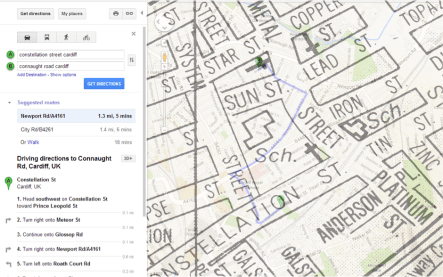
Untitled2

Wait. Here it is. Sometimes the past slips and skids away.
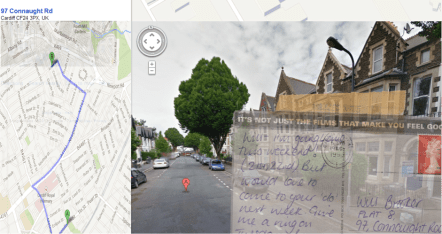
Untitled3

Here it is. Here’s the street where I lived. Flat 8, 97, Connaught Road.

But that was 1998, and this story begins in 96. Let’s start again.

I used to keep a diary. I’ve kept many diaries (though some are lost).
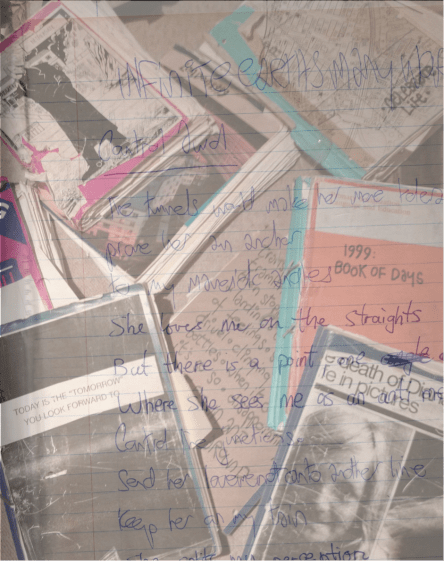
Untitled4

I’ve kept many diaries.

Untitled5

This is the one I should have started with.
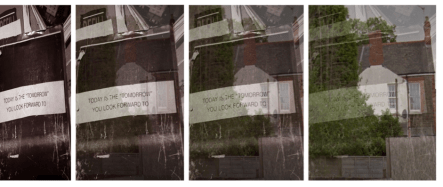
Untitled6

This is the one. This is the place where it began.

Cathays Terrace is a scruffy, scrubby long road, five minutes from Cardiff University. You could tell how long people had lived there by whether they could pronounce the name of the next street, Crwys.

Cathays itself is one of Cardiff’s student zones. It has a tiny railway station, the size of a tilt-shift miniature, where trains stop outside the undergraduate club, The Terminal.

I’d come up from London in 96. I’d grown up in London. Cathays – and the surround of Cardiff itself – seemed a small world, to me. It suited me perfectly. I felt I could master its map.

That was arrogant. But, you know. I was twenty-six. When else can you be arrogant?

Untitled8

Now we begin. (And it’s my story, so I get captions and a narration, obviously.)
Untitled9

Wait. I was still blond at this point. My hair was yellow like a block of vanilla ice cream.
Untitled10

It doesn’t look like much. They film Doctor Who around here now, and pretend it’s London, but it doesn’t look like London; not even the scruffy parts of London I was from. The houses – even the windows and doors – are smaller. The sky hangs lower, always threatening rain.

The picture above doesn’t actually show my road, Cathays Terrace. I had to manoeuvre Google Street View around the corner and swivel its virtual camera back, to find my own origin point. That window in a white wall. That’s where I stayed.

It was a tiny room – a tiny room divided in two with a thin partition. People joked that it was my Batcave, but I used to call it my cell. There was a shower in a cupboard and I shaved at the kitchen sink, using a plastic mirror propped against the taps.

There was no internet – no personal internet, no going online at home. But the university had 24-hour computer rooms with sluggish 484s, scattered around the city, and I knew where they all were. I added them to my map. I spent twelve hours there at a time, 5pm to 5am, and walked home at sunrise; I slept until 10.

Social networking then was done through notes, postcards, landlines. Somehow – because I was from London, because I was 26, because I was doing a PhD (because I was doing a PhD on Batman) I became the kind of social kingpin I’d fantasised about when I was a sixth former, watching 1980s party movies. Those diaries are a collage of phone numbers with lipstick prints.
Untitled11

What can I say. I’d spent my teenage years reading feminist science fiction, programming in BASIC and doing my homework. I’d spent most of my early 20s painstakingly plucking my eyebrows and being chatted up by businessmen in cross-dressing clubs, like someone from a Lou Reed song. Now Cardiff offered me the chance to be a kind of small-town Bruce Wayne. It was a fun role to play, at the time. It isn’t an interesting story to tell.

What’s more interesting is that I was only this poor-man’s Bruce Wayne by day – and for the sociable part of the evening and night. Nightlife, in Cardiff at least, ends by about 3am. The day doesn’t start – the cleaners don’t wake up and leave for work – until a couple of hours later.

In that time – during that unsociable slice of night – you can be almost alone in the city. And in a small city, you can cover a lot of ground within two hours. You can get a lot done.

You can cover a lot of ground if you run. And I ran every night.

Of course, people asked me if I wanted to be Batman; if I had the costume, if I had the car. I denied it, because look at the Batman everyone knew, back then.
Untitled12

A strange thing happened, though: the day after I saw Clooney as Batman at the Cardiff Odeon, I went to another film called Metroland, at Chapter, the city’s art cinema – on the outskirts of town, across a river bridge, hidden at the end of a park.
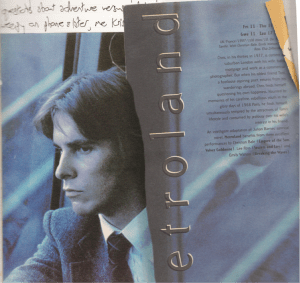
Untitled13

A strange thing sometimes happens, in diaries; especially diaries with thin pages.

One page sometimes bleeds through to another.
Untitled14

Today is the ‘tomorrow’ you look forward to.

Anyway. This wasn’t my Batman, at the time.

Officially, I embraced the Batman of multiple, mosaic earths. My kitchen was plastered in postcards of Adam West. One metre along the wall, where it became my living room, there were framed images of the Animated Series Batman and Frank Miller’s Dark Knight of 86. Another few steps across my cell, and the mantelpiece by the shower cubicle was decorated with a print of Tim Sale’s Long Halloween Batman from the late 1990s.

But these weren’t really the Batman I connected with; the Batman I aspired to be. You couldn’t be those Batmen. They were too professional, too slick, too rich.

Untitled15

But you could be this Batman, from Brian Augustyn and Mike Mignola’s Gotham by Gaslight. He wasn’t a billionaire or a technocrat. He was just wearing a big coat with the collar turned up, heavy boots, and leather gloves.

I already had a big black coat, which I wore with the collar turned up. I bought black heavy boots and black leather gloves. That was easy: The Matrix had just come out, and Neo-style outfits and accessories were popping up in the indie shops next to Spillers Records, on Canal Street. You couldn’t buy Batman t-shirts at the time, so I scanned a logo from the back of a comic and had it printed onto a tight grey top.

I still went out, as normal, as a civilian – to the Terminal, to the Rummer, to the Clwb Ifor Bach – then came home at 3am, got changed and went out again. I lived mainly on oranges and bread; baguettes from the Tesco bakery at opening time, shoved still-warm in my mouth as I walked home. I started sleeping until 2pm, waking myself with espresso the colour and thickness of tar.

In the afternoon, I trained. I stopped listening to indie pop and began lifting weights to a soundtrack of Tricky, Chemical Brothers and Prodigy.

After a while, I stopped going out – that is, I stopped going out socially. I just went out…antisocially.

When I say I went out: I mean, I went out of that window. That back window in the photograph. And across the garage roof below, along the wall, and down to the street.

I knew a lot of people and a lot of places. I had a lot of contacts, a lot of keys, a lot of door codes. I was twenty-six. It wasn’t a large city. I could cross it in twenty minutes.

I didn’t do anything wrong. I was being Batman. I was gathering information. That’s what Batman does: he’s a researcher.

I didn’t do anything wrong. At least, I didn’t think I was doing anything wrong.

Something happened, later, but it really wasn’t my fault.

I stopped the training, the night-time patrols, but not because I’d done anything wrong. I stopped because I’d become too well-known. First in Cardiff, after I gave a lecture on the Dark Knight from 1939-99 – Y Marchog Tywyll was the headline (in Welsh) in Gair Rhydd, the student newspaper – and then beyond, as the media picked up on the story that someone was doing a doctorate in Batman.
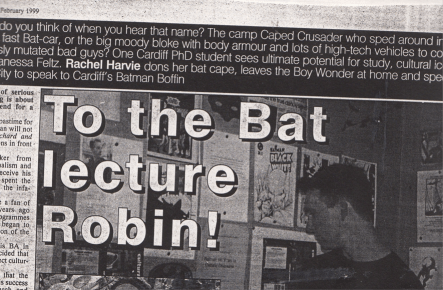
Untitled16

I’d enjoyed being a local face, a familiar name on a small scene. Suddenly I was getting calls from the BBC and invitations back to London to appear on TV. For the first time in my life, companies were paying me to take cabs and stay in hotels.
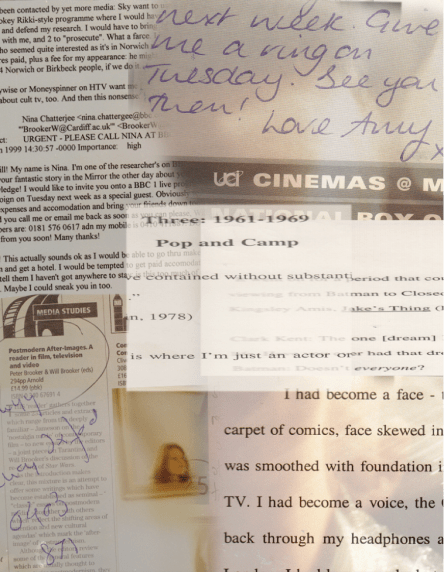
Untitled17

I moved to a far larger flat on Connaught Road. I had a steady girlfriend now. I bought things like matching cups and plates. Fridge magnets. Bottle stoppers. Things like that. I finished my PhD. I applied for jobs.
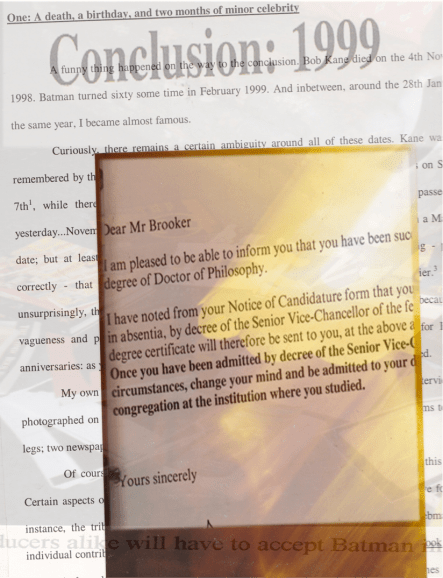
Untitled18

I got a job. It wasn’t as easy as that makes it sound, but I got a job. I moved back to London. I became an assistant professor. My thesis was published as a book. I became respectable, on the surface at least.

It was the twenty-first century now. People had internet at home. I joined discussion forums. I checked them with my first coffee of the day, before work. I wore a suit now.
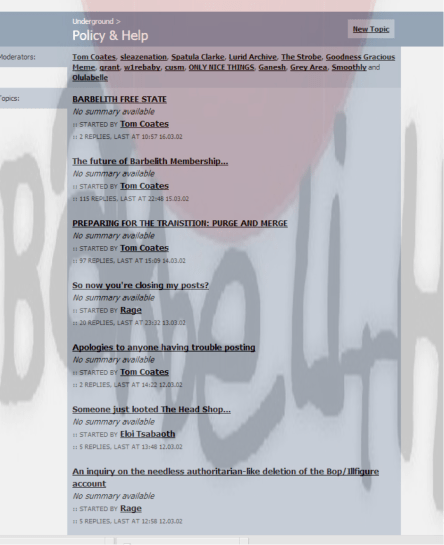
Untitled19

Barbelith was a progressive, intelligent site named after a scarlet satellite – a cosmic stoplight – from Grant Morrison’s comic book series The Invisibles. It was a supportive community, but tightly run and strictly policed. I posted on there for many years, first as myself and then, changing persona to give myself more freedom, under a female name. That name may have saved my career.

Barbelith was tightly run and strictly policed, but someone managed to sabotage it. His name circulated on the discussion boards like a curse, a word of power. His original handle was ‘DisInformation’, and people even became superstitious about invoking it: they referred instead to DisInfo, or The Formation.

I can’t remember the details of his strategy: a back-door exploit that took advantage of the ‘forgot your password’ facility, and mailed the details of regular board members to his own multiple accounts. But the community lived in fear of this guy, who had discovered the real identities behind their codenames and contacted their employers.

Nobody was doing anything wrong exactly. But it was a board based on Grant Morrison’s The Invisibles, and most everyone on there styled themselves as a member of Morrison’s subversive superhero group, a real-life extension of the fiction. There was a lot of discussion about chaos magic, ritual drugs, sexual fetish, political protest. Not the kind of thing you talk about at work; not if you have the kind of job where you wear a suit.
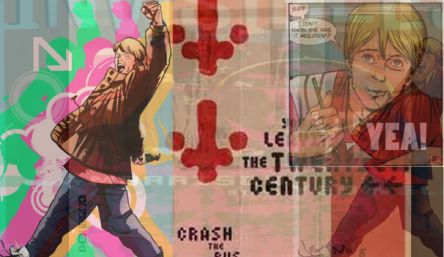
Untitled21

Like me, most people on Barbelith were living a double life, a secret identity, a phantom existence behind the official day-to-day. Separate pages in a diary. But sometimes pages bleed through.
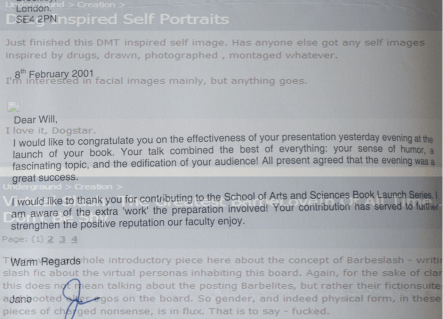
Untitled22

Most people on Barbelith were living a double life. Unlike me, most of them hadn’t genderswapped.

Except, it turned out, for the guy causing so much trouble. He emailed the site manager, Tom Coates, under the name ‘Andrea’, and confessed the password exploit. Their correspondence was made public.
Untitled23

Barbelith had a private message function, a back-channel behind its public discussion forums. Messages flew back and forward between the moderators, the manager and the veterans, sharing and collating information on DisInformation; trying to claw back some power from this guy who seemed to know everything about them. They pieced together details about his identity, and frantically pasted it into a dossier. One private message bled through to the main boards, posted in the wrong place by mistake, and before it was deleted, I saw a name I recognised; starred out like a curse word (‘A***** C****’) and then repeated, uncensored.

I recognised it, and the boundary between two worlds, the real and the virtual, suddenly collapsed. The barriers I’d imagined between Barbelith and my professional life, I realised, had never truly existed. I recognised the name from one of my class registers. The guy under the name DisInformation was a first year student called Andrew. I taught him.

I went through all my posts that morning, erasing and revising any giveaway clues – I’d even written about a specific class, on John Ford, that Andrew had taken part in.  Barbelith was a large discussion board, and I hoped he hadn’t read every detail. I emailed the moderators, the manager and the veterans, telling them I knew who this Andrew was; I knew his email, I knew what he looked like, I knew, roughly, where he lived. They invited me to their private discussion room and took my evidence very seriously. It was exciting, like being a boy witness surrounded by grave but kindly policemen. They thanked me for letting them know, and said they would act on it.

Then I went to work, and taught Andrew as usual, except of course nothing was usual and nothing was the same. Whenever he spoke, I studied his face, wondering what he knew about me; wondering if he knew I knew.

At the end of class, he approached me at my desk, and I prepared myself. But he just gave me a video cassette – this was 2000, or ‘the year 2000’ as we said at the time – and awkwardly told me he thought I’d find it interesting. I imagine we both blushed. Fortunately, he left the room.

In fact, I later realised, he left the university that day.

I watched the video at home. I couldn’t screengrab it, of course. It was a video, on a television. But I took a photograph of it, on freezeframe, then had it developed and stuck it in my diary.
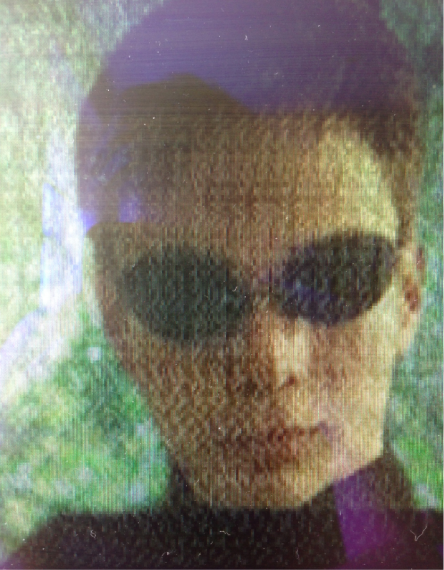
Untitled24

He was in a forest, dressed like Neo from The Matrix. There was a lot of rhetoric about conspiracies, government cover-ups and what humanity would need to do to survive in the 21st century; the kind of thing he wrote on Barbelith. After ten minutes, I fast-forwarded it to the end. Nothing but static and snowstorm.

Andrew dropped out from college, and DisInformation was finally banned from the boards. I never heard from him again, though I searched for his name a few months later (I would have said I googled it, but it probably wasn’t Google, at the time) and found a blog of travel photos, showing him in various locations around the world.
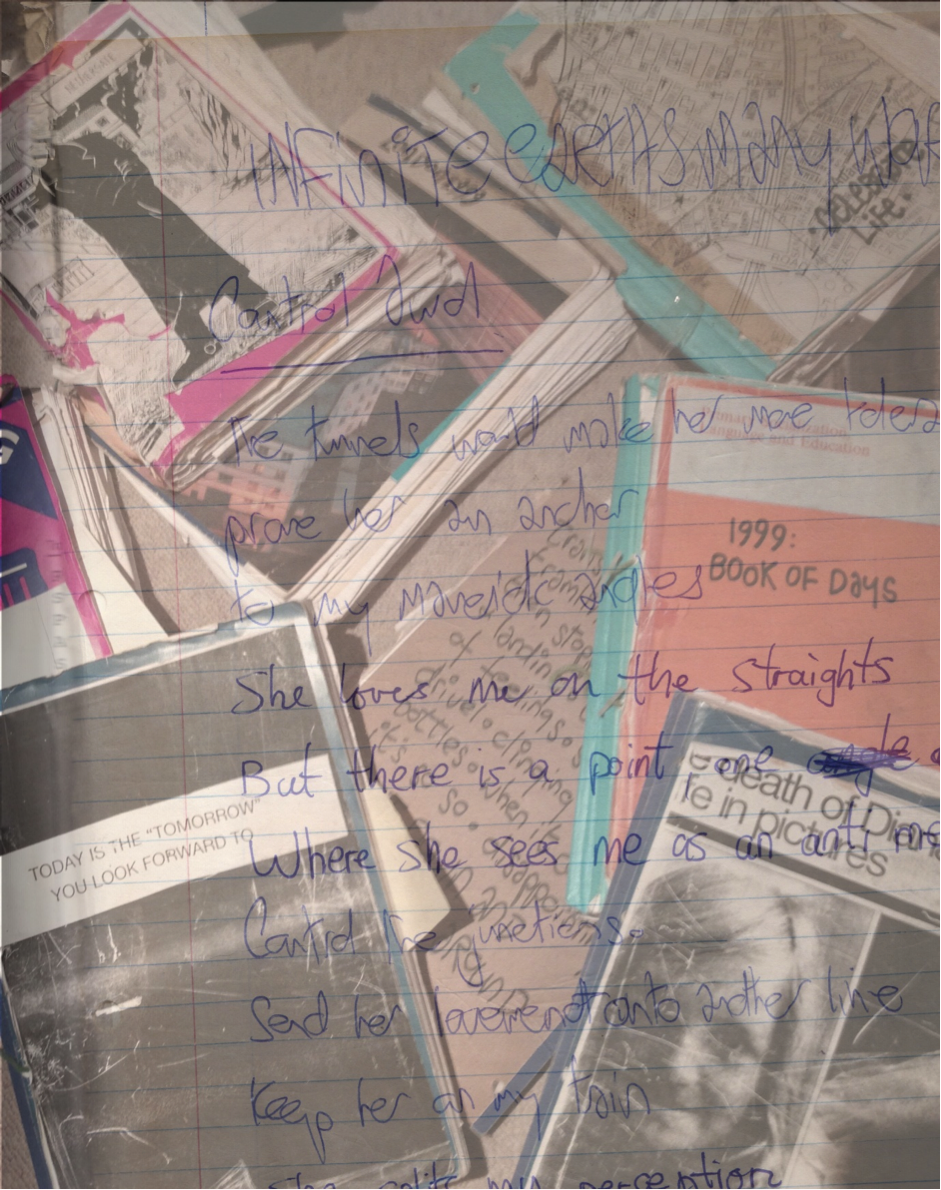
My credibility was boosted on Barbelith and I became regarded as one of the big players, the iconic characters, until the boards declined and collapsed, overrun with spam and deserted by the regulars. You can check it out now at www.Barbelith.com and see what I mean. My old posts are still there. In the real world, I got promoted and continued to climb.

I wish I could give you a better story. I don’t know how much Andrew knew of me; whether he’d witnessed my branding as ‘Dr Batman’ and decided to make himself into a kind of online supervillain, a worthy enemy. He was Welsh, and he could have been in Cardiff at the same time as me; he would have read the local newspaper stories, even seen my lectures. Perhaps the whole online performance was for my benefit. Perhaps that’s vanity, and the crossing of our paths, online and in real life, was just coincidence.

I’d like to give you a better story, a better ending. But this is a true story, and true stories never end.

About the author

Will Brooker is editor of Cinema Journal and author of several books including Batman Unmasked (2000) and Hunting the Dark Knight (2012)