I’ve never punched anyone in my life. Nor have I slapped anyone. I don’t believe in spanking children. I’ve defended myself with a quick mind and a sharp tongue. My family moved out of Queens before I reached the requisite age of teenage girl hair-pulling fights on the Q29 Express bus. I’ve almost never had to use my hands to get out of trouble.
Just once, actually. Twenty years ago, I’d been fêted by colleagues with drinks on the last day of my job. A lot of drinks. Lost-count-of-how-many-drinks kind-of drinks, at the kind of goodbye party where your colleagues are no longer your colleagues, and feel comfortable telling you the dirtiest details of their lives, now that everyone’s guard is down and you’re a few bottles into the evening.
By fête’s end, it was just my newly-ex-boss and me, sitting on padded stools in a bar in Chelsea. We’d just ordered another God-awful round of drinks. He had a drinking problem. I knew that from Monday morning meetings. I just didn’t know how bad his drinking problem actually was.
I lit a cigarette and waited for our order. He looked at me, and asked why I was leaving him, in a mock-sad voice with a pouty face. I smirked. What the hell was he talking about? I had explained all of this when I resigned. My husband had a job opportunity in San Francisco. I had to go with him. There was a ring on my finger. I loved the man.
He stared at me. He repeated himself, this time in a colder, more serious tone. Why are you leaving me? And then he slapped me across the face. Hard.
I was stunned. Literally stunned, as every person in the bar moved before me in psychotic slow-motion ballet. I’d been hit across the face. A man hit me. That had never happened before. That had just happened. The mind registers such events out of sequence.
I turned back to him, my face frozen in the open-mouthed position it had assumed when his palm struck my cheek. He was sneering at me, and he actually raised his hand to me again. He actually had it held up in the air to strike me a second time.
I caught his wrist with my left hand as it came down — my good hand. The one still holding the cigarette. High school softball drills surfaced to defend me. I held his wrist between my thumb and first two fingers in a vice-like grip that I didn’t know I was capable of. I felt surges of blood pulsing in the veins between his weak wrist bones. Maybe it was from my own fingertips. I couldn’t tell. My heart was erupting out of my blouse.
I held his arm on the bar. I didn’t cry from the sting. The alcohol must have numbed the pain somewhat. Instead, I told him, quietly and plainly, that if he ever did anything like that again, to me or any other woman, I’d leave a cigarette burn so deep in his hand that he’d never forget me. Ever. I’d do it right then and there if he thought he couldn’t keep that promise. I stared at him until I watched tears form in his eyes. I was bluffing. But I had to seem as if I meant every word. I had to make him stop.
Our drinks arrived just then. Somehow, the bartender had missed the slap. I let his arm go, walked out of the bar, propelled by a tsunami of adrenaline, and hailed a cab.
About the author
Kathleen Harris is a writer, native New Yorker, wife and mother living in northern New Jersey with her husband and two children. Some of her work has appeared or is forthcoming in Creative Nonfiction, The Rumpus, Full Grown People, Huffington Post, McSweeney’s, Literary Mama, and Family Fun Magazine. I’ve also been named as a Glimmer Train Press short story finalist, and as a three-time finalist at the Woodstock Writers’ Festival Story Slam.
It was me, Terri,
my best friend Binky,
and whatever guy she was dating at the time.
I think it was Chad.
On a nondescript summer evening
We loafed about our
sleepy midwestern college town, where
nothing ever happens around here,
GOD!
Someday we were all going to
get the hell out of this place, but
tonight
we were sixteen years old
and there was nothing to do.
Chad, let’s call him Chad,
wanted to impress us all
with his urban exploration skills, so he said, You want to see something cool? He took us around back of the Ideal Diner,
where they’d kicked us out for cramming
eight teenagers in a booth every day after school to
split a single basket of fries and make a
general nuisance of ourselves.
It was really dark back there.
The weed colony
obscured a vast collection of
furniture skeletal remains and
unidentifiable rusty objects.
Chad scaled a drain pipe on the back of the building like
a monkey
or Spiderman
or Evel Knievel,
and we three girls looked at each other
in doubt and trepidation
and dare.
I’ve never been too good with heights,
but I’ve always considered myself
macho
Binky, the girlfriend,
had to go first.
That’s just how it was done.
I followed her with false courage,
Terri brought up the rear.
At the top, Chad beckoned us to follow as he
slid across a narrow ledge that ran
along the brick wall that lined
a seemingly bottomless courtyard that came
between us and the rooftop
where Chad now stood.
He’d done it so fast
like a tightrope walker or
a monkey.
But we were teenage girls, not gymnasts,
so we lined ourselves up holding hands,
me in the middle,
our backs to the wall,
facing the bottomless courtyard
from which grew an elm tree
not three feet in front of us.
We sidled along this tiny ledge,
just a few inches wide,
our toes hanging over abyss
very
very
slowly.
There was nothing to hold onto,
but two hands.
I pictured plunging into the darkness onto
rusty shapes or dining room chairs
or whatever lay below,
so that’s what I did.
I tipped,
unable to stop,
ever slowly forward,
watching myself tumble to unknown.
At the last moment before my feet lost their purchase,
I grabbed the tree.
There was no coming back from this,
no reverse momentum I could imagine.
I hung at a 45 degree angle from the wall,
feet gripping the ledge,
hands clutching feeble branches,
Binky, whom I’d inadvertently pulled along with me,
hanging from my arm over the chasm.
As I accepted that she would surely soon fall to her death,
and I might be able to swing out to the tree,
but I’d most likely fail, she said, Hey, there’s another ledge down here.
It was not twelve inches below us;
a good couple of feet wide.
You could walk it leisurely facing forward,
for chrissakes.
She let go of my arm,
just
standing there,
and I dropped down easily,
death faced and overcome.
Chad, when challenged,
admitted he knew about the other ledge, but That one’s not as fun.
When we reached him,
I choked him to death.
Or at least I pretended to.
And we all looked out over the cornice
of the Ideal Diner,
two floors above the street
at the cars below.
There wasn’t really much to do after that.
We didn’t stay up there long.
About the author
Thadra Sheridan is a writer and performer from Minneapolis, MN. Her work has appeared in Rattle, The Legendary, Specter, Blotterature, The Pine Hills Review, Abyss & Apex, on Upworthy, HBO’s Def Poetry Jam, Button Poetry, and in several anthologies. She is a recipient of the Jerome Foundation’s Verve Grant for Spoken Word and a past weekly columnist for Opine Season. She reads her live stories regularly at live storytelling shows nationwide such as The Moth in St. Paul, MN and Story Showdown in Oakland, CA.
Since we opened our doors nearly 3 years ago, Tell Us A Story‘s mission has been a simple one: to publish stories about “true things” once per week, every week. We loved that model, and the way it allowed us to focus on one writer’s story each week.
But as we begin year 4 of the blog, we wanted to try out a new approach: we are shifting to a quarterly format. That means we will still be bringing you the best true stories we can find, but we will publish these stories 4 times per year: in the fall, winter, spring and summer.
We feel this new format will better accommodate submission cycles as well as our own busy lives.
We will close out year 3 with a few of our favorite recent submissions, then we’ll be back in the fall with our new quarterly schedule. Next up? “Fifty Years Later” by R. W. Haynes, first published on January 13 2016:
***
Fifty years later, the writer reflected that it might not have been such a good idea to drop acid before the high school graduation rehearsal, but, by then, there was nothing more he could do than remember and regret, if regret is the right word, because there was some curious pleasure in recalling the consequences of that decision, if decision is the right word.
He remembered the ceremony itself, with Billy Bonstead*, who had also missed the rehearsal, marching a few students ahead in line with an air of having marched toward academic excellence many times before. And he remembered how the principal growled fiercely, his glassy eyes bulging with vindictive vindication, standing there with that pathetic diploma case as though it held all happiness, all futurity, all the silly bullshit that academic (if that’s the right word) bureaucrats pretend they have a death grip on.
As the writer told his students long afterward, he had replied with two words, the second of which was “you,” but the first of which was not “Thank,” even if it ended with the same letter. It happened that there fell one of those unexpected moments of total silence just as he reached the principal, so his words sounded like a war cry on the ancient steppes of Russia and were followed by a horrific gasp from the audience. He had taken the half-extended diploma case from the furious principal and walked on off the platform, noting with embattled pleasure the smile on the face of John Quincy, the student walking just ahead of him in that glorious parade.
John was one of the first black students to graduate from Suwanoochee High School, and he had had a fair amount of hell from the rednecks and the administrative stuffed shirts. There had been a kind of lifting of shadows at that moment, possibly for many present, but as surely for John as for himself. As the closing invocation began, John lifted up his resonant voice in a powerful farewell to the school and his persecutors (more gasps), and it was easy to tell he had much sympathy among his fellow students as he announced at some length he was signing off.
What was most memorable about the night which had produced the outrageous non-attendance at the rehearsal was that on the radio was played again and again a strange song which seemed to reach to and from an unanticipated world. “The Israelites,” by Desmond Dekker and the Aces was the first Jamaican song extensively aired in the region, and it appeared to have hypnotized one or more of the late-night disc jockeys on local radio stations. Perhaps chemically-stimulated susceptibility lent it a mystical profundity that made the antics of school administrators loom even smaller than those of ants (or ticks) and inspired defiance of petty tyrants in stoned brains.
Outside the football stadium where graduation was held, the writer had parked his father’s Ford station wagon, his parents having come in the family’s other car, and he headed briskly for it, meeting Billy on the way. It had been reported that the head football coach had encouraged some of his players to give graduation haircuts to some of the more visible hippies, and Billy was evidently mindful of the need for all deliberate speed as he extended his hand in congratulation. Billy also had Desmond Dekker stuck in his mind as well, as he danced a step and sang “We don’t wanna end up like Bonnie and Clyde….”
“Watch your back,” said the writer, and Billy replied “Always.” The writer went on to the station wagon and got behind the wheel. He reached down and took up the double-barreled 16-gauge, opened the glove compartment and took out four #4 shells, loading one into each barrel and putting the others on the seat beside him. He waited about twenty minutes before he realized that no one was coming. “Good thing nobody did,” he said to himself, fifty years later.
*All names have been changed in this story.
About the author
R. W. Haynes is a professor at a South Texas university, where he teaches Shakespeare and Early British literature.
Note: “Israelites,” written by Desmond Dekker and Leslie Kong. Recorded by Desmond Dekker and the Aces. Trojan Records, 1968.
Since we opened our doors nearly 3 years ago, Tell Us A Story‘s mission has been a simple one: to publish stories about “true things” once per week, every week. We loved that model, and the way it allowed us to focus on one writer’s story each week.
But as we begin year 4 of the blog, we wanted to try out a new approach: we are shifting to a quarterly format. That means we will still be bringing you the best true stories we can find, but we will publish these stories 4 times per year: in the fall, winter, spring and summer.
We feel this new format will better accommodate submission cycles as well as our own busy lives.
We will close out year 3 with a few of our favorite recent submissions, then we’ll be back in the fall with our new quarterly schedule. Next up? “My Face” by Brandon Antonio Smith, first published on October 28. 2015:
***
The Face in question
A child, sitting in the passenger’s seat
While my father drove,
I’d do my best impression of
Dwayne “The Rock” Johnson’s
Peculiarly raised eyebrow
In the rearview mirror,
However silly that may sound.
I was enthralled by
What was known as
The World Wrestling Federation
At the time.
I would imagine having his face.
I found it attractive, unlike my own.
I detested smiling in school pictures.
To this day I’m still not fond
Of smiling in pictures in general.
My hate amplified when
Puberty debuted in my life.
Pimples soon bulged from
Every corner of my face,
And I’d scratch at them menacingly
Until they bled sometimes.
Blots and polka dots are the remnants.
I could see myself in a character like Shrek.
One of the first stories I wrote
Was unconsciously based on the ugly duckling motif.
It was about a dog with only three legs,
Aptly titled The Weird Dog.
The original was lost and I rewrote it
From an opaque memory in Mrs. Aldridge’s
Creative writing class when
I was a freshman in high school.
That version was lost too.
In hindsight, I realize
The weird dog always
Represented me
About the author
Brandon Antonio Smith is a 23 year old homebody from Tampa, Florida struggling to embrace himself. Thus far he’s been published in The Stardust Gazette. Writing is the closest he’ll ever come towards freedom.
Since we opened our doors nearly 3 years ago, Tell Us A Story‘s mission has been a simple one: to publish stories about “true things” once per week, every week. We loved that model, and the way it allowed us to focus on one writer’s story each week.
But as we begin year 4 of the blog, we wanted to try out a new approach: we are shifting to a quarterly format. That means we will still be bringing you the best true stories we can find, but we will publish these stories 4 times per year: in the fall, winter, spring and summer.
We feel this new format will better accommodate submission cycles as well as our own busy lives.
We will close out year 3 with a few of our favorite recent submissions, then we’ll be back in the fall with our new quarterly schedule. First up? “Eat Crow” by Jaen Hawkins, first published on August 30. 2015:
***
October 31st, 2013
6:15 am
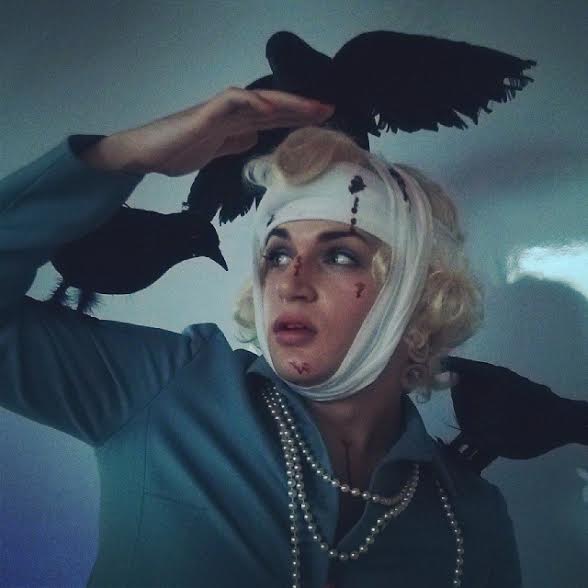
I woke up an hour earlier than usual to soak a few head bandages in blood and hot glue a crow to a purse. I sat at the kitchen table, mixing corn syrup and food coloring to find the best ratio for realistic clots. The cheap gauze I used kept sticking to itself and would either absorb too much blood or not enough. The pattern couldn’t be splattered and nondirectional. It had to be congruent with an entry wound from a sharp, slightly-curved beak that had just penetrated my scalp.
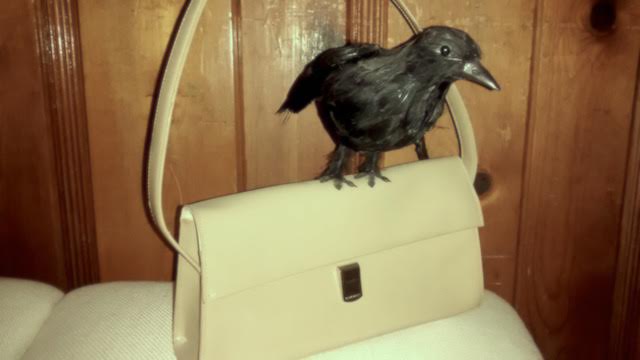
While the bandages were drying I poked two holes into the top of a beige plastic purse. I’d gotten it the day before from a thrift shop across the street from my apartment. It had the clean lines of a mid-century coffee table, and thankfully a thin but sturdy inner lining. I untwisted a crows wire feet from the branch stand it came attached to and threaded them through the holes. The wires were sturdy enough for the bird to stand on its own, so I’d heated up my glue gun for nothing. A structurally sound Halloween costume with no glue whatsoever? I couldn’t really believe it either.
6:45 am
My roommate left her Marilyn Monroe wig out on the kitchen table for me. Its styrofoam head support base donned 2-inch false lashes and red glittered lips. She was dashing, and one of dozens from my roommate’s extensive burlesque wardrobe that occupied the entire third bedroom of our Brooklyn apartment. The curls weren’t the exact look I was looking for, but the blond effect was there, and no one who pulls a highly conceptual costume together in twelve hours can be picky.
My hair was in the flattest bun possible and pinned to my crown. I cut a nude stocking at the calf, pulled it tightly over my head down below my ears, and looked like a baby conehead. I wiggled into the wig and discovered that blond is not my color. Luckily the hairline far enough down my forehead that the bandages could hold it in place without pins, so I started wrapping the cotton in different directions across my face.
I never appreciated my natural beauty as much as when I tried to make myself look glamorous and nearly dead. Can this much blood come out of my forehead? Does my coral nail polish clash with the blood clots hanging from the birds’ beaks? Is that a good thing? We should bring back this early ‘60s powder-blue eyeshadow look. Does the blood give me enough color or should I wear blush, too? Should I powder my face and risk matting-down the blood, or hope that my natural grease/sweat enhances the look? I wonder if Tippi Hedren had huge pores. Is there a difference between crows and ravens? Do I have time to make a fake eyeball to hang off the side of my face?
After securing the bandages with cloth tape, I took my favorite crow (the one with an open wingspan as to appear in mid-flight) and threaded the feet and wires through the wig’s lace scalp. I secured it with bobby pins on the top of my head and, after a vigorous headbanger test to System of a Down’s “Chop Suey!”, decided it would last through the day.
7:35 am
I concluded that the most effective costumes for any occasion are the simplest ones, because they allow you to finish so far ahead of schedule that you can cook steel cut oats for breakfast. While I was waiting for the water to boil, I walked out on our roof deck to watch the sunrise. The sky was orange over the row houses, silhouetting a pair of sneakers that dangled over the street from a power line strung between two buildings. Our neighbor came out onto her roof to water her browning herb garden. She me staring over the cityscape covered in blood and birds, and walked back inside. I felt my tummy rumble and did the same.
7:50 am
I hopped up onto the kitchen counter to eat my oatmeal. I always liked sitting there, because it made me feel tall. Our kitchen was a six-inch step up from the living room, and with my feathery friend atop my head, I could almost touch the ceiling. It was the tallest I’d ever felt.
8:05 am
I packed my work computer and coral lipstick into my bag and looked at myself one more time in the mirror. Tippy Hedren, about an hour and fifteen minutes into The Birds, no mistake.
I took a deep breath. What if I got my dates mixed up and today isn’t actually Halloween? Or what if this is the year everyone gets super serious and doesn’t dress up at all? I refuse to accept that I may be too old for this. Wait, what if everyone is terrible and has no idea who Alfred Hitchcock or Tippi Hedren is or what birds are? Luckily my neighborhood wasn’t very busy in the morning, so I could decide to abort at the last minute without too many social catastrophes.
8:08 am
My first encounter was with two guys walking a hotdog. All three were wearing neon trucker hats. Perhaps I wasn’t caught up on my pop culture references, but I couldn’t understand why a dog quite clearly dressed as food would need a hat on top of his relish and mustard.
“Yo, that’s dope,” one of them said. The other took out his phone and took a picture. And then another picture. And then another. He took a photo of me every second as I was walking by. “That’s goin’ on Facebook, man. Happy Halloween yo!”
Okay, date confirmed, so far so good.
8:10 am
An old man with a long gray beard was sweeping Twizzler wrappers off the sidewalk outside of his deli.
“Hey!” he said, “It’s The Birds! That’s neat.” Not neat enough to stop him from sweeping, though.
Okay, I’m on a role here. I’m killin’ this shit. Best costume of all time. I win Halloween.
8:12 am
I was one block from the train station when I recognized a man. He was tall and black, with a lot of aged acne scars on his nose and cheeks. He didn’t appear exceptionally overweight, but his hands were interlaced below his belly and it looked like he was supporting a sack of yams underneath his baggy t-shirt. He’d followed me home from the subway two nights prior, whispering details the whole way about how he wanted to be my “ass-pussy king” and “fuck me all night hanging from the rafters.” As if anyone’s apartment in Bushwick had visible rafters.
I’d like to say that encountering this goose was an isolated incident – a blip during the playback of my roaring early-twenties in New York. But he was only one of many sexually-charged stalkers who thought it their solemn duty to tell every trans or gender non-conforming person they saw how sweet their ass-candy was, often so aggressively that we’d rather spend 20 minutes inside a bodega than lead them to our apartment buildings, where they’d no doubt break in and hang us from the “rafters.”
I turned my head and looked across the street so that he couldn’t make eye contact. I hoped that in the harsh light of day he’d be distracted by my crows and their gory mutilation of my body.
“Woah, that’s crazy,” he said. “Those birds ain’t real?”
Okay, he doesn’t recognize me. I didn’t answer and walked around him.
“Girl, that’s the best costume I’ve seen all day, and that’s still the best ass I’ve seen all week.”
Oh, my, gods. I need someone dressed as a pizza slice to walk by so that he’ll look away for two seconds and I can disappear behind one of these parked cars.
“Damn that’s a tight-ass skirt on top of a tight-ass ass,” he said. “Let me eat that ass-pussy for breakfast.”
I turned red and clenched my jaw. I contemplated taking my backup vile of blood out of my purse and smashing it into his right eye socket.
“I’ll let you fuck me, too, girl, after I lick your hole all day.” He stuck out his tongue and made a horrific slurping noise, not unlike Anthony Hopkin’s tonal description of human liver with a side of fava beans and a nice Chianti.
This was always the case with these overgrown turkeys; they’d say phrases like “I’ll let you fuck me” and “give me that ass-pussy” to infer “I know you have a penis and I literally want you to put it in my ass after I give you oral and put my tongue in your butt.’”But they could never actually say that, because it would be too gay and uncomfortable and embarrassing and humiliating to say those specific words to a stranger on the street.
8:13 am
All I wanted to do was get away from this loon, but a garbage truck pulled up and blocked the crosswalk to the other side of the street. He stepped closer, talking about my “sweet nectar ass-juice” so aggressively that a drop of his spit landed on my left forearm.
With no means of escape, I turned around, stomped my heel to the ground, and yelled, “THERE IS A DEAD CROW INSIDE MY ASS RIGHT NOW, SIR. DO YOU REALLY WANT TO EAT A BLOODY CROW OUT OF MY ASS FOR BREAKFAST? RIGHT NOW? HERE? ON THE STREET?”
A few people within earshot turned their heads as they walked by. The man seemed offended, appalled even, clutching an imaginary set of pearls atop his collarbone.
“Yo, that’s nasty, you fucking faggot.”
He walked away, hugging his sack of yams.
8:14 am
I stood on the corner and cried. I don’t think anyone noticed the tears, because people generally cry when they’ve been assaulted by crows.
I had programmed myself to fear only the men who hated me for being feminine. I never thought men would pursue me for sex, let alone so aggressively and in public spaces. They started following me home and touching me on the train and dive-bombing me on the street. At first I thought it was a blessing, because I’d rather be called ‘sexy’ and have my ass grabbed than be called ‘tranny’ and punched in the face. But now it felt dirty and destructive, like a strategic invasion and declaration of war on my body.
I shook and couldn’t breathe. When is this shit going to stop?
The train roared on the elevated tracks above my head. I closed my eyes and let the sound of scraping metal drown out everything around me. I tilted my head back and pictured Tippi looking up to a sky blackened by swarms of birds. The flocks were threatening and infinite. She squinted her eyes, pressed the wound on her temple, and said, “Don’t they ever stop migrating?”
About the author
Jaen is in her mid twenties and splits her time between NYC and Raleigh. She forgot to finish college and has yet to accept her status as an adult. You should read her blog and watch her YouTube videos.
We’re back from our spring break with news of some exciting changes at Tell Us A Story.
Since we opened our doors nearly 3 years ago, Tell Us A Story‘s mission has been a simple one: to publish stories about “true things” once per week, every week. We loved that model, and the way it allowed us to focus on one writer’s story each week.
But as we begin year 4 of the blog (year 4!!!!), we wanted to try out a new approach: we are shifting to a quarterly format. That means we will still be bringing you the best true stories we can find, but we will publish these stories 4 times per year: in the fall, winter, spring and summer.
We feel this new format will better accommodate submission cycles as well as our own busy lives.
We will close out year 3 with a few of our favorite recent submissions, then we’ll be back in the fall with our new quarterly schedule.
In the meantime, we encourage you to keep reading and please keep sharing your wonderful stories with us:
All submissions must be less than 2000 words and must be based on something that actually happened to you (not to your friend or your cousin or your high school math teacher). We are also interested in very short stories (flash [non]fiction), experimental stories, poems, or plays as long as they are true. When possible, we’d like you to send us a scanned photograph or document that correlates with your story, because those kinds of details are nice.
Please send submissions as an editable attachment (no PDFs please!!!), along with images, and a 100 word (or less) biographical statement to tellusastoryblog@gmail.com. Put “TUAS Submission” in the subject line. Please submit only one submission at a time (unless you are sending poetry).
Jiordan Castle is a writer from New York living in San Francisco. Her work has appeared elsewhere in print and online. She gets personal at nomoreundead.tumblr.com and can be tweeted @jiordancastle.
The Existential Reader was lying on the floor again. “Are you going to pick that up?” asked my husband. “I would, but what’s the point?” I said from my seat at the kitchen table. He barely smiled. A paltry response for a decent existentialist joke, I thought, and it’s true, there really is no point. Despite our best efforts, the books in our house are always moving, seemingly on their own.
One year ago, we moved into our old wreck of a dream house, a once-beautiful place that sat on the market for three years because no one else could bear the thought of replacing a long driveway and a leaking roof or cutting back decades of overgrowth. But we were in its thrall from the start, in part, because in the center of it is a library. It is the kind of room that existed only on the board game Clue in my childhood, with four walls of shelves and a fireplace with a hammered copper hearth. The only improvement necessary there was the shelving of all of the books we had brought to our marriage and acquired since that had never been unpacked at the same time before, many of them awaiting us in boxes in our garage or my in-law’s attic. Finally, my copy of Mara, Daughter of the Nile, discovered on eBay long after my favorite book from Seventh Grade had gone out of print, sat next to John’s copy of Lincoln’s Speeches. Our refugee books had the home they deserved, and yet some still roam.
Rifling through a stack of school notices on the kitchen counter, I’ll find Catcher in the Rye, its paperback binding stiff from having been wedged on a shelf or in a box since it was last read. It is most often books that have been long-neglected, put away decades ago when term papers were completed, that confront us in this way, desperate to be read again. Surprise titles will show up on our nightstands as though directing my husband or me toward a truth in Lawrence of Arabia. We put them back on the shelves and within hours or days they have again drifted, back out in the open as though asking us why they aren’t being read, or, in the case of the French-English dictionary, why we are no longer trying to speak French.
If I pass by the library in the right moment, I can hear singing, “books, books BOOKS, booky book BOOKS.” If I sneak a glimpse, I see our kindergarten daughter, Maeve, standing on a chair, pulling out a volume of the Waverly Novels from 1880 that my mother-in-law bought as a set at an estate sale, poring over the brown musty picture-less pages of The Bride of Lammermoor with faux comprehension before restoring it to the shelf alongside the rest of the forest green bindings or placing it on the window sill or she could be grabbing one and tucking it under her arm as if rushing off to class.
Despite the documented sightings of our book spirit, my husband still takes the appearances of the books to heart. “I should read the Meditations of Marcus Aurelius again,” he’ll say when he finds it lying in the middle of the hallway; but then he’ll put it down and forget about it, reflexively reaching for his tablet with more current books, like those written in the last millennium, when he goes to bed. When the tide turns Marcus Aurelius up again, he might turn to me and say, “you know, you might really like this.” “Huh, you think?” I’ll say, while replacing it on a shelf. I congratulate myself on not being prone to the suggestion of a book’s appearance until I find three copies of the cover of Northanger Abbey in the tray of our copier and am tempted to take it from the glass and sit down and read it there and then.
Were I to do that, I would likely land on a pile of dust jackets. Our books shed their jackets like summer wedding guests on a dance floor. The jackets sometimes go on to live lives of their own, collecting in piles or consorting with magazines. I wonder what compels our book spirit to dismantle them like is. All I can think is that she must be determined to get inside them, to know their secrets, which she is, as yet, unable to decipher.
Her reading now is limited to Green Eggs and Ham, which migrates some, as our other books do, but these days no further than the bedroom where it is read each night with Maeve playing Sam from memory and me the furry guy Sam pursues with his tray of food. These are some of those rare moments of parenthood that are just as enjoyable and gratifying as I imagined they would be. I tell myself, nevermind that at the foot of the bed, nestled in the carpet is a tower of From Julia Child’s Kitchen, two volumes of the Dialogues of Plato, and a 1917 copy of Lord Charnwood’s Abraham Lincoln. The stacks and the orphaned jackets and the constant book migration represent the things I never anticipated and cannot understand about my life, much like Maeve herself.
I have three children and each of them surprises me with who they are becoming, but Maeve is in some ways unknowable thus far. Her quiet other-worldliness can at times trouble us, but it leaves Maeve content, even joyful in her own experience of the world, and in books especially. Perhaps we seize upon the books as our clues to what she is thinking. Or they could mean nothing, are merely something that we have in abundance. Regardless, the moving books are our comfort. While Maeve’s purpose remains a mystery, that we all love the books is enough. Regardless of what Marcus Aurelius wrote, his mere presence peeking out from under the closet door is a sign that Maeve is one of us. So, I re-shelve and re-jacket, but I never turn to Maeve and tell her that she has to leave the books alone.
About the author
Rebecca Martin is a former lawyer and political fundraiser who is now doing the two things she has always wanted to do: writing and raising a family. Her work has previously appeared in The New York Times Motherlode, Brain, Child, and Literary Mama, among other publications.
Fifty years later, the writer reflected that it might not have been such a good idea to drop acid before the high school graduation rehearsal, but, by then, there was nothing more he could do than remember and regret, if regret is the right word, because there was some curious pleasure in recalling the consequences of that decision, if decision is the right word.
He remembered the ceremony itself, with Billy Bonstead*, who had also missed the rehearsal, marching a few students ahead in line with an air of having marched toward academic excellence many times before. And he remembered how the principal growled fiercely, his glassy eyes bulging with vindictive vindication, standing there with that pathetic diploma case as though it held all happiness, all futurity, all the silly bullshit that academic (if that’s the right word) bureaucrats pretend they have a death grip on.
As the writer told his students long afterward, he had replied with two words, the second of which was “you,” but the first of which was not “Thank,” even if it ended with the same letter. It happened that there fell one of those unexpected moments of total silence just as he reached the principal, so his words sounded like a war cry on the ancient steppes of Russia and were followed by a horrific gasp from the audience. He had taken the half-extended diploma case from the furious principal and walked on off the platform, noting with embattled pleasure the smile on the face of John Quincy, the student walking just ahead of him in that glorious parade.
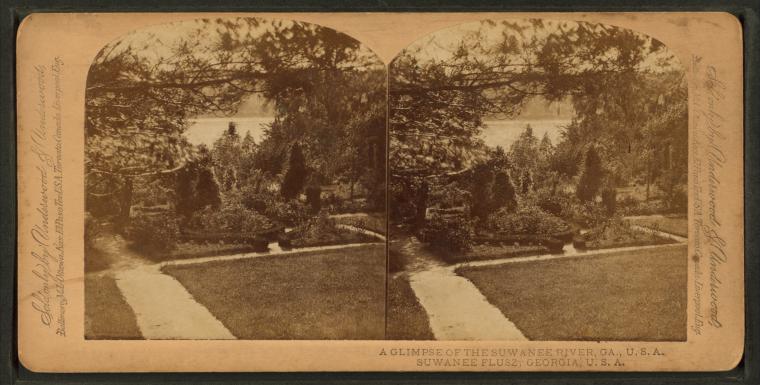
Image credit: New York Public Library Digital Collection
John was one of the first black students to graduate from Suwanoochee High School, and he had had a fair amount of hell from the rednecks and the administrative stuffed shirts. There had been a kind of lifting of shadows at that moment, possibly for many present, but as surely for John as for himself. As the closing invocation began, John lifted up his resonant voice in a powerful farewell to the school and his persecutors (more gasps), and it was easy to tell he had much sympathy among his fellow students as he announced at some length he was signing off.
What was most memorable about the night which had produced the outrageous non-attendance at the rehearsal was that on the radio was played again and again a strange song which seemed to reach to and from an unanticipated world. “The Israelites,” by Desmond Dekker and the Aces was the first Jamaican song extensively aired in the region, and it appeared to have hypnotized one or more of the late-night disc jockeys on local radio stations. Perhaps chemically-stimulated susceptibility lent it a mystical profundity that made the antics of school administrators loom even smaller than those of ants (or ticks) and inspired defiance of petty tyrants in stoned brains.
Outside the football stadium where graduation was held, the writer had parked his father’s Ford station wagon, his parents having come in the family’s other car, and he headed briskly for it, meeting Billy on the way. It had been reported that the head football coach had encouraged some of his players to give graduation haircuts to some of the more visible hippies, and Billy was evidently mindful of the need for all deliberate speed as he extended his hand in congratulation. Billy also had Desmond Dekker stuck in his mind as well, as he danced a step and sang “We don’t wanna end up like Bonnie and Clyde….”
“Watch your back,” said the writer, and Billy replied “Always.” The writer went on to the station wagon and got behind the wheel. He reached down and took up the double-barreled 16-gauge, opened the glove compartment and took out four #4 shells, loading one into each barrel and putting the others on the seat beside him. He waited about twenty minutes before he realized that no one was coming. “Good thing nobody did,” he said to himself, fifty years later.
*All names have been changed in this story.
About the author
R. W. Haynes is a professor at a South Texas university, where he teaches Shakespeare and Early British literature.
Note: “Israelites,” written by Desmond Dekker and Leslie Kong. Recorded by Desmond Dekker and the Aces. Trojan Records, 1968.
Joaquin Jaramillo (JJ) was a Norteño. He wore red, was covered with tattoos and came into Teen City out of breath. It was an hour before opening time (2:00 PM). His eyes darted side-to-side and he kept can eye out the window. I introduced myself and he gave me a complicated handshake. Then I challenged him to a game of air-hockey.
“What is this place,” he asked. “I heard a lotta Scraps hang out here.”
That’s how our first conversation went. He asked a lot of questions, I gave honest answers and invited him back. Whoever was chasing him had either given up or was waiting patiently somewhere.
The following day, same time, he returned. In addition to being out of breath, he was bleeding from a shotgun pellet wound to the left shoulder.
“Nah, man,” he protested as I lifted the phone to call for help,“this ain’t nothin’.”
I set the phone down, “What happened?”
“Got ambushed by a carload of Scraps. They can’t shoot for shit,” he finished.
“Why don’t you stop bangin’?” I asked.
“It ain’t that easy,” JJ said.
“How old are you, Joaquin?”
“Eighteen.”
“Want to see nineteen?”
Joaquin did stop. He came back to Teen City five days a week—half the day on Saturday, and he knew better than to show up wearing anything red. With time, the other kids came to accept him and soon he was joining in many of the Tulare Teen City activities. JJ ran in the Max Chaboian Memorial 10K wearing black dress shoes, a wife-beater and a pair of baggy Dickies. He had to hold up his pants with one hand as he ran, yet took first in his age group.
One day he complained to me that he couldn’t find work because of his tattoos. They ran up and down his arms, around his neck, and his knuckles were festooned with gang affiliated dots.
“I have an idea,” I said.
In the Yellow Pages I found, Doctor Michael Johnson/Laser Specialist. I asked the receptionist if I could talk with him. She left a message and a short time later, Michael called me back.
“How would you like to be famous overnight and have so many clients that you’ll need to open a bigger office?”
“Are you my fairy godmother?”
“Michael—can you remove tattoo’s with laser?”
“I’ve done a few, yeah. It’s painful as hell and not too popular.”
“I have someone I’d like you to meet.”
The next morning, I drove JJ to Michael’s office. He examined the tattoos—especially the deep dots on his fingers.
“Jailhouse,” he said, “deep and hard to fade out—but it can be done.”
He explained the procedure to Joaquin—how painful it would be—more than when he’d gotten them.
“Pain,” JJ said, “I’ve lived with pain all my life.”
“Okay. Be here at nine tomorrow morning and we’ll get started.”
Afterword:
The next morning I brought a reporter and a photographer along and the entire procedure was documented and published on the front page of the Visalia Times-Delta. To my knowledge it was the genesis of the first Laser Tattoo Removal Program in the United States.
About the author
Ty Spencer Vossler (MFA) currently lives in Oaxaca, Mexico with his wife and their daughter. Vossler has published novels, many short stories, poetry and essays. He attributes his originality to the fact that he shot his television over two decades ago.



 Tell Us a Story