That Easter

by Leonore Wilson

I remember how cold it was that Easter, a bitter cold that kept us in as if it were winter, but the sun was out; the sun was a big deception in the sky. We were all at dinner — picture the ham, mashed potatoes, dyed eggs, the jelly beans. Then the phone rang. My mother answered. The dispatcher said people saw a naked woman running through traffic, she was running like a scared doe in headlights. They couldn’t shout her down or weave her in. They asked us if we had seen her, that she was last spotted running into the open field in back of the house. The police wanted to know if they could come up to the ranch and find her. A naked girl? Or was it a woman? My mother said it didn’t matter, no we hadn’t seen her. Then my husband left the table as if he were a doctor and this was his call. He ran out of the house and so did our boys. I was left with my mother at the table. We were the women. The food like a big accident before us. We ate the ham, the salad, drank our milk in silence to the sirens.

My husband came back. He said something about her wearing only underwear, big panties, nothing fancy, and that she had lived in the field for three days. He said she was nothing to look at really. In fact she looked like a dog, dog-ugly. He asked if I would give her a sweatshirt, some pants. I went to the laundry room, picked out the pink ones I hated, the color of peonies. Later I saw her at a distance. They had her handcuffed. They were taking her down the mountain. It was starting to rain. She had her head down, the way Jesus had his head hung, ready for the crucifixion; she was that scrawny. I put my body in her body. She was wearing my clothes. My husband told me she kept telling the cops that she was a mother, that no mother should be treated with handcuffs, that she was no danger. The cop said she was covered with bruises, that her husband had beaten her and left her on the highway, that she wanted to die in the field where she first met him, her lover. The cop said she was on drugs and loony. He said she’d probably go back to her husband. That they always do. These strays, these losers.

That was ten years ago, but I still think of her. This woman, not the only inconsolable stray I’ve found on my rural road, in this paradise called Napa, this manna of land fluted by canyons, sharpened by cliffs. Wappo territory where wild irises bloom their white flags from the portholes of meadows. There’s been others. Other women. The woman with purple welts around her neck, scourged neck of the black and blue, weeping near her stalled U-Haul and the oversized drunken tattoo of a man. Or the woman whose husband drove his black sedan behind her as she walked the dotted line, the mean bumper of his souped-up car butting up against her like a bull. But it was she, the woman discovered on Easter, who remains in my center like the blue throat of the owl in the center of moonlight. She the vixen’s red breath coming out of the garden and into the pitch. She emerging from the earth-bed like Persephone released from Hades, but returning to Hades. She, the matted camellia, the numbed apostrophe of the killdeer stirred from the cinders. Who is she, whose handiwork? Whose heat did she trigger? What ownership? Who was she, that threadbare girl of skin and ribs, feeling invisible, that field witch? Did anyone ask her; what are you feeling, do you feel anything, as they cuffed her bare feet, stuffed her in back of that cop car? Was she bound and flogged before he, her lover, her spouse, tossed her out like rotten trash? Is there any way to explain her naked body? Her naked fingers? Her fallen legs collapsing under her like unplayed cards?

I think of her, of all the women I have found in my country, their shadows writhe within me. I who have stayed silent. They with their loosened hair, stained with soil and blood, drugged eyes glazed forever on the black chart of amnesia. There have been many in these hills, this valley. Wild, hard women. Endangered sisters. Their heaped colors suddenly gone ashen like the cloudiness that forms over winter blacktop. They who scratch themselves, who urinate, who stay in unspeakable loneliness, their feminine power routed backward like miles of barbwire. They are homeless cursed women, naughty women, the words stolen out of their teeth like bread. They who would rather choke than be vulgar.

How can I wrap my house in sleep thinking of them, thinking of her making a fire of wet wood, telling stories to herself, singing lullabies, nursing the tragedy of her sex. I pace the floor thinking of her. I poke my spade into the dry loam and think of her. I find her everywhere. I have learned her by heart. I have worn her close to my body. For she is my body. She is the foundling of the woods, the one slip of tongue, the liquid mist that burns off the highway as the new day forms.

I want to know who touched the match to her flesh, who left her blanketless in the frost as I stoked and blazed my stove. I know she was there in the twilight and thorns. I’ve felt her mouth on mine like a lump of bitter jelly all those times alcohol was fire on my breath. The times I starved myself with pills in my pocket, wanting love, wanting the brisk taste of airports and ferries, I’ve been her. The times I wanted the impermissible. I’ve been her. Discontent as a cormorant that pokes around the corpses of roses, wanting to be fractured, exiled under the floss of many petals, I’ve been her. Wanting to be seduced by that floral nard. Me, in the snowstorm of unimaginable longing while the hangman’s noose rose inside my chest, taunting, taunting. I too tried on death too many times. I who wore my own bruises like badges around my jaw. I of steely posture.

Why?

I lowered myself in the chaparral, afraid, my breasts full of milk, my hair disheveled. I thought I could stand betrayal, that I could spill myself like purple vetch, like legend down the lush gametrails into drink. What soothed me? Sometimes mint in the mouth, sometimes the pearl-gray mist. I wanted to be like my ancestors. I wanted to be strong as shattered rock, as basalt mortars. I didn’t think it right that a woman go off like a kettle full boil. But I was proud and half-blind. I was a stuttering tadpole. A spectacle. An odd empty thing.

I was a master of nothing. I wrestled with the serpent inside me, the female totem of melancholy. Me with my teacups and miniature cakes. I sucked in my midnights, my howls and my whelps. Why? How many dead girls like me smelled of old lunatic lies?

My sentence was mine: my well-piped breeding, my pilgrim dreams. Guardian of chandeliers, when my heart was always squawking like an interior swan.

Be damned the well-scrubbed house, the family snapshots. Be damned the flowers of Hell, the ostracized penance, the lowermost regions, Lethe’s spell where Eurydice wastes away with Persephone. Be damned if the dark snake of Eden flew out of my mouth. I want the Easter woman at my table, I want her story. I want to take her groggy hand, lead her away from the fettered ring, the life of sacrifice, of thick-scented curses. My tongue dips into the chewed meat of thistled honey when I say this. Mothering is the dilation of feathers. Forget the flower-pressed face concealing its failures, bleeding its kindness like a parasite. Inside our smile is the knife-grind, the winged lion. What abscesses in our flesh — not our humiliation, nor our quarrel, but our rising.
grain

About the author

Leonore Wilson is the mother of three sons in their early twenties. Her husband is a scientist. She lives in the wilds of Northern California. Like it or not, she comes from generations of rugged females keeping nature both fertile and sacred. She has won awards as well as fellowships for her work and has published in Poets Against the War, Madison Review, Sing Heavenly Muse, Rattle, Quarterly West, Third Coast, Pedestal, Laurel Review, Pif, DMQ Review, and Unlikely Stories.

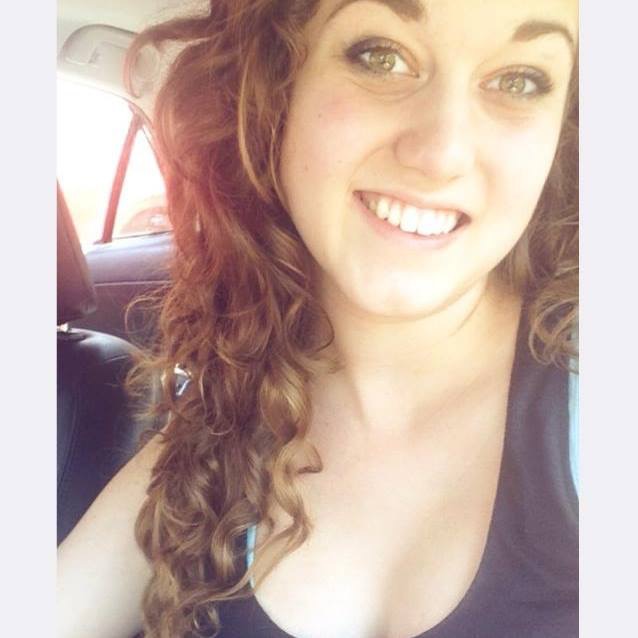
To My Sixteen-Year-Old Self

by Shelbie Davis

Editor’s note: The following letter, which accompanied the author’s submission, is reprinted below with her permission.

Hello there!
My name is Shelbie Davis, a 21 year old and lifelong, imperfect Christian.
In the last year of my life, my family and the church I attended for 8 years has chosen not to speak to me. This happened right after I left the man who abused me, and yet no one believes me. So I had to move on.
I attend a wonderful, healthy church now, and the last year has given me a lot of time to reflect on what went wrong. What even HAPPENED, honestly. And this concept keeps coming into my head over and over again…almost like God is knocking on the door of my heart and giving me a message to myself at 16, and a million other teenagers as well.
My biggest regret is never turning in my abuser to the police, and God knows that. I’ve always asked him if there was a way to spread my message, and I feel this is what he has in mind.
Thank you for your time, and I hope you see this letter below fit enough to be used in your publications. If not, I still graciously thank you for your time and feedback.
Shelbie Davis

***

The author at age 16

The author at age 16

To My 16 Year Old Self –

What I’m about to tell you goes against everything you’ve been taught in the church, and everything you will be taught at the same place, for the next four years until you figure things out for yourself.

God doesn’t hate sex.

You heard me right. God doesn’t hate sex.

I know between the two to three days a week you spend in church, it’s brought up at least twice how much God hates sexual immorality. (Whatever that means, right?) It’s dirty. It’s the elephant in the room. You and everyone your age has it on their minds, but good luck finding someone to explain that to you. You even admitting you think about it is gonna get you in the doghouse with God. Because it’s a bad thing, right?

So, naturally, you should save this dirty-oh no-hush hush-bad thing for your soulmate, your spouse, your other half.

Uh, what?

That’s confusing.

I know right now you’re on your way to dating a guy who will spend the bulk of your following two years hammering into you that sex and everything associated with it is a really bad thing, and we shouldn’t do it, or even discuss why we’re not going to do it.The church will back him up — sorry, no time alone. You might have sex. Don’t have adult discussions about the future, you might say the S-word. It will be assumed that YOURE the risky one here, since you’re not white and pristine like he is. You’ll start to focus on this value set so hard, your tunnel vision will prevent you from seeing what’s lacking.

Like respect.

And love.

Loyalty.

Trust.

Above all, friendship.

You’ll hear about those five things above about 50 percent less than you’ll hear about sex, and all the ways to avoid it or anything relatively close.

And then later, when that boy you thought you had to spend your life with starts hitting you, and shoving you, and dragging you around by your ponytail, you’ll stick around and think you’re doing alright because, well, “at least we’re not having sex. God and all our friends would be SO mad about that.”

Oh, sweetie. How you will be mislead.

At the end, you’ll leave him. Thanks be to Jesus, your Father, you will leave him. And at the end, a huge chunk of you will be gone. I’m so sorry to tell you that.

Don’t get me wrong, you’ll always be relieved that you two never physically connected in that way (even though right towards the end, he comes close to taking it anyway). But was it the most important thing? Was focusing on abstinence and pretty much only abstinence for two years really worth sacrificing those actual foundations of a healthy relationship?

The answer is no.

And God would back me up on that.

Sweet girl, I want to remind you that your God is a God of pleasure. Of happiness. Of sanctuary. Of health. Four  words that will later apply to your sex life as an adult in a fully committed and forever relationship.

And by the way, he’s okay with being associated with sex. Because he created it.

Re-read Song of Solomon. It got skipped over in church, but it’s so important.

Read it as a love note from your future spouse to you, and be excited.

Read the part where God tells the new couple to “drink their fill of love.”

You’ll be 21 years old one day and be so frustrated that no one ever sat you down and had “the talk.” And not the talk that a thousand Christian parents have with their daughters at 12 or 13, and hand them a pretty silver ring to wear until their wedding night. But the talk that says:

“Wait for the man who loves you. Respects you. Adores you. Treats you like a daughter of the King. Is your very best friend. Then, if God sees fit, marry him and do the things that married people do. God will LOVE that.”

Because it’s true, and most parents, pastors, and leaders dance around it.

Save yourself for that man. And don’t be so worried about sex that you forget about the thousand other things you deserve.

By the way, 2014 shapes up to be one of the best years of your life. Just wait, and trust in Him.

-Me.

The author today.

The author today.

About the author

My name is Shelbie, and my world consists of working at Starbucks, my cat, the love of my life, and being Loved unconditionally. I am the big sister of two sisters and four brothers. Also, I’m a crazy good cook.

Comfort and Conscience

by Harper Burke

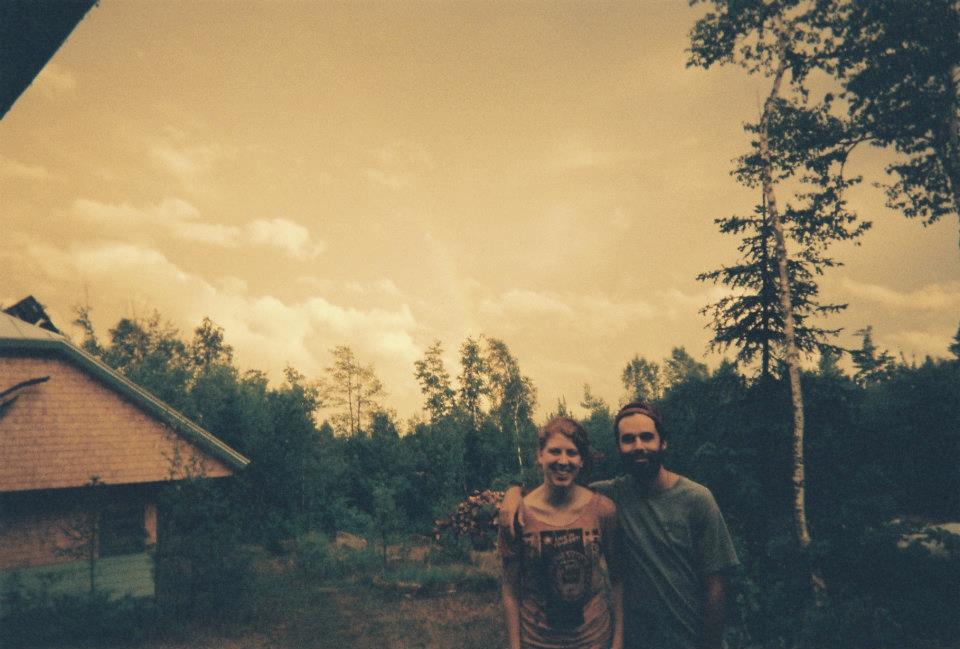
The author and Zach, standing outside of the hut.

The author and Zach, standing outside of the hut.

It was late morning by the time we noticed the rabbit. The sun was hanging high in the sky, almost oppressively orange and bright, beating its cheer down upon the dirt road behind the hut. The dust of the road hung just above where our feet were planted, where the tires of his car were parked, as if the sun had been urging it upwards all morning while we slept and cooked and cleaned and yawned inside the hut, hiding in the cool, clean shadows of our home and running to the dock to dip our feet, calves, thighs in the water. The flat, shallow water of Flagstaff Lake looked inviting even on the most crisp of these late summer days, perhaps even more so as the leaves bordering the water turned, exposing their brilliant reds and oranges, changing the lake into a landscape we felt obliged to take full advantage of.

We had just finished cleaning up from the breakfast we had cooked for our overnight guests at the hut where we both worked and lived, Zach and I, for the summer and fall. It was a Monday, the day Zach was to leave for his days off, and I was envying his imminent freedom and mobility, eyeing his Saturn sedan that was parked—although our boss would have disapproved—just behind the huts. He was leaving me alone, in charge of whatever guests might stumble in from the heat, for the rest of the day, as our other coworker was out on the trail with the unwieldy machine, the Morooka, that we used to carry the dry and splintering firewood that we would soon spend days splitting and stacking and chopping and moving and splitting and stacking.

The rabbit was lying on the dusty path, just behind the wheels of Zach’s car, and it was not moving. Its eye was open, roaming, a scared and helpless glimmer flashing each time we moved nearer to it.

“What’s wrong with it?” I asked, hoping Zach would have the answer. As I knelt down to see if it was injured, it gave a great, frantic kick with all four of its legs, peddling them sideways against the ground as it lay on its side.

We puzzled over the rabbit, poking it, prodding it with sticks, our fingers, to see if we could diagnose it. The thing was tiny, not fully grown, one of the many wild rabbits that wandered into the fields behind our hut, walked into our summer home, to eat our clover and be scared off by the yapping dogs our guests brought with them. Ten minutes passed, then twenty, and the thing was still lying on the ground, kicking its legs and looking at us with a glare in its glassy eyes.

We tossed around various ideas of what could be wrong with the rabbit. I believed it had a spinal injury, due to the way it was moving on the dust, kicking only its legs and unable to stand up, but clearly conscious. Zach thought it was drunk; I guess he saw it move in the same way he had seen some friends move, their limbs flapping, eyes glazed, unable to communicate or interact.

“How does a rabbit get drunk?”

“It eats rotten, decaying berries.” Zach replied as if I was an idiot. Doesn’t everyone know how rabbits get drunk?

*          *          *

We know we need to kill it. We arrive at this conclusion almost as if we had always known; we don’t discuss it or propose an alternative. The rabbit is dying. We still haven’t determined what is wrong with it, but its kicking is coming less and less frequently, and there seems to be something about it that is fading, giving up; even the fear is leaving its eyes. Our next question is how. It is a tiny creature, easy to “take care of,” as the hit man always says in mobster movies, but it’s too cute for us to fathom doing anything gruesome. Zach is getting impatient; his days off have started, it is hot out, and he is ready to leave. He argues that it is crueler for us to leave the thing there in pain than for us to get rid of it as quickly as possible. He proposes we shoot it.

*          *          *

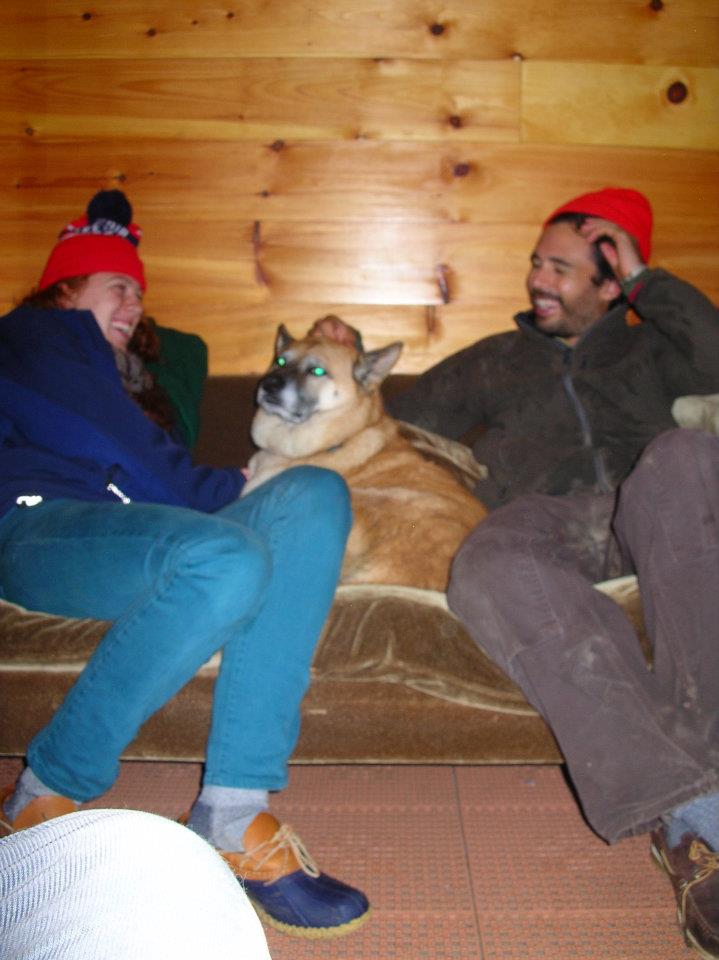
The author and Zach inside the hut.

The author and Zach inside the hut.

Inside the clean hut, just inside the door that connects our cozy and cool staff quarters to the porch where our firewood is stacked higher than our heads, we survey our options. Stacked neatly on a long bookshelf, near the bottom, are two guns. Both belong to Chris; Zach and I hardly know how to handle or manage a gun, sure only of the basics, of how we held one once in a friend’s backyard or how we saw them do it on TV. The first option is a rifle; this is what Chris takes with him when he wakes up at 4:45 in the mornings, pulls on his boots and walks through the still-wet fields and woods, returning before breakfast with a squirrel or a duck. We take the rifle outside, to where the rabbit has not moved, making tracks with its kicking legs in the dust. Zach, first, carrying the gun, shoves its long barrel toward the head of the rabbit. The rabbit shows no change. To it, the barrel of the gun is no more menacing than our outstretched arms. He closes his eyes, finger on the trigger.

“Don’t close your eyes!” Shooting a hunting rifle with your eyes closed seems like a stupid thing to do.

The mess this rifle shot will make suddenly seems apparent to us. A rifle is too large, this rabbit too small; and then what? The rabbit doesn’t go away once we shoot it. It just gets, for lack of a better phrase, spread out on the path: an even bigger mess to deal with. How would we take care of that? How would we hide it from the guests? That would be a mess—unlike the ones made daily by Zach and I and the children that run through the hut, muddy footprints on our slate floors, flour all over our aprons and the counters—that I would not know how to take care of.

We fetch the other option, a BB gun with which Zach, Chris and I have been shooting at cans behind the hut in our spare time, practicing our aim. The cans, when hit, make a fantastically loud and dramatic noise, as if real damage has been done. They pop and crumple, a satisfying crinkle of soft metal.

We, again, take turns holding the gun to the head of the creature, each closing our eyes and picturing what will happen when our fingers, shaking on the trigger, jerk backwards; what will be achieved. Just as we determined the rifle to be too much force, we wonder if the BB gun would complete our purpose at all. Would a BB, fired point-blank, even kill a baby rabbit? How much force does a BB gun exert? We definitely have no idea.

Instead of shooting the metal pellets at the rabbit, we shoot at the trunk of a tree a few feet away, both to stall, waste time, shoot the shit in this uncomfortable situation, and to test the strength of the gun. When we shoot it at the trunk, a mark is made, a piece of bark falls off. But what would happen to the skull of the rabbit? I am reminded of the time I found, with my childhood friend Hannah, a small animal skull in the woods behind our house. It was perfectly clean and intact, despite the creature having clearly been dead for some time, but when we picked it up and began to examine it, bits of bone began to break off. If those pieces could shatter so easily under our small fingers, wouldn’t the same effect be achieved with the BB gun? Wouldn’t it do its job? Or were our calloused fingers not careful or caring enough to know how not to break bones?

*          *          *

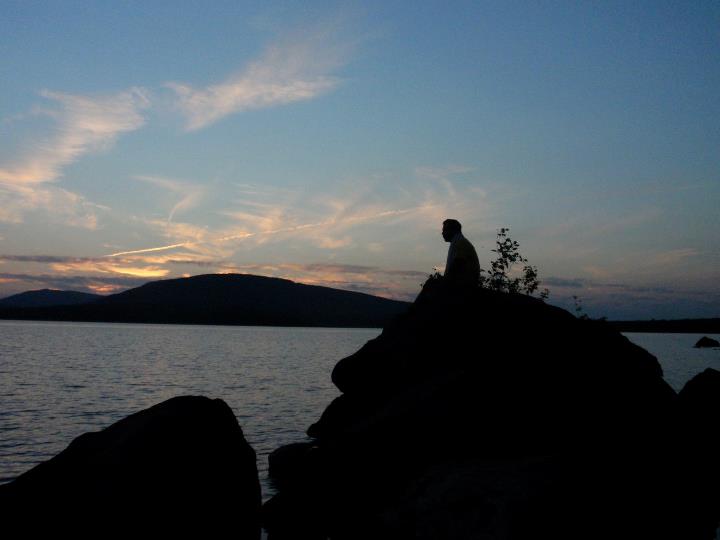
Zach seated at his favorite spot.

Zach seated at his favorite spot.

Later in the day I am sitting alone in the hut. Zach has left, giving up on the animal and its life or death, and I have all day been alone, baking bread and reading, and entertaining the single family of hikers and dogs that has passed through for half an hour. This is how my days this summer are filled; swift movements from kneading to baking, to sweeping, then picking up my banjo, putting it down, and in the evening, with a glass of wine, cooking dinner for the ten or twenty tired hikers we will entertain. The cooking and cleaning has become, in the months I’ve been living at the hut, almost instinctual. My motions have become easy and fluid, and my movements in the kitchen seem to be inherent, etched into my muscle memory.

Every hour or two I have been out to check on the rabbit. We left it where we had found it, discovering that neither of us had the courage to shoot it. Each time I check, it is laying in the same spot, or perhaps having moved a few inches as a result of its kicking, still laying on its side, its white fur becoming dirtier each time I look. Now, though, the sun is setting and I have not been out to check on it for a couple of hours, since the family passed through. Each time I look, I am hoping to find it already dead. I am hoping that the day would do what we could not, and that none of the images we held in our mind as we closed our eyes and held the gun, imagining what would come next, would be real when we looked. I am hoping someone else dealt with it, because I couldn’t.

I decide to check on the rabbit one more time before it is too dark to see. I walk across the field, wondering if tonight, the first night I have felt a genuine chill at being outside, it might frost. I hope that the children—the little girls, three and six—did not see the dying rabbit outside. I hope they did not sense our cowardice, know that we had held guns and not shot them, and then retreated back into the hut to entertain the guests with smiles.

When I reach the place where the rabbit had been, I find only dust, footprints, mine, Zach’s, a dog’s, but no rabbit. I check the bushes and brush around the path, to see if it kicked itself elsewhere. I cannot see it anywhere. I listen for its frantic kicks, its eager glassy eye movements, but do not see or hear anything. The rabbit is gone. I look down at the dog prints, remembering the two grown black labs that ran over our trails and across our field in the afternoon. I had let them do it, had not stopped them. They had undoubtedly snatched it up easily and smoothly, a swift opening and closing of the jaws; it was, of course, what canines were made to do. They left no mess to clean. I went inside alone, sheltered in my room and comforted by the steady certainty of the ordered night within the hut.

 About the author

Harper Burke is a writer, reader and avid consumer of anything in the written form living in Portland, ME. Harper was bred, born, raised and educated in rural central Maine, and now lives in Portland – the big city – with her partner.

Green Apple Red Book

by Rebecca Li-Huang

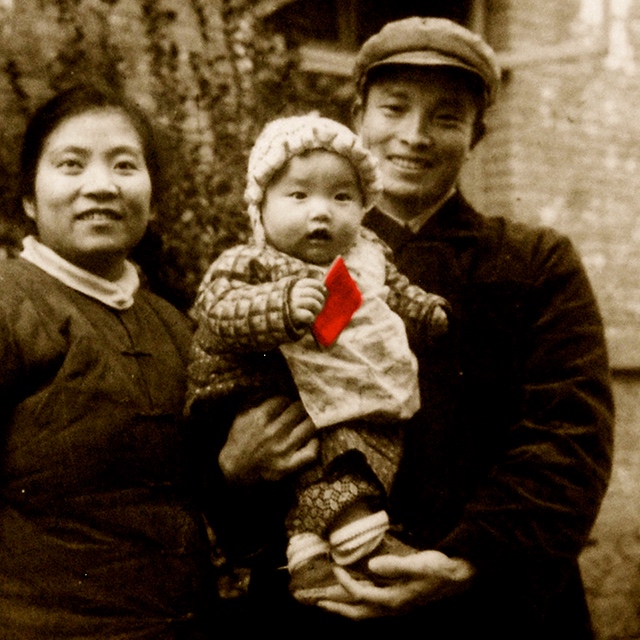
My dad was sent to Xichang, an outpost, to “reform” and “serve the people” when I was born. Dad saw me, his firstborn, for the first time when I was a seven-month-old. The Little Red Book in my hand served as the standard photo pop and rattle for a baby. I looked a little rattled—the photographer was shining too much light on me with a rice-bowl-sized Mao pin.

My dad was sent to Xichang, an outpost, to “reform” and “serve the people” when I was born. Dad saw me, his firstborn, for the first time when I was a seven-month-old. The Little Red Book in my hand served as the standard photo prop and rattle for a baby. I looked a little rattled—the photographer was shining too much light on me with a rice-bowl-sized Mao pin.

I grew up in China, and might have had a rare case of dyslexia for my native Chinese language. Fortunately, I had a good memory and had done very well in Chinese schools: I often scored 100% or very close on exams in which memorization was essential, even though I didn’t quite understand what I was being taught, except for math and science, where I could apply numbers and logic.

This was long before the advent of computer, internet and smartphones, and so my mother was always afraid that my memory would run out, that I wouldn’t have enough to power all the knowledge or wisdom one needs to acquire in a lifetime. She taught me to remember only my mistakes, so as to optimize my cognitive memory and so I would never repeat the same mistakes. She even tried hard to help me memorize all my mistakes and constantly refreshed my memory of them.

In retrospect, one recurring “mistake” I made as a child was indulging in happy memories instead of strictly following my mother’s teaching. And my father was an obliging accomplice, as he deferred parental judgment.

A delicious morsel of memory dates from the summer when I turned five, the first summer I remember spending time with my father. I can still taste the early picked apples filled to the brim on the army trucks: all green and small, only the ones with wormholes and scabs were sweet. My father had been working in Xichang (a town in a mountainous region that would become the home of China’s Satellite Launch Center) 270 miles away from our home in Chengdu (a city of 14 million people), where my parents still reside. Dad was a geologist who lived in a military camp of the People’s Liberation Army (PLA). He was a quiet man, but I could ask him anything to my heart’s content.

That glorious summer day, my mom, my eight-month-old baby brother, whom my dad had not yet met, and I finally arrived after twelve hours on a sardine-packed slow train. Mao’s revolutionary Red Guards with red armbands hung on the doors and windows of the moving train for a free ride. Xichang was hustling and bustling with PLA soldiers in green uniforms and red stars, carrying real guns. The army farm had harvested the green apples before they were ripe and the soldiers were handing out the apples from loaded army trucks. Dad said the apple trees would be chopped down to clear the way for an army project. I saw real helicopters and tanks for the first time in my life—the army was performing war games on the base. Dad got me a fresh collection of shells, so fresh out of the barrels that I could smell the gunpowder that left black circles on my hands. The shells were the coolest present a kid at that time would ever dream of, a collection that would make me the envy of any playground. I begged Dad to take me to the shooting range to collect more shells, when the soldiers were studying Mao’s Little Red Book, and Mom was nursing baby inside our temporary dorm.

It was a beautiful night: the full moon lit up the sky and the ground, and I had my dad’s attention all to myself for the longest time. Dad and I sat on a rock on the edge of the shooting range, and I was full of questions.

“Can you tell me truth? I want to know all truth,” I asked. I had a hunch that there might be an unabridged truth outside the Little Red Book, which was only “a selection.”

“There’s no absolute truth, unless… Ask away.”

“Is there a God, and Goddess?” I had heard about gods and goddesses from folklore and fairy tales, the very ones Mao’s Red Guards had been campaigning to eradicate, but I secretly wished for an all-knowing deity who would help me out when I got into trouble.

“Goddess? Yes!” Dad pointed to the glowing full moon. “Look at the Moon, can you see the beautiful Moon Goddess Chang’e and her jade rabbit, under the tree? She can’t come down to the earth because she has taken too much eternal medicine and she regrets it. She is lonely and misses her lover, a mortal on earth…”

I had heard of Chang’e, who supposedly made a personal appearance in the shady part of a full moon, but I couldn’t make a rabbit or tree out, let alone a beautiful woman. As the grownups had promised, the Moon appeared bigger and brighter in Xichang. But I was unimpressed because this goddess character was shady, and besides, she wasn’t very powerful. “She has pills that make herself live forever but can’t make a man go to the Moon?”

“She should have shared the magic pills. Men can go to the Moon; the Americans did, in the year you were born. But they have stopped going to the Moon – supposedly, it costs them too much money and they have to send men to Vietnam, to replace the soldiers who died in the war…”

“Can Americans make eternal medicine?” I liked the way the word “America” looked and sounded in Chinese: 美国a beautiful country, but the war sounded like a spoiler.

“I guess it’s up to the Americans, but wouldn’t it be nice to have a pill for every problem on earth?”

“Do they have a nicer God, or maybe they have a genie?” All Chinese gods in fairytales and folklores I had heard of were tyrannical and fearsome, and goddesses moody and fragile. I hoped the Americans had a better deal.

“I don’t know much about the American God or what they believe…”

“Chairman Mao has said that there is no God.”

“Good, that settles the matter of God. There’s no need for God in China, if Chairman Mao says so. We don’t understand the Americans—I certainly prefer going to the Moon or staying home than fighting a war. Chairman Mao’s own son went to the Korean War and was killed by an American bomb. We are not going to Vietnam to fight with the Americans. Remember, no more questions about God when you go to school…”

It was a lot of information, but I took it all in. “But Chairman Mao hasn’t said anything about a genie. Does a genie make my wishes come true?” I was closing in on my quest.

“Everyone gets three wishes at birth. But you have to believe it to make it true.”

Dad turned to look behind us, as if he was trying to spot an eavesdropper. I could only spot the army camp trailers in the distance, their lights flickering in the steamy summer air. The shooting range guardhouse was now dark—not a single living soul around, just the two of us.

“Once upon a time, there was a little girl who wanted a lot of things that her poor parents couldn’t give her, like candy and toys—”

“Are you and mom too poor to buy candy?” I had had a dozen hard candies and one toy at that point in my entire life.

“No, nobody is poor in the New China, as Chairman Mao said. And we are fortunate that your grandparents were not wealthy so we were not the Class Enemy of the People. When the Communist Party liberated China—”

“—but you promised to tell a genie story…” I knew that life would be hell if we were deemed a “Class Enemy.” I grasped the bullet casings and willed myself not to interrupt the story. Dad looked hesitant, but he did not renege—he was a man of few promises and, as far as I knew, he had never broken any of them.

“All right, we’ll save our own stories for another day. So the little girl wanted to be wealthy with unlimited gold. She asked the genie to turn everything into gold so that she could buy anything she ever wanted—candy, toys, even castles, carriages, and beautiful clothes. She got her first wish granted.

“Everything—food, water, books, clothes, candy and toys—turned to shimmering gold. But she quickly realized that she couldn’t eat, drink, read, play or live in gold. So she used another wish to ask the genie to turn everything back to its original state until she could decide what she truly wanted. She came up with a long list of wants, but she still wasn’t sure which one was the most important, because she had only one precious wish left, as the genie reminded her.

“‘I wish I had known what I wanted before wasting two wishes!’ she grumbled. Guess what, the genie heard it and granted her last wish, then disappeared in a puff of smoke. At last, our little girl knew what she wanted in life, and then she met her prince and lived happily ever after.”

“So what does she want exactly?” I was eager to hear the secret, as Dad fixed his eyes on the moon and seemed to be lost in his thoughts.

“Can’t tell you—I don’t have the power of a genie. Just remember, the most important thing to know in life is what you don’t want.”

“How do I know what I don’t want? I wish—”

“—Shh.” Dad put a finger to my lips. “Be careful what you wish for from others—they might misunderstand your thoughts or misjudge you. Use your three wishes wisely and only on the things you can’t control…”

“But how do I know what I can’t control?”

“Good question. Knowledge is the power to control the journeys that we humans can map out, such as going to the Moon when we determine to. So you must study hard and acquire knowledge every day. As for the unknown, you discover that by trial and error.”

I had wanted to ask more about the unknown, and trial and error, but an incredibly loud bell rang, disrupting the tranquil night—a warning that the lights would soon be off and curfew would start in the camp. We ran and I asked Dad to carry me, as my legs began to hurt. I soon came down with the acute symptoms of infantile paralysis, according to the self-taught army nurse, who had studied Mao’s Barefoot Doctors Manual. Polio had not been eradicated at the time and some children had not been vaccinated.

To save my life and legs, my parents pleaded to see a doctor in the nearby reformation labor camp, which was ringed with barbed wire. They didn’t care if the doctor was as guilty as the Red Guards claimed (the labor camp was for Rightists, Capitalists and people with bad thoughts and bad character). The long ride on the unsanitary train was ruled out as the culprit since my baby brother was fine.

It turned out to be the apples, or at least that’s what they speculated: I had eaten bad apples and they suspected I might have ingested a bug when I wolfed down the sweet ones. Since the apples were from the army farm and I might be infected with poliovirus or even unknown strain of virus, Dad leveraged that theory to get me admitted to the army hospital, which was off-limits to average civilians.

Dad prayed to those unknown gods, the ones he wasn’t sure even existed. My legs were saved. I turn out to be a runner for life.

Mao Tse-Tung would die two years later and take his dying thoughts—Maoism—with his eternal body to a crystal coffin on one side of the Tiananmen Square. The Cultural Revolution would end. I would only remember my dad’s fairy tale and forget most of Mao’s teachings. I haven’t yet found the right bottle or seen a genie, but the fairy tale of the three wishes did come true. And this is the true story of how it did.


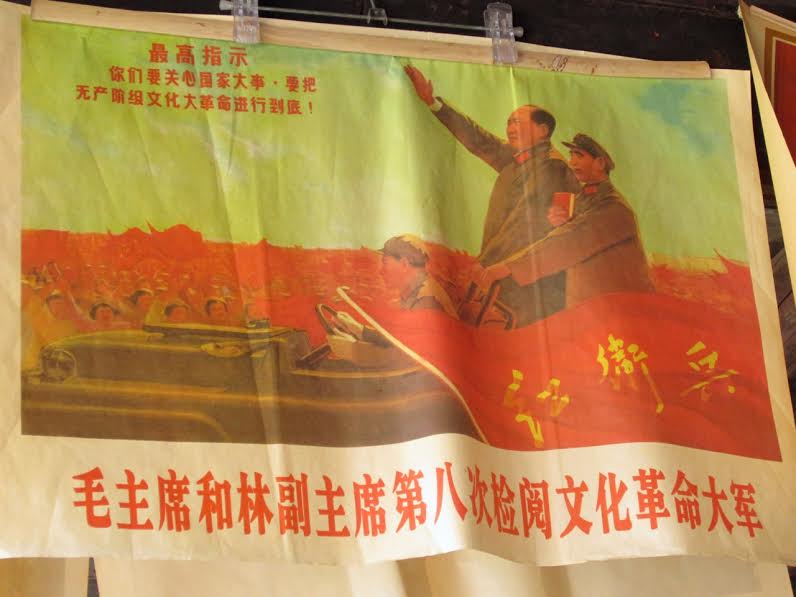
The tall man is Mao Tse-Tung receiving Red Guards, the short man holding the Little Red Book is Lin Biao, who wrote the script on my baby photo and later attempted to assassin Mao.

The tall man is Mao Tse-Tung receiving Red Guards, the short man holding the Little Red Book is Lin Biao, who wrote the script on my baby photo and later attempted to assassin Mao.

About the author

Rebecca Li-Huang was born in China to a Tiger Mother and a permissive father, and came to the US by herself with $250 for graduate school in 1990. She has worked and lived in the Midwest, Northern California and the UK. She lives near Philadelphia with her husband and two children. Rebecca holds a Master of Science from Purdue University and an MBA from the University of Chicago. This is an excerpt from her book: Green Apple Red Book: A Trial and Errors, A Memoir of a Chinese-American. 

After the Second One Comes

Story by Amanda Ann Klein

Photos by Maisy Gold Woodmansee

Only years later did I think to upload any of the hundreds of photos my daughter took with her brand new Fisher Price “Kid Tough” digital camera during the first few months of 2010. In addition to her burgeoning interest in amateur photography, it was during this time that my daughter learned what it meant to have a sibling, a brother who arrived, angry and red, late in the evening on that January 13th.

These photos are a record, in a way, of the shifting of my world from one thing into another. In this new world I was expected to love another human being with the same totalizing, one-of-a-kind, impossible-to-share love that I had for my daughter. My new world was wrapped in the gauzy fabric of sleeplessness that my fussy baby spun around us both like a soft, suffocating dream. My new world was 2 hours of sleep, then 1 hour, then 2 again, all logged with pen and paper in neat columns, a puzzle I could never solve, only record. I read a lot of blogs about sleep training and feverishly skimmed the tearful testimonials published to online mommy groups, anxious to learn of yet another sleep training method, another technique that would finally transform those 2s and 1s into 4s and 6s and, Lord Almighty, even 8s.

My memories from that time are brief and scattered bursts of moments in an otherwise blank expanse. I remember, for example, taking both children for a walk, a few weeks after the birth of my son, and my mother taking him from my arms. “Go on,” she said, “Go walk with your daughter.” This was the first (but not the last) time I would have to pull myself out of that obsessive, abusive relationship that a mother often has with her newborn — a co-dependence which is not chosen but which is thrust upon them both — in order to remind myself of my daughter’s existence. I knew she still needed me, but I had nothing left for her.

***

A large percentage of the photos on the camera were illegible — out of focus, streaked with action, or simply opaque frames, the product, most likely, of my daughter repeatedly pressing the shutter while the camera was buried in her lap. She was, after all, only 3 years old at the time.

Screen Shot 2015-01-23 at 12.43.55 PM

Screen Shot 2015-01-23 at 12.44.07 PM

Screen Shot 2015-01-23 at 12.44.32 PM

Screen Shot 2015-01-23 at 12.45.05 PM

***

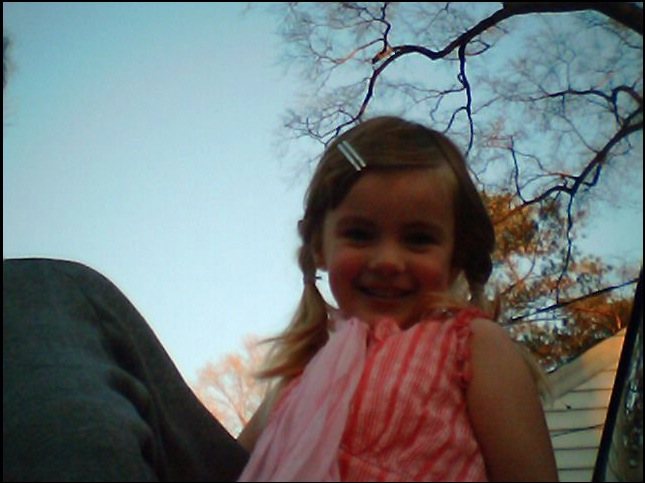
My daughter’s favorite subject was surely her face. Her expressions are either of concentration or surprise, a reflection not of her mindset at the time, I hope, but of the 3 year old’s total absence of self-consciousness. She can’t yet see how she might look from the outside, as a photographic subject. These are un-selfies.

Screen Shot 2015-01-23 at 10.56.32 AM

Screen Shot 2015-01-23 at 10.56.21 AM

Screen Shot 2015-01-23 at 10.55.25 AM

Screen Shot 2015-01-23 at 10.54.20 AM

Screen Shot 2015-01-23 at 10.52.07 AM

Screen Shot 2015-01-23 at 10.50.55 AM

Screen Shot 2015-01-23 at 10.50.44 AM

Screen Shot 2015-01-23 at 2.25.56 PM

***

Her next favorite subject was me, then the center of her world, and these photos reveal me from her point of view: as a woman forever holding The Baby. And when I’m not holding or feeding or changing The Baby, I’m about to pick up or put down The Baby. We are not two but one, The Baby and me, and my daughter is on the outside looking in.

Screen Shot 2015-01-23 at 10.55.34 AM

Screen Shot 2015-01-23 at 10.52.17 AM

Screen Shot 2015-01-23 at 10.51.22 AM

Screen Shot 2015-01-23 at 10.50.30 AM

Screen Shot 2015-01-23 at 10.49.17 AM

Sometimes my daughter catches me eating furtively in darkened corners of the house, like a fugitive who knows she might need to drop her food and dash at any minute.

Screen Shot 2015-01-23 at 12.04.07 PM

Screen Shot 2015-01-23 at 10.50.14 AM

Sometimes I’m cleaning.

Screen Shot 2015-01-23 at 10.58.17 AM

In these photos I am barely there, a ghost-mother hovering over her life. My body was not my own then; it belonged to my captor, my accomplice, my paramour, who controlled when I ate and slept and woke and shit and showered. I wasn’t Me then; I was Mother. Some days, though, I would remember myself, and I would pose.

Screen Shot 2015-01-23 at 10.48.36 AM

***

 When my daughter had enough of me, she turned to still life compositions.

Screen Shot 2015-01-23 at 10.58.07 AM

Screen Shot 2015-01-23 at 10.52.50 AM

Screen Shot 2015-01-23 at 12.20.33 PM

Screen Shot 2015-01-23 at 10.49.49 AM

Screen Shot 2015-01-23 at 12.18.39 PM

Screen Shot 2015-01-23 at 12.21.21 PM

Some, weirdly artful.

Screen Shot 2015-01-23 at 12.43.42 PM

Screen Shot 2015-01-23 at 12.21.59 PM

Screen Shot 2015-01-23 at 12.44.22 PM

***

Without her mother’s constant attention, my daughter found herself increasingly in the company of her father, who, unlike me, was always willing to pose.

Screen Shot 2015-01-23 at 10.49.05 AM

Screen Shot 2015-01-23 at 12.13.29 PM

Screen Shot 2015-01-23 at 12.25.03 PM

I’m comforted by these photos, proof of my husband’s existence in 2010, because I can barely picture his face from this time, only his actions: he is the driver of carpools, the drawer of baths, the maker of meals, the buyer of groceries, the one who can’t breastfeed.

I can only remember him on one day clearly. It was a Saturday in May, warm enough to open the screen doors and let the spring pollen dust the hardwoods and the tile countertops with its fine green coat. I had washed my hair. I remember that it smelled good that day. And I was telling my husband that his weekend afternoons alone at the community garden were too much to ask for because, while he felt entitled to a hobby, I didn’t get to have any hobbies other than keeping the baby alive, a baby who swallowed hours and days whole with his great gaping baby maw, so that meant that nobody got to have any hobbies.

I was holding on so tight then, fearful that my bone-white grip would loosen and then break free altogether, sending me spinning, weightless and out of control, into space. I don’t think I said this last part out loud. But he understood me. Some days were like that.

That summer the tomatoes in the community garden didn’t bud. Instead we bought bright, flavorless heirlooms at the store and no one complained. This is my only memory of my husband before July.

Screen Shot 2015-01-23 at 10.56.55 AM

Screen Shot 2015-01-23 at 12.23.36 PM

***

My daughter’s camera also documented the steady stream of visitors who came and went during those first few months — bringing gifts and extra arms and the promise of naps which never came — and who acted like they were there to see my daughter even though she was old enough to understand they were not.

My mother:

Screen Shot 2015-01-23 at 10.51.46 AM

My in-laws:

Screen Shot 2015-01-23 at 10.53.26 AM

Screen Shot 2015-01-23 at 10.53.04 AM

Screen Shot 2015-01-23 at 10.51.08 AM

Screen Shot 2015-01-23 at 12.15.54 PM

Screen Shot 2015-01-23 at 12.16.07 PM


Screen Shot 2015-01-23 at 10.50.02 AM

Screen Shot 2015-01-23 at 12.18.08 PM

Screen Shot 2015-01-23 at 10.49.33 AM

My husband’s cousins:

Screen Shot 2015-01-23 at 10.57.12 AM

Screen Shot 2015-01-23 at 10.52.28 AM

My hometown best friend:

Screen Shot 2015-01-23 at 10.55.46 AM

My friends from work:
Screen Shot 2015-01-23 at 10.54.54 AM

Screen Shot 2015-01-23 at 10.57.27 AM

And her friends, too:
Screen Shot 2015-01-23 at 10.53.47 AM

Screen Shot 2015-01-23 at 10.51.34 AM

Screen Shot 2015-01-23 at 12.24.16 PM

Screen Shot 2015-01-23 at 12.22.42 PM


Screen Shot 2015-01-23 at 12.19.55 PM

***

And there were, of course, photos of him, The Baby, the one who everyone loved but who barely did anything at all. Did she love him then? There was nothing in it for her, but still, I think she loved him a little.

Screen Shot 2015-01-23 at 10.51.58 AM

Screen Shot 2015-01-23 at 10.52.39 AM

Screen Shot 2015-01-23 at 10.54.01 AM

***

Looking back to 5 years ago, I’m remembering my guilt. I’m remembering how I assumed my daughter felt abandoned by a mother who possibly loved her a little less now that there was a new baby in the house. I imagined her pining for me, the mother who cried during bedding commercials because she wanted to slip between the cool whiteness of that Egyptian cotton and sleep for hours with a big smile on her face, too, the mother who was always around but never really there, the mother who was so close to spinning away and away and away. I always assumed that this time was as hard on her as it was on me.

But now, when I look back at these photos, I can see that my daughter was fine all along. These pictures tell me the story of her life from moment to moment as she set up still life compositions or went to the park with our neighbors or, after many failed attempts, figured out how to take one, perfect selfie.

Screen Shot 2015-01-23 at 2.26.29 PM

Editor’s Note: After Maisy read this story, I asked her if I could interview her and if I could add it to the story. She was down.

About the photographer

Maisy Gold Woodmansee is 8 years old and lives with her parents and younger brother in North Carolina. She has a high blue belt in Tae Kwon Do and enjoys acting and singing.

Flash Fiction Week!

This week we bring you two pieces of flash fiction: “Method Acting,” by Jeremy Osbern, and “The First Time,” by Alice Lowe. Scroll down to read both.

“Method Acting”

by Jeremy Osbern

The author, on set.

The author, on set.

It was just the three of us in that small room, waiting to block the day’s first scene.

Oscar-winning actress started, “So, Guy From Platoon, how do you like to do your drugs?”

His voice was monotone.

“I just like to do ’em evenly. Space them out.”

“Really?” she shouted. “I like to do my uppers all at once and then add the downers to even it out. And then I do the uppers all at once again all over again.”

Guy From Platoon just shrugged.

“The First Time”

by Alice Lowe

image source: wikipedia.com

image source:
wikipedia.com

New Year’s Eve. I was 13, maybe 14. My parents were going out but would be home soon after midnight. Katty, a second or third cousin, came over to spend the night. She was my favorite companion in 1950s-style mischief, a year older, physically mature, streetwise. I was easily led, drawn outside my comfort zone in my eagerness to be liked and accepted.

We watched specials on TV, the ball dropping at Times Square. Katty suggested we have a drink to celebrate. My father was a heavy drinker, so my mother didn’t allow hard liquor in the house. A search of the kitchen turned up a bottle of Manischewitz concord grape—sweet, syrupy wine that my mother kept for Jewish holidays and to dose me in small amounts for menstrual cramps. I poured a couple of glasses; we toasted and sipped, neither of us admitting how cloying and medicinal it tasted.

“A drink always makes me want a cigarette,” Katty said.

“Oh yeah, me too,” I replied.

“I was going to quit for New Year’s,” she said, “so it would be nice to have one last smoke.”

I agreed, both to quitting and wanting to kiss off my “habit” with a few last fond puffs.

We found an open pack. Tareyton’s, I think, a long gone brand with the grammatically incorrect slogan, “Us Tareyton smokers would rather fight than switch!” Or they may have been Raleighs, which came with coupons that my mother collected and redeemed for gifts.

I held a lit match to the end of the cigarette before figuring out that I had to suck on it for the paper and tobacco to ignite. I watched Katty inhale. Not wanting her to guess that this was my first, I drew in, just a little, and coughed, just a little. “I must be catching a cold,” I said; “my throat’s a little scratchy.” We fanned the room, disposed of the butts, and washed the glasses. At midnight we went outside to catch glimpses of the fireworks from the nearby fairgrounds, my rite of passage behind me.

About this week’s authors

Jeremy Osbern is a filmmaker and writer. His most recent film, COURTESAN, is premiering next week at the Slamdance Film Festival. You can view more at: http://www.jeremyosbern.com

Alice Lowe reads and writes about food and family, Virginia Woolf, and life. Her work has appeared in numerous literary journals, including Upstreet,Hippocampus, Tinge, Switchback, Prime Number, Phoebe, and Hobart. She was the 2013 national award winner at City Works Journal and winner of a 2011 essay contest at Writing It Real. A monograph, “Beyond the Icon: Virginia Woolf in Contemporary Fiction” was published by Cecil Woolf Publishers in London. Alice lives in San Diego, California and blogs at www.aliceloweblogs.wordpress.com

.

Survival (Part 2)

Editor’s note: Today’s story is a follow up to “Survival (Part I),” which we published on November 5th of this year. We have requested and received permission to reprint all of the correspondence in this story.

by Allyson Wuerth and Amanda Ann Klein

In the 18 months we’ve been on the internet Tell Us A Story has published stories both unusual and banal. Anjila Joi Guadet wrote about her experiences as a homeless teenager living on the streets of D.C. in “Squat” and Adam Rose told us what it was like to pump his body full of chemicals in “Treatment: Cycles Three & Four.” But a story need not include teenage runaways or cancer or the police to win a spot on our blog; we’ve also published far less sensational fare, like Allyson Wuerth’s sordid history with math or Jesse Millner’s simple, beautiful meditation on the small miracles of life. Mostly, we just want to hear about people’s lives and what sticks in their minds as a story worth telling, worth writing, and worth hearing. Some stories are too terrible to share while others are too wonderful not to. But, no matter the subject, we like to believe that all our stories are linked together by one thing: they are true.

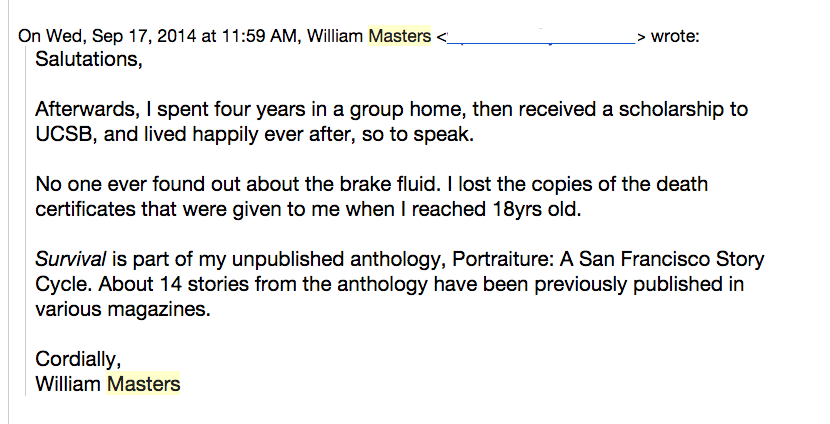
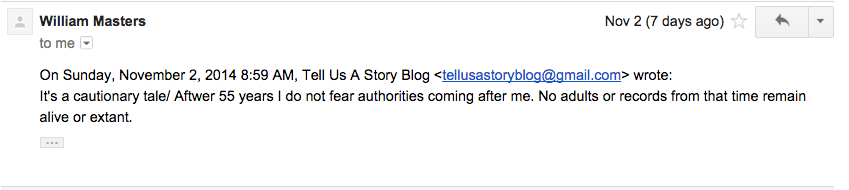
Then, one fine day in September, we received a submission along with this email:

masters1

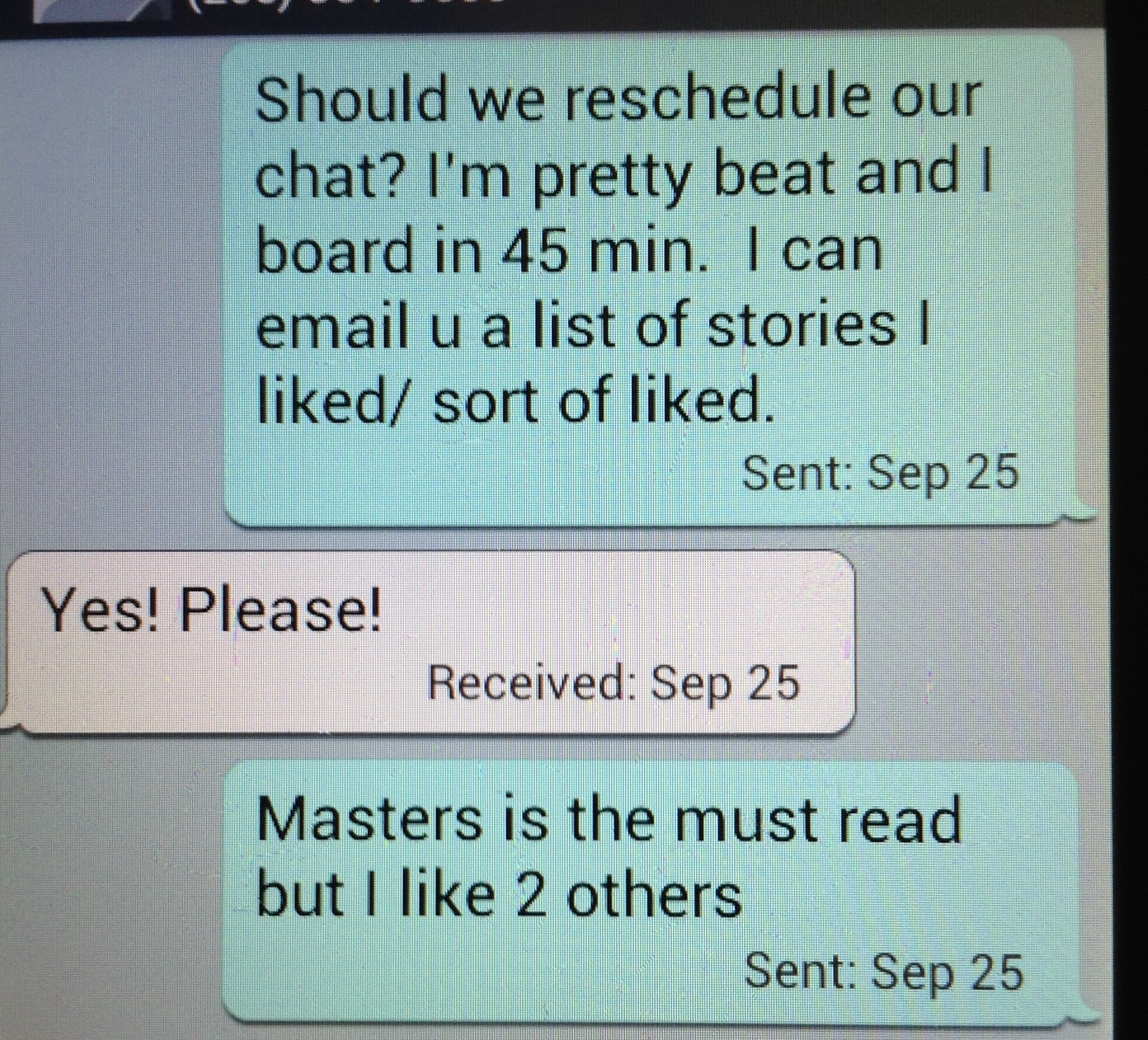
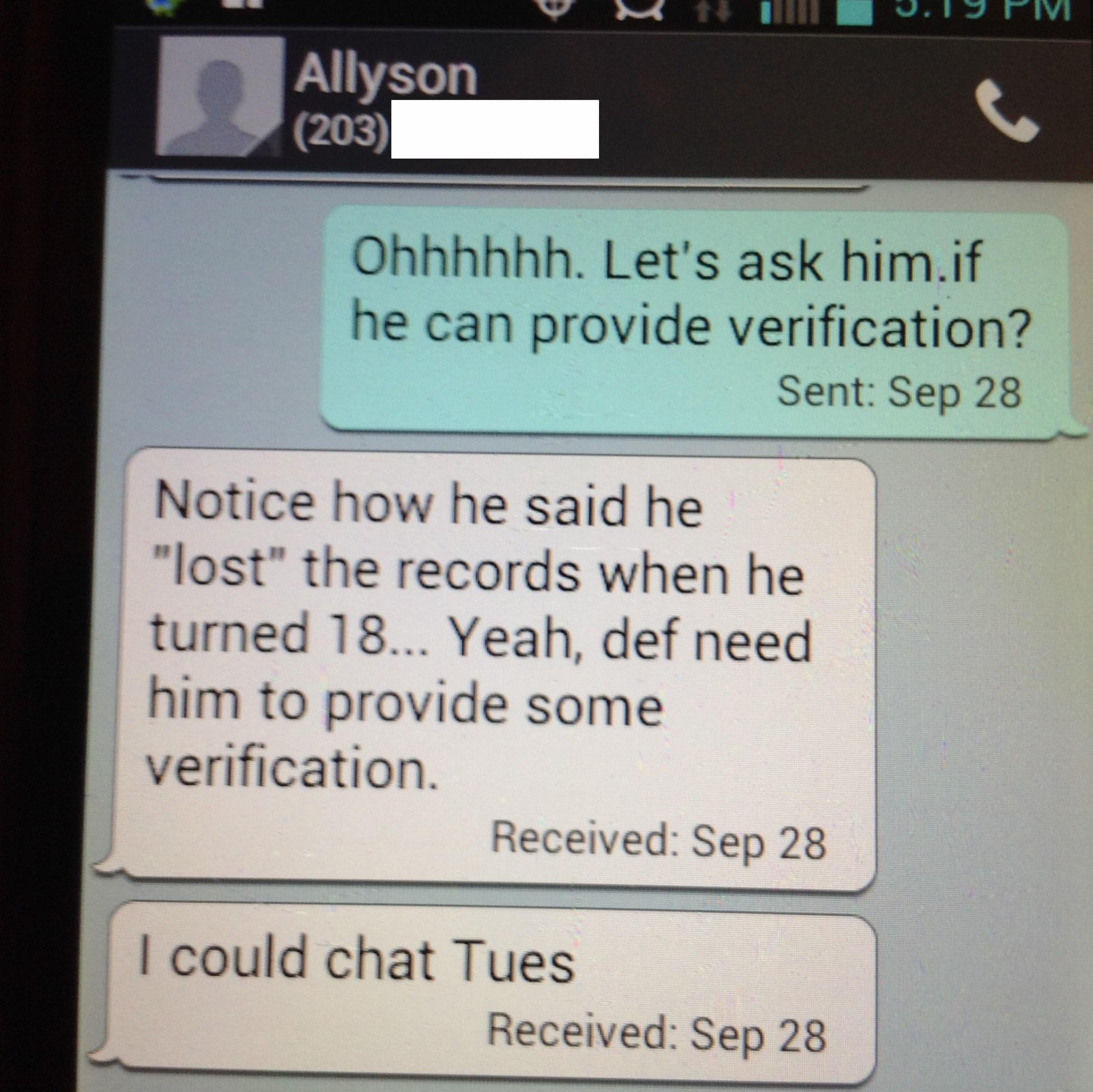
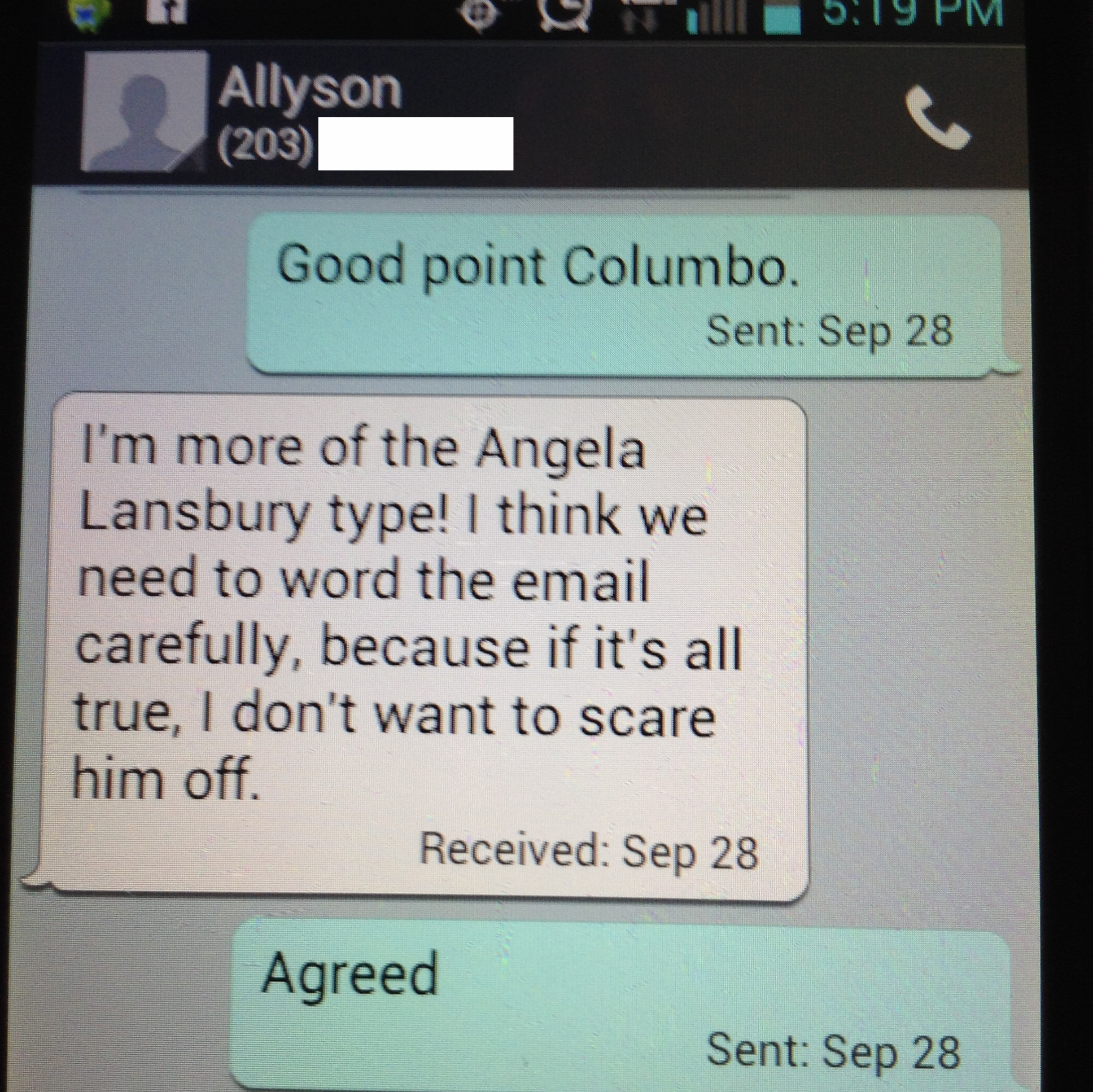
In the attached story, “Survival,” William Masters described how, as a young boy, he brought about the death of his own parents. On purpose. Because they deserved it. When I finished reading his story, I was, needless to say, in shock. Allyson and I were planning to discuss “Survival” the following week, but we were short on time and needed to reschedule. Still, I urged her to read Masters’ piece no matter what because I didn’t want to lose it to another magazine (this has happened to us before):

text1

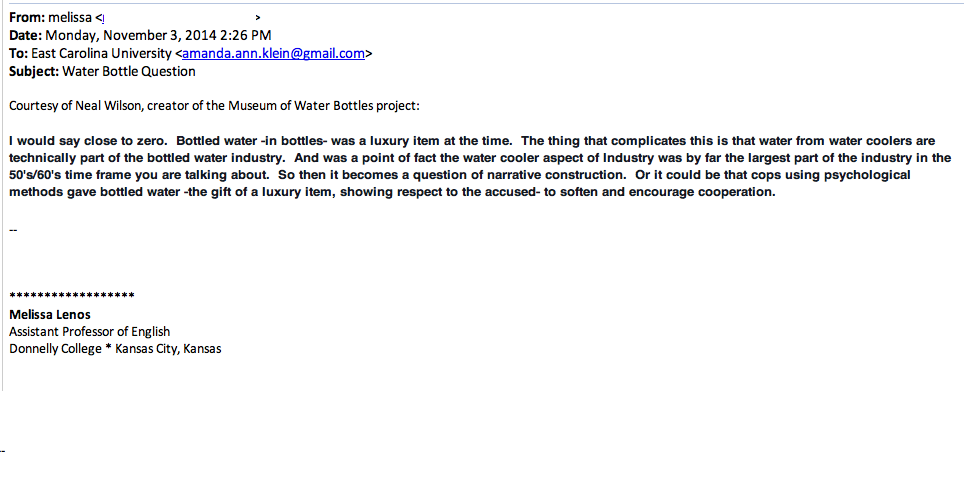
We’ve received hard-to-believe stories before, like Karra Shimabukuro’s narrative about her infamous Stradivarious-stealing step-grandfather, a bad man who met a bad end. But Karra knew her story was hard to believe, which is why her submission was accompanied with numerous newspaper clippings and personal photographs, documentation that backed up her almost unbelievable story. Indeed, many of our stories are constructed around their sources, like Shari Barnett’s “Meeting Frank,” a delightful tale of video games and aging crooners centered on a black and white photograph of an early 80s Pac Man costume, or Melissa Lenos’ “The Box,” which may or may not be about a super-spy Nana. Masters’ story was, without a doubt, the most salacious story we’d ever received and although he offered us no documentation to back up his claims, my excitement blinded me to the possibility that the author might be lying.  

Yes, I was excited. But Allyson had her doubts. 

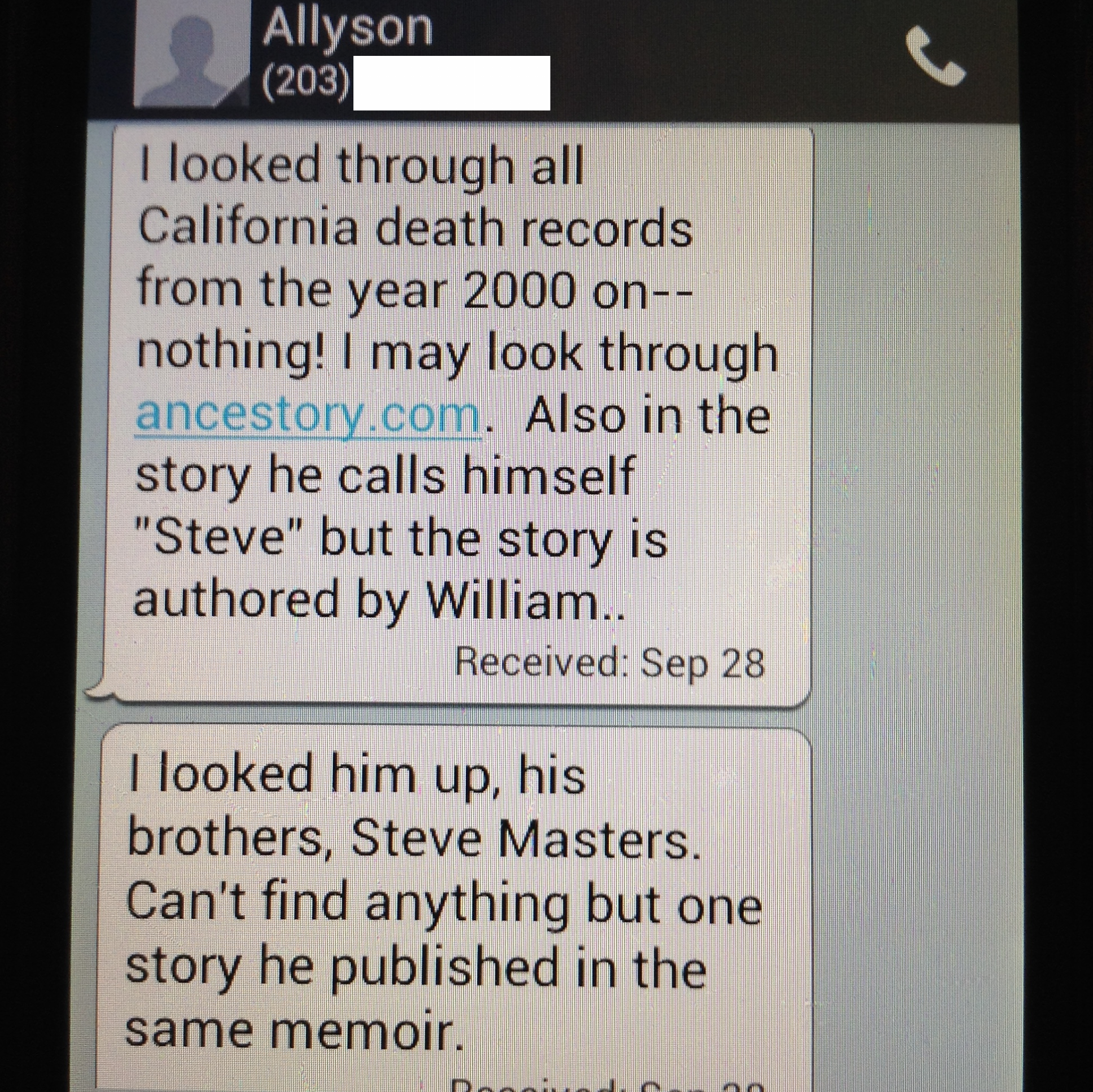
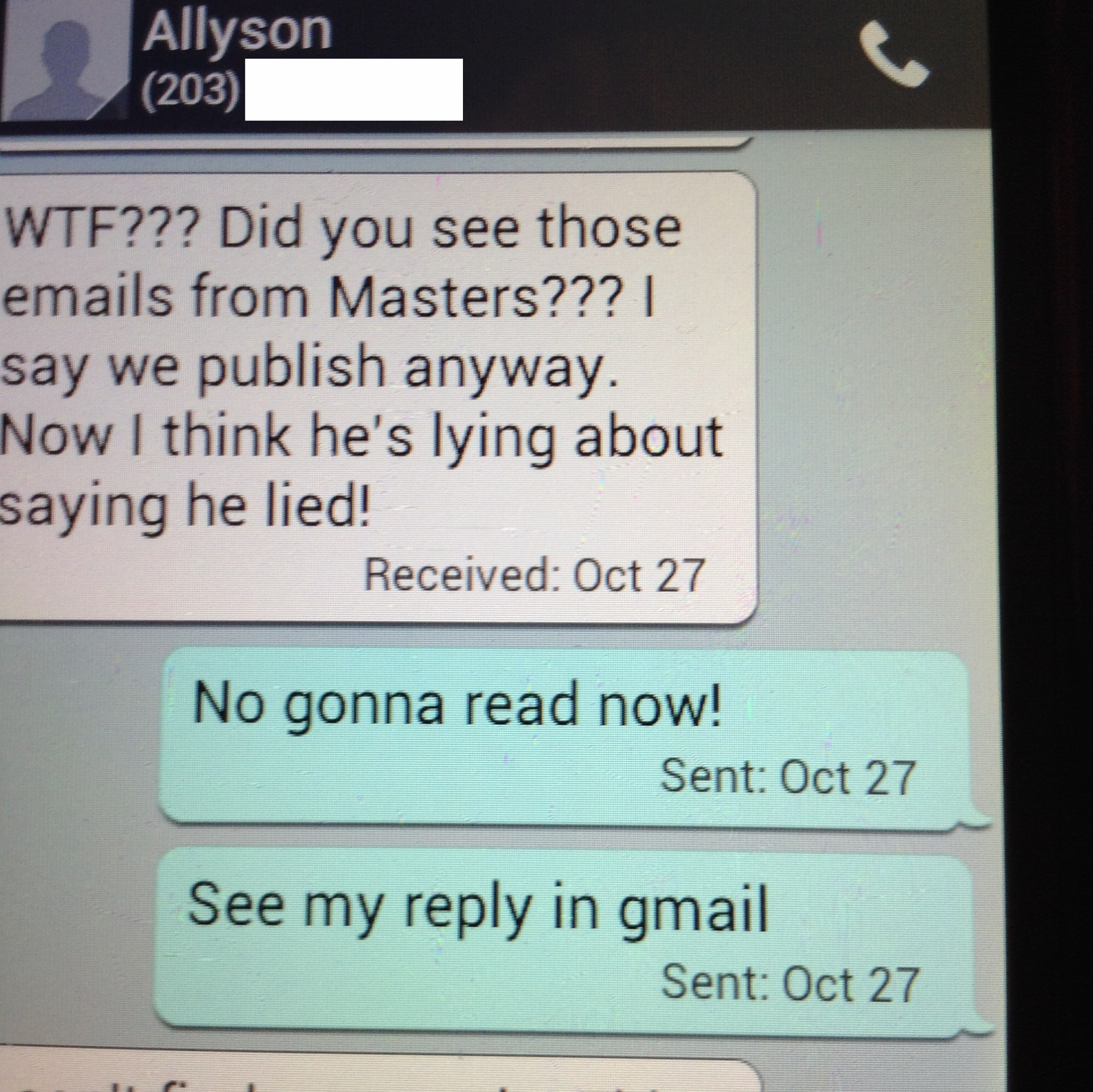
Indeed, I did. First, I was not as enthusiastic about the prose as Amanda was. Second, this story was nothing like our other forays into the underworld. Sure, we’ve covered ambiguously dead roommates, dead cats like Blacky and Roogie, but dead parents? And not just dead dead parents, but murdered dead parents!

So, I purchased an account on some online family search website and scoured all California obituaries that I could find:

text 4

So, I suppose it could really happen, a boy, a teen — like the ones I stand before 5 days a week — deciding enough is enough. Perhaps an auto shop class under his belt, some under-sized wise ass whose fists were no match for his father’s. He took a gamble, maybe the innocent suggestion of some teacher trying to bring him out out his shell: “Take some risks, William. Go ahead.”

Or maybe brake fluid is something all boys of a certain generation know about draining?

Or maybe all of it was just a lie…

For what gain? While we work hard generating readership on Tell Us a Story, we’re still very much the new kids on the block. Why send such a story to us, where maybe a few hundred people might see it? We certainly don’t offer payment to our contributors.

text 2


columbo text

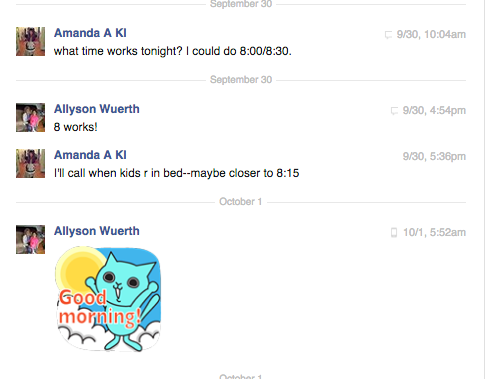
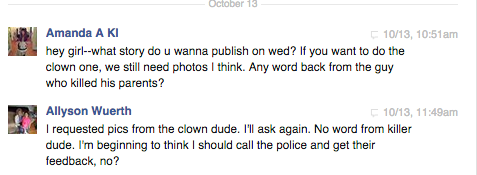
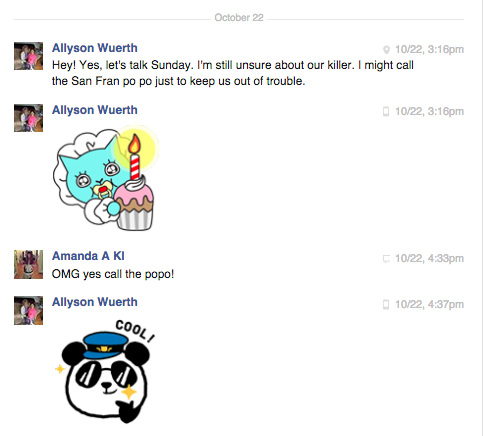
Yes, my Angela Lansbury was suspicious, but me? I wasn’t ready to give up on the dream of publishing Masters’ story. Allyson and I continued to discuss it whenever we had our editorial meetings:

Screen Shot 2014-11-09 at 6.11.37 PM

 We finally decided to accept the piece, but to ask the author for verifying documents:

Screen Shot 2014-11-09 at 5.32.30 PM


masters

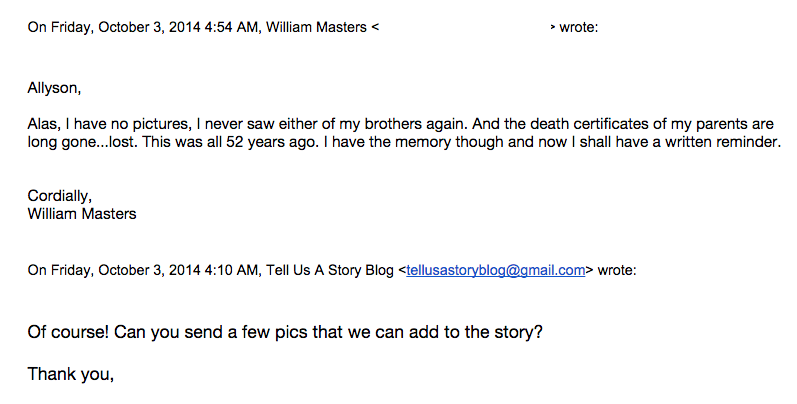
Of course, Masters’ continued evasiveness complicated our plans to publish his story. We kept putting it off, week after week.
Screen Shot 2014-11-09 at 6.10.25 PM


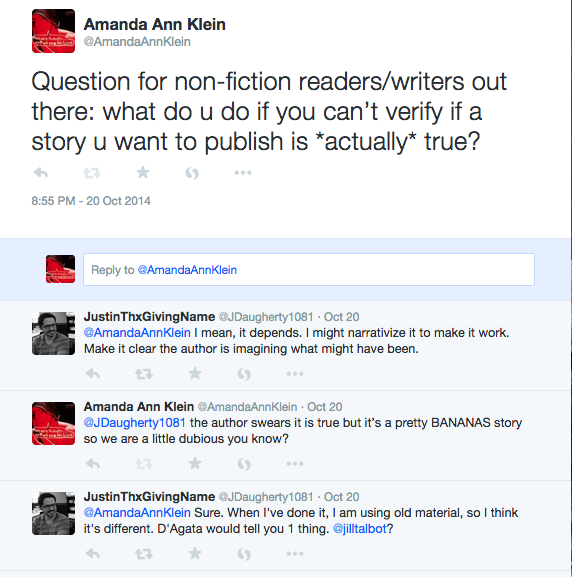
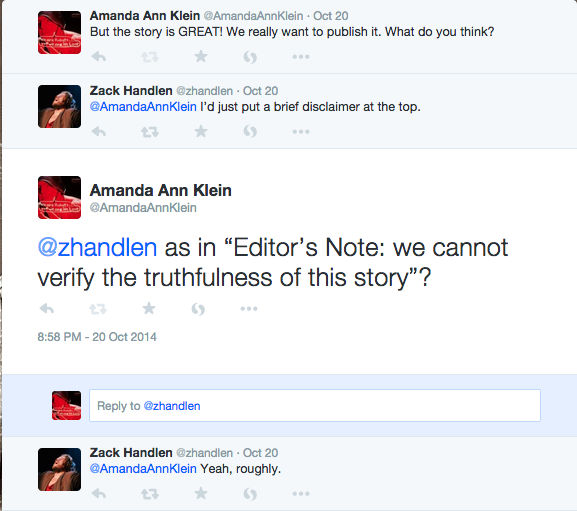
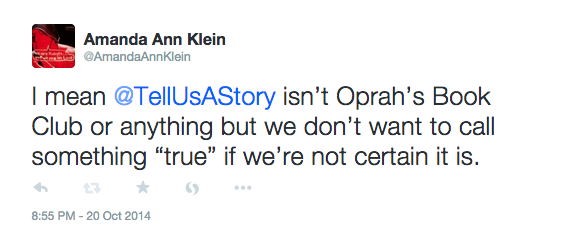
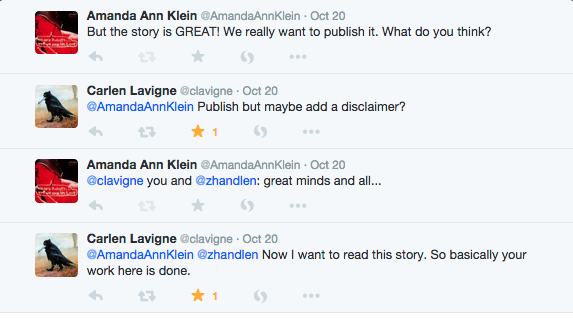
While Allyson pondered calling the police, I went ahead and consulted my most trusted source: Twitter.

Screen Shot 2014-11-09 at 5.56.34 PMScreen Shot 2014-11-09 at 6.00.25 PM

Screen Shot 2014-11-09 at 5.57.46 PMScreen Shot 2014-11-09 at 6.02.52 PM

Then I reported Twitter’s useful advice back to Allyson: 

Screen Shot 2014-11-09 at 6.13.01 PMScreen Shot 2014-11-09 at 6.14.06 PM

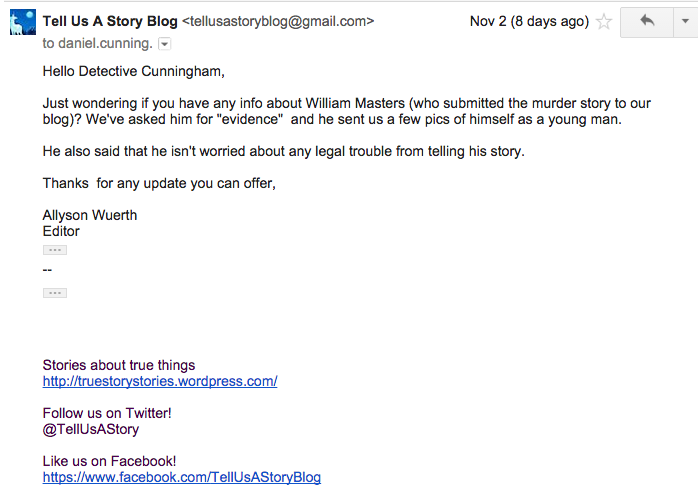
So I called Detective Daniel Cunningham at the San Francisco Police Department. The more questions he asked me, the more I doubted William’s story.

I narrated William’s story, including his discrepancies and other unlikely bits: the name Steven instead of William (which appears twice in the story), the bottled water in a story that had to have happened in the early 1960s, and the eleven-year-old brother who hops a freight train and heads to the mid west. After a long pause, Detective Cunningham asks, “Is the story well-written or does it have a lot of grammar mistakes?”

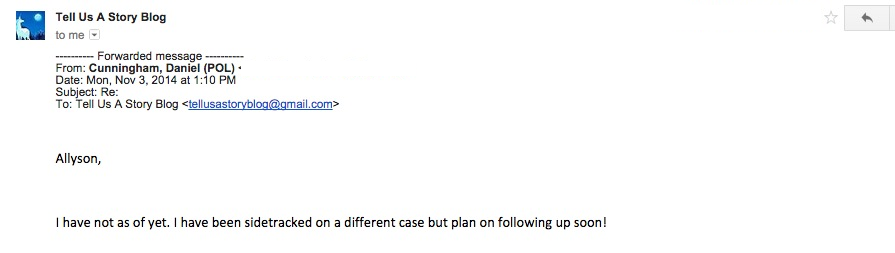
As if it were impossible for a murderer to write or speak well. Still he seemed interested and asked me to send him any information or communication I had with William. I sent him follow-up communications and then waited.

Screen Shot 2014-11-09 at 6.14.43 PM

dc

And waited. . .finally getting this response:

Screen Shot 2014-12-02 at 10.06.39 AM

Then we received this email from Masters:

Screen Shot 2014-12-01 at 2.05.57 PM

Sure, we had our suspicions about the story’s veracity before, but to have Masters send us an email declaring that the whole thing was a lie? Well that just seemed insane. We had no idea what was going on. A few minutes later, we received this email from the author:

Screen Shot 2014-11-09 at 5.35.51 PMClearly William had accidentally sent us an email intended for his friend. It was careless and silly of him but what really outraged us were his attempts to cover it up.

lying emails text

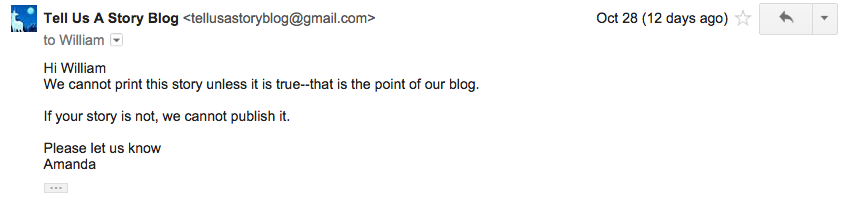
Then Allyson wrote this email to Masters (she was mad):

Screen Shot 2014-11-09 at 5.37.28 PM

Screen Shot 2014-11-09 at 5.38.34 PM

Screen Shot 2014-11-09 at 4.57.09 PM

Then, still more denials:

Screen Shot 2014-11-09 at 4.57.16 PM

Screen Shot 2014-11-09 at 5.41.34 PM

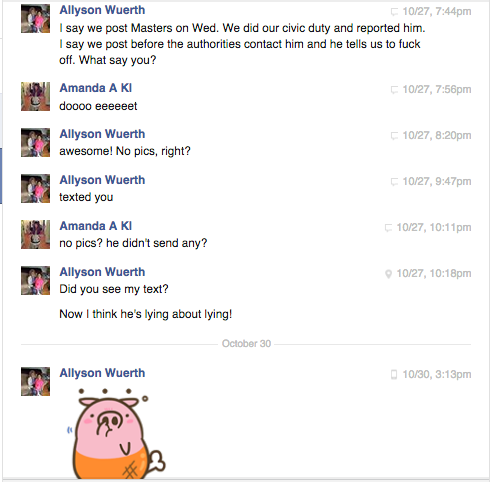
Then, onto Facebook we went:

Screen Shot 2014-11-09 at 6.15.36 PM

Amanda gets real:

Screen Shot 2014-11-09 at 4.57.55 PM

Screen Shot 2014-11-09 at 4.58.05 PM

Screen Shot 2014-11-09 at 4.58.14 PM

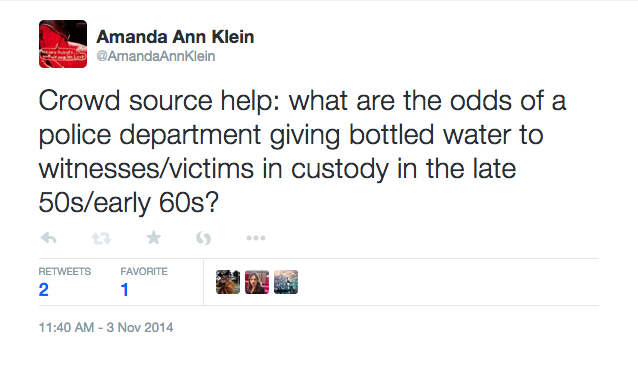
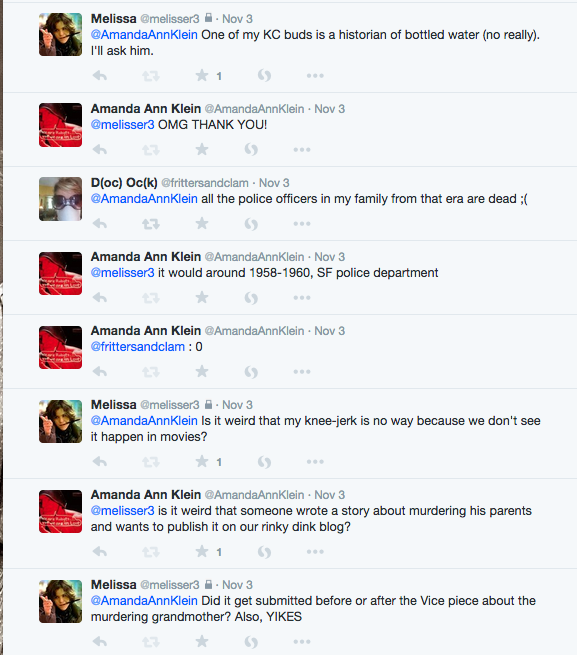
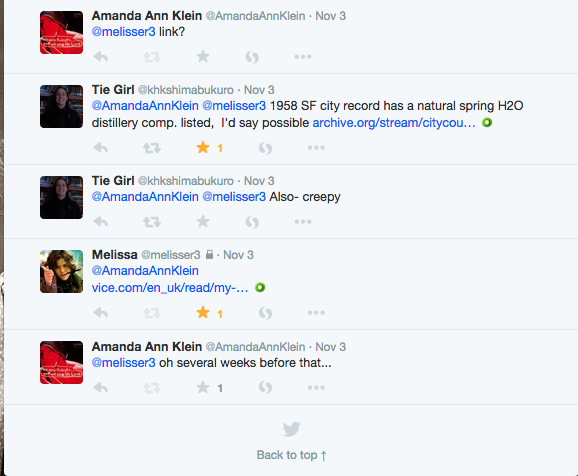
Screen Shot 2014-11-09 at 4.58.22 PMLacking any further evidence from the author and getting nowhere with the San Francisco Police Department, Angela Lansbury  Allyson suggested that we look into things we *could* verify about the story, such as the fact that Masters claimed he was given a bottle of water at the police station:

Screen Shot 2014-11-09 at 5.47.53 PM

Screen Shot 2014-11-09 at 5.51.44 PMScreen Shot 2014-11-09 at 5.48.33 PM

Screen Shot 2014-11-09 at 5.48.44 PM

Thank you Twitter!

screen-shot-2014-11-09-at-5-50-37-pmThe more we emailed with William, and with our Associate editors, Coral and Brandon, the more we realized that the story we were telling was not of fictional, murderous William and his fictional, Dickensian parents. The story, rather, was about us—two frazzled working moms who were hoping to find a story that would garner some attention for their blog and who therefore invested weeks of time and energy into trying to prove the story was true before realizing that it was, ultimately, a fool’s errand. And this new story that emerged out of Masters’ lie, about what it means to try to create art when your life is filled with carpooling and dentist appointments and piles of laundry and deadlines and no goddamned raises from your broke-ass state university and bored students who call you a “bitch” when you ask them not to use their cell-phones and beg them for the love of god  to just pretend to be interested in Frankenstein, and to want so badly for that art to be seen and read and appreciated. So this story, you see, became about us. And so we decided to publish Masters’ story—not because we believed his dramatic tale, but because we didn’t.

Screen Shot 2014-12-01 at 2.18.38 PM

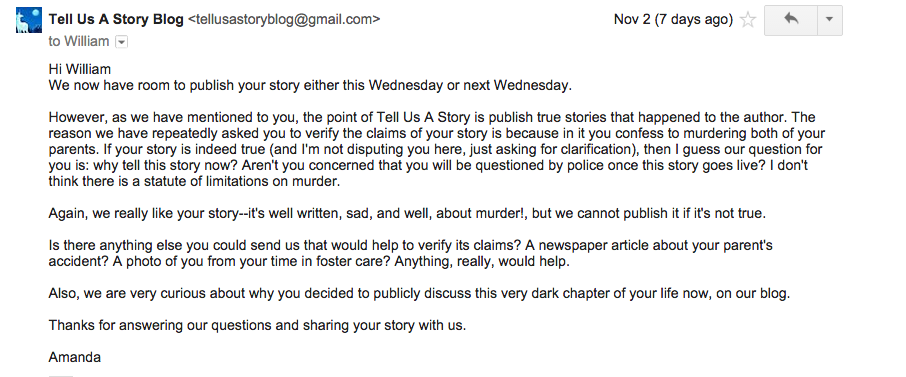
Our preface really pissed off the author (you can read his reactions in the comments section of “Survival (Part I)”) and at that point Allyson and I had pretty much decided to drop the whole thing. We wanted to write our follow up, explaining why a true story blog would publish a piece we didn’t believe was true, but the author seemed so angry with us that a follow up just seemed like rubbing salt in the wounds. Were we telling a good story or were we just making fun of an easy target? We bagged our plans to post our follow up the next week and published several more stories. We thought that our readers had likely forgotten about our promise to post a follow up and we planned to leave it at that. But then, like a gift, Masters sent us this email just after Thanksgiving:
Screen Shot 2014-12-01 at 1.19.42 PM

Screen Shot 2014-12-01 at 1.21.19 PMScreen Shot 2014-12-01 at 1.21.56 PMScreen Shot 2014-12-01 at 1.22.39 PMScreen Shot 2014-12-01 at 1.23.34 PMScreen Shot 2014-12-01 at 1.24.16 PMI, for one, still want to see those death certificates, some papery souvenir to commemorate the distance that grew between a fourteen-year-old boy and his drunken parents’ brake-less car.  And, as a mother, I need to know the truth about whether an eleven-year-old boy felt his life was so horrible that he needed to jump a freight train to nowhere. I need to know whether or not three boys were willing to run, to steal, to go to jail, to kill in order to survive the people who were supposed to love them most in this world.

Call for Submissions

Tell Us A Story is taking this week off so we can spend some quality time with our families this Thanksgiving. But don’t worry–we are still reading your submissions!

So do you have a good story to tell? Remember, you don’t need to be an author by trade (or by hobby) to submit to us. We’re looking for good, compelling, true stories, in any form.

All submissions must be less than 2000 words and must be based on something that actually happened to you (not to your friend or your cousin or your high school math teacher). We are also interested in very short stories (flash [non]fiction), experimental stories, poems, or plays as long as they are true. When possible, we’d like you to send us a scanned photograph or document that correlates with your story, because those kinds of details are nice.

Please send submissions as an editable attachment (no PDFs please!!!), along with images, and a 100 word (or less) biographical statement to tellusastoryblog@gmail.com.  Put “TUAS Submission” in the subject line. Please submit only one submission at a time (unless you are sending poetry).

The Box

by Melissa Lenos

The Box, lined with archival inserts and conscientiously tagged Ziploc bags full of photos, had become something of a party trick. One friend has a hilarious story that becomes more elaborate with each retelling, another a dog that can open the refrigerator and bring guests beers.

And I had the Grandmother Box: a plastic file bin packed with the history of my mother’s mother, hundreds upon hundreds of photos, newspapers clippings, fan letters and bizarre remnants of the life of a woman I don’t remember. My grandmother: the professional wrestler, the author, the songwriter, the model, the airplane enthusiast, the amateur sports fisherwoman, the possible (probable) escort. I would tell you her name, except that I’m not certain of it – the Box contains documents that use half a dozen different names and variations on their spellings, so I just refer to her as Grandmother.

pic1

The author’s grandmother: “Polaroid Glamor – a Girl’s First Mink”

When my older sister sent me the Box, it was a different Box: brown cardboard packed with the ancient, non-archival photo albums, shredded promotional posters and a handwritten account of my grandmother’s life, taken down by my biological mother, who I haven’t seen or spoken to since I was three years old.

pic2

The author’s biological mother (age 15) and grandmother at a wrestlers’ reunion cookout.

Grandmother launched a legacy of chaotic women; we are prone to extremes, drawn to anarchy, bright but restless, physically powerful and true extroverts. In other words: generally interesting and charismatic women, and not terribly maternal. The photocopies of my mother’s handwritten pages were the only contact I’d had with her in two decades. I noticed that it seemed as though she might be left-handed, because of the slant of the script, then I dropped the sheaf of pages back into the Box, and didn’t open it again for several years.

barpose

The author’s grandmother enjoys the use of her home bar (1964)

It was my husband who saw the Box as a beginning, rather than the end of an extraordinary life. He pointed out that my grandmother was fascinating enough to warrant a biography of her exploits, and that I, her final grandchild, was the perfect candidate for the task: an academic obsessed with research and armed with a friends list full of historians of popular culture. But there was always a reason to put the project off – I was just starting a doctoral program, I was drowning in dissertation, I just began a tenure track job, I need to focus on my promotion binder.

promo2

The author’s grandmother supporting some troops (undated)

All along, the real reason skimmed under the surface: that I reveled in being somewhat pastless; that I feared what Grandmother’s legacy might reveal.

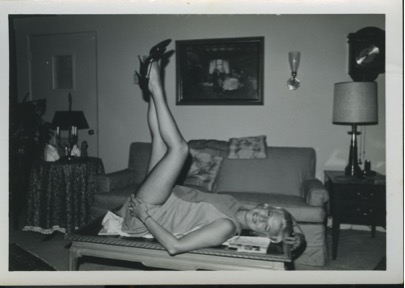
tablepose

The author’s grandmother enjoys her coffee table (undated)

I also struggled with deciding on a format. “Memoir is my least favorite form,” I’d been known to declare in a bitchy tone, so while that did not seem like an option, writing an arm’s-length biography of a family member also seemed disingenuous. “Just start digging,” one of my writing partners said. “Why don’t you hire a research assistant?” my husband asked. To research what? The woman’s life was a hurricane of activity and there didn’t seem like a logical beginning.

book-intro

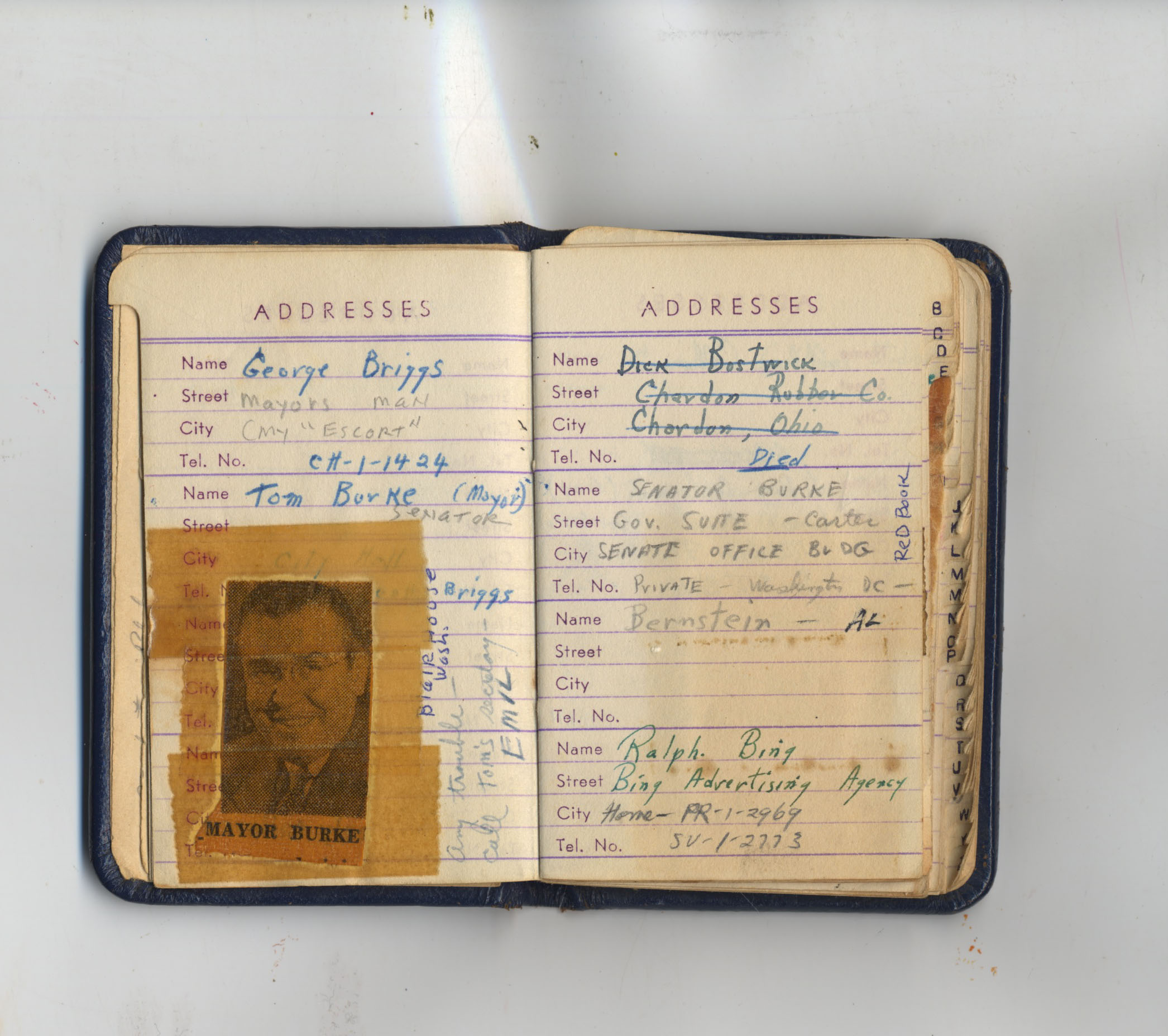
I started with a small address book. The second entry is Tom Burke, a mayor of Cleveland from the mid-1950s. The entry includes a phone number for “the mayor’s man” and a pasted-in photograph of Burke. The second page contains the updated entry: “Senator Burke” and a number that is annotated “private extension.”

book-B

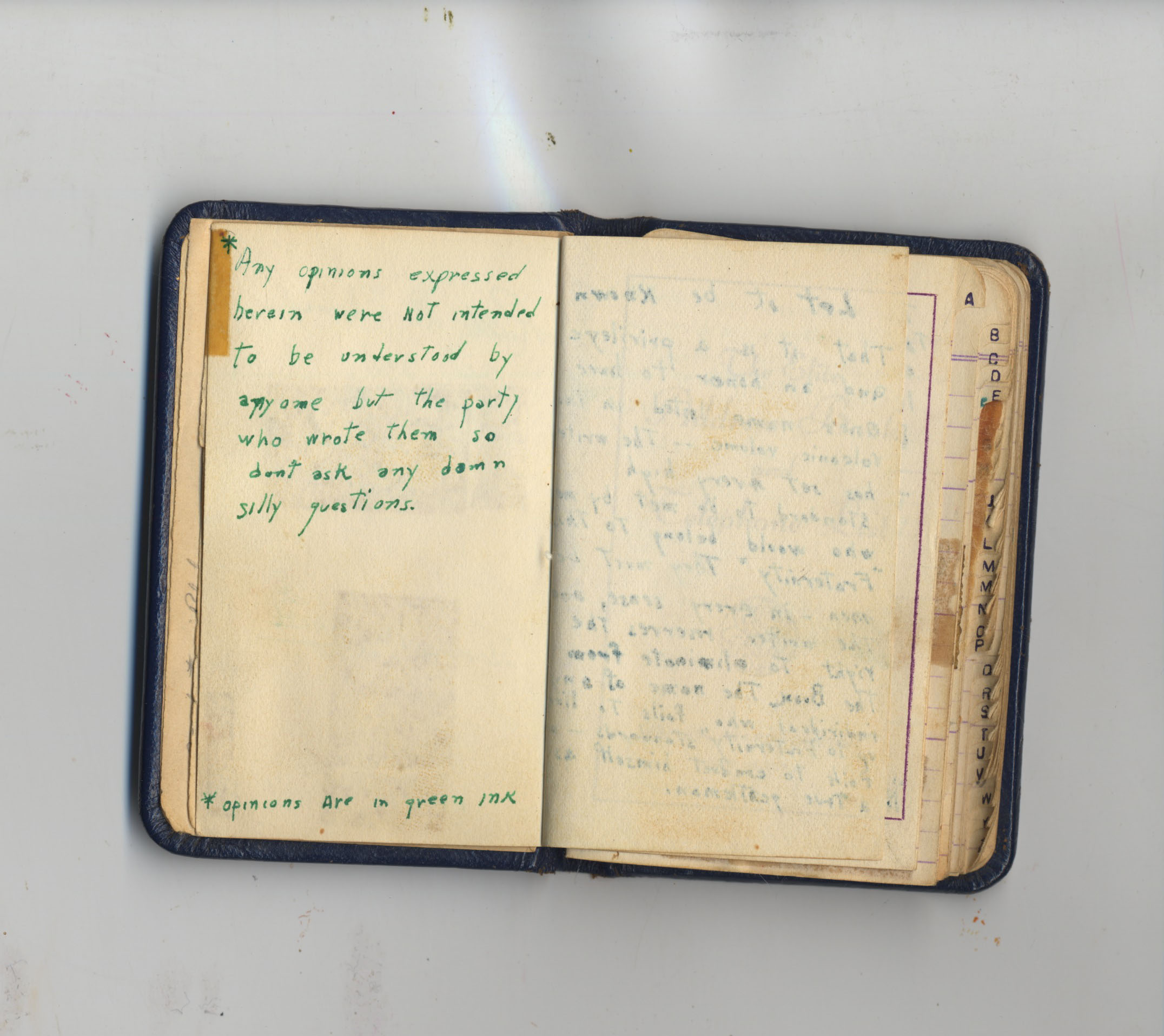
I put down the book. This task is daunting and frankly, surreal. What can this possibly mean? As though predicting my confusion, Grandmother included an additional preface: 

book-opinions

Then below:

* opinions are in green ink

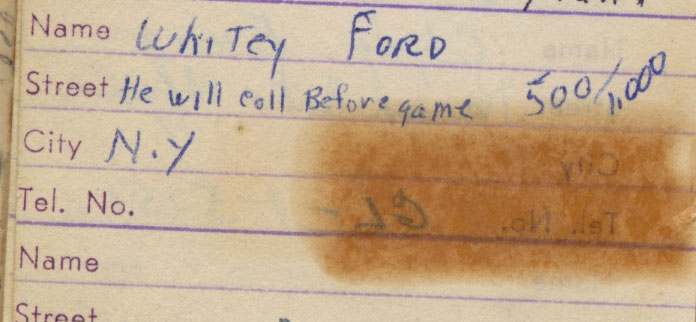
My grandmother had a lot of opinions; most of them are written in a code I cannot decipher. She occasionally made price notations in the margins as well – billing scales? At some point (between World Series wins?) good old Whitey Ford’s bill jumped from $500 to $1,000.

book-Ford-detail

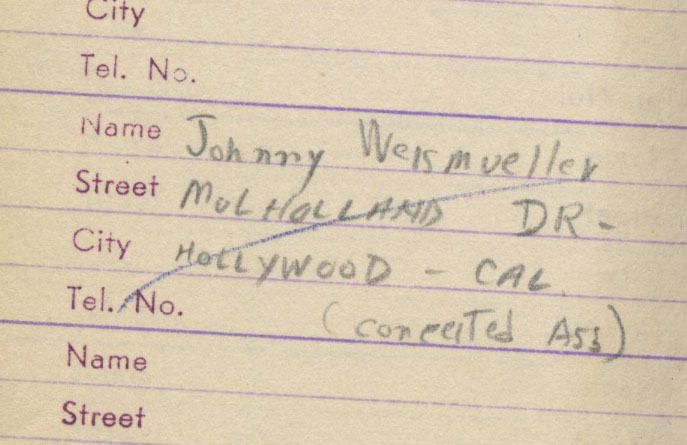
And every now and then someone is crossed out with a violent strike across the page:

Weismueller1

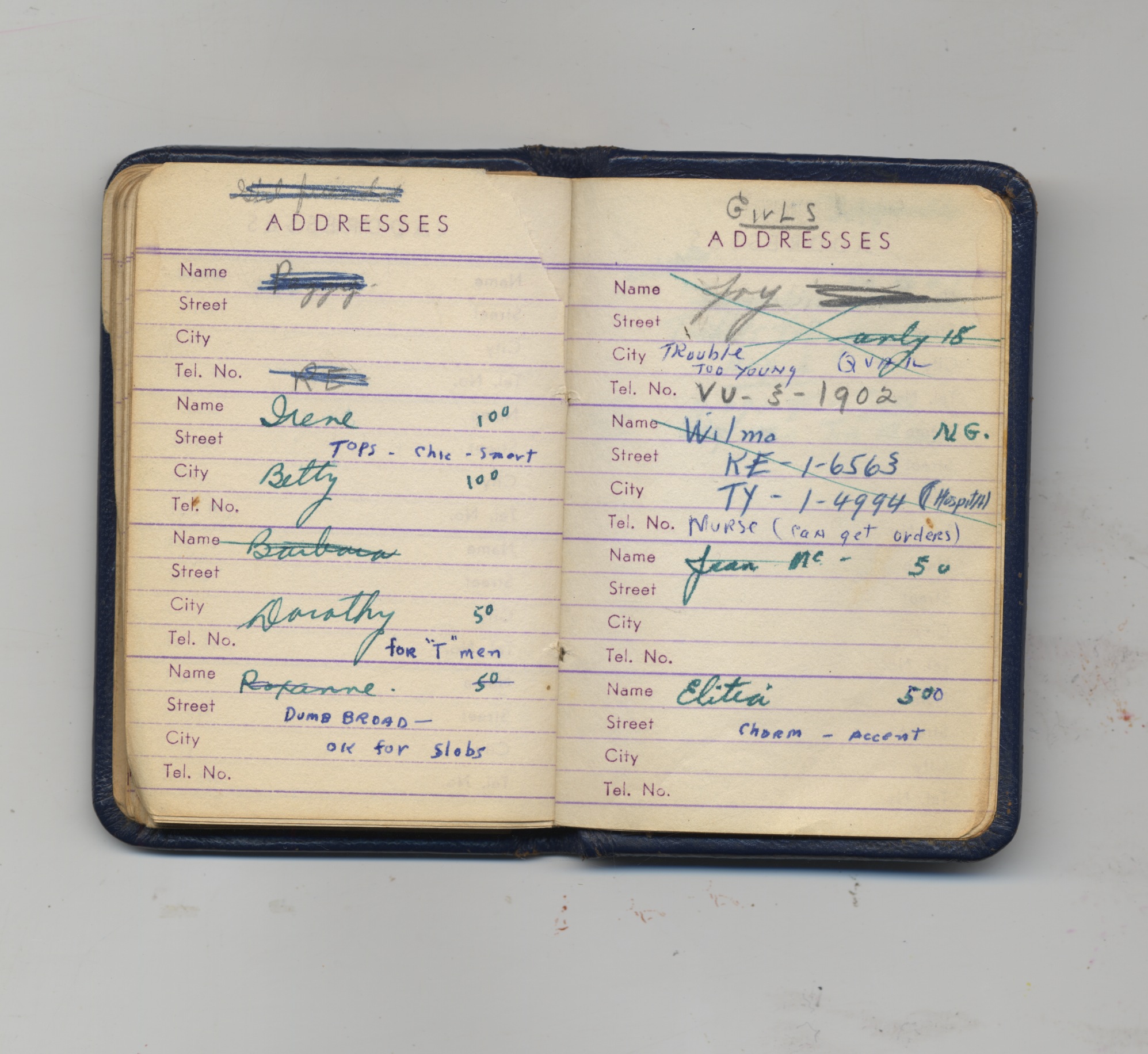
Not all of the notes are about men; near the back is a list of women’s names and brief notes:

book-Girls 

Irene – tops, chic, smart

Joy – TROUBLE too young

Elitia – charmer, accent

Wilma, nurse – can get orders

And poor Roxanne, “dumb broad – okay for slobs before Grandmother changed her mind and crossed Roxanne out altogether.

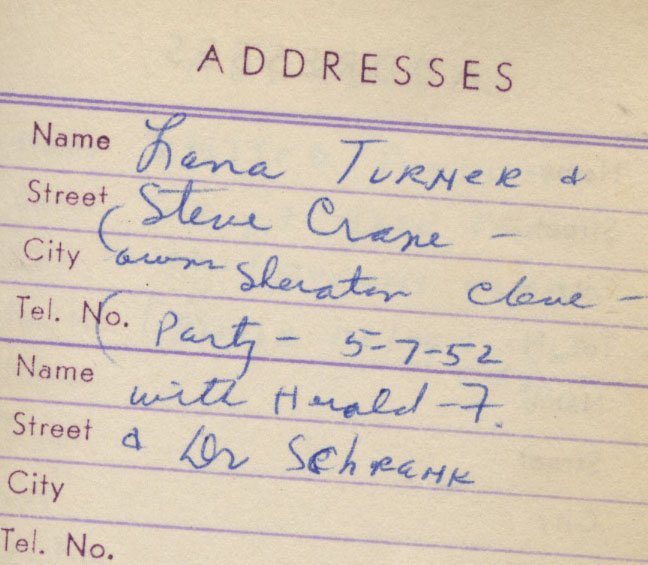
The next time I opened the book, I discovered a page that had previously been stuck to another, in the section marked T, an offhand note in my grandmother’s now familiar script:

book-Turner-detail

My grandmother, who knew me as a shrill, precocious three-year-old, could not have known that I would become a film scholar obsessed with Classical Hollywood and that this single line of text (Lana Turner!) would yank like a steel cable on my heart; backward to her, to my past, more than any actual event in my life ever would.

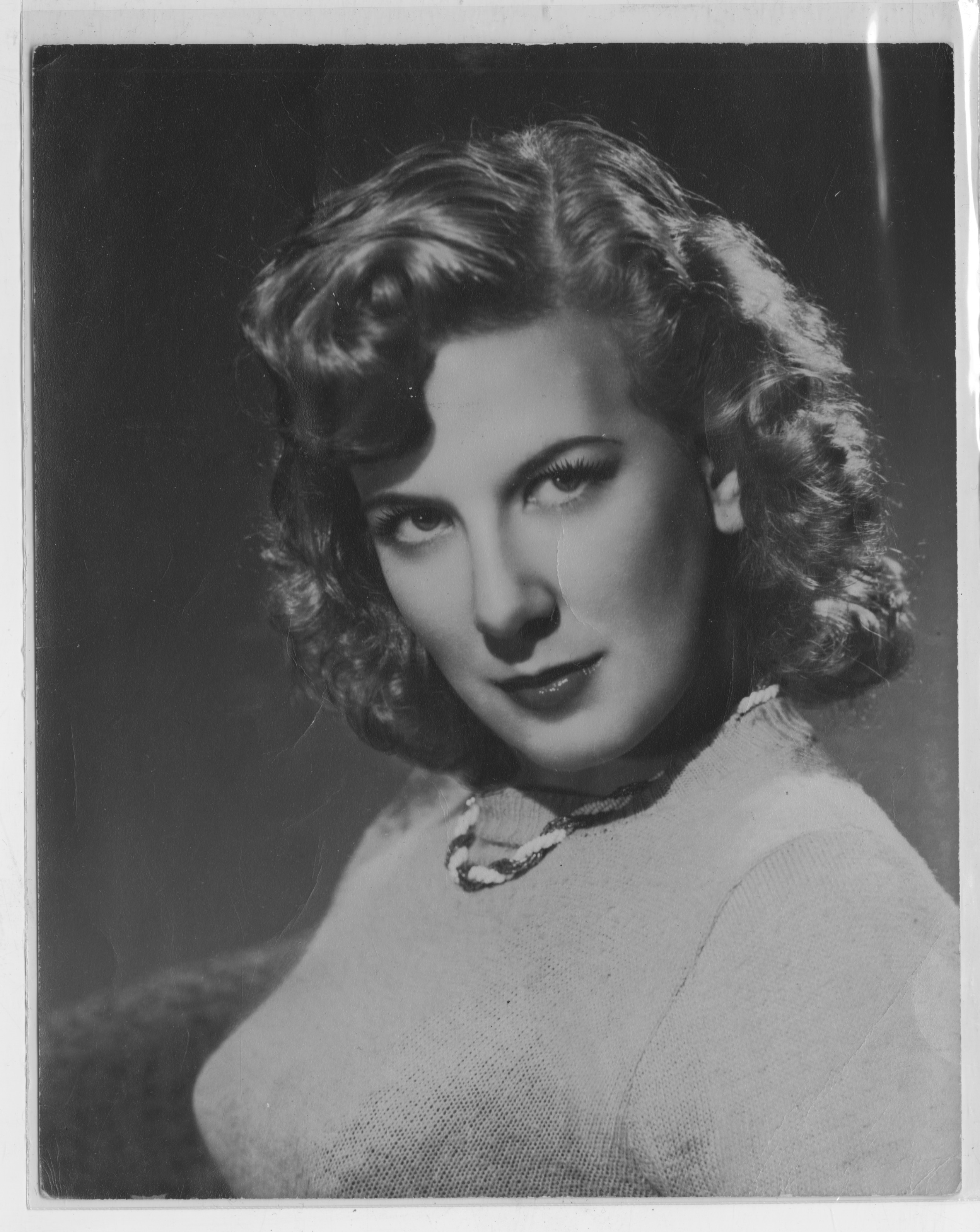
promo

The author’s grandmother in 1947

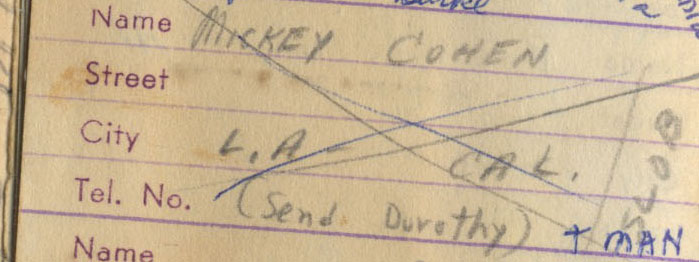
The date next to the party notation is long after Lana and Steve had divorced for the second time, but before Crane’s daughter killed Lana’s boyfriend Joey Stompanato (who, it should be noted, is not in the book – although his boss Mickey Cohen is … or rather, was…)

cohen-slob

Poor Dorothy!

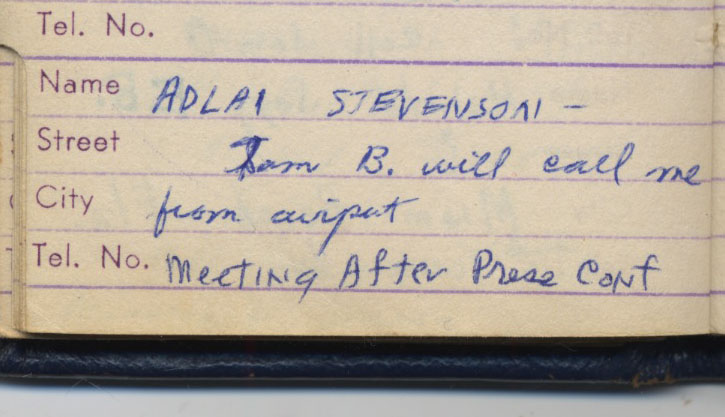
After this discovery, I put the Box away again for a long time. I couldn’t work out if all or none of this was real or fantasy; it seems too bizarre to be made up, and the lists seem deadly serious, full of references to Feds and T-Men and secret entrance instructions (“take elevator to 7 then back hall”) private lines to police chiefs paired with first-name only women, lines and lines of indecipherable code words, acronyms and seemingly random numbers and finally, the somehow ominous, “Sam B will call from airport – meet AFTER press conferences” because of course my grandmother would not be meeting Adlai Stevenson BEFORE press conferences; that would make no sense at all. To paraphrase Sherman Alexie, if my grandmother was a liar, then she was a magnificent liar.

stevenson-detail

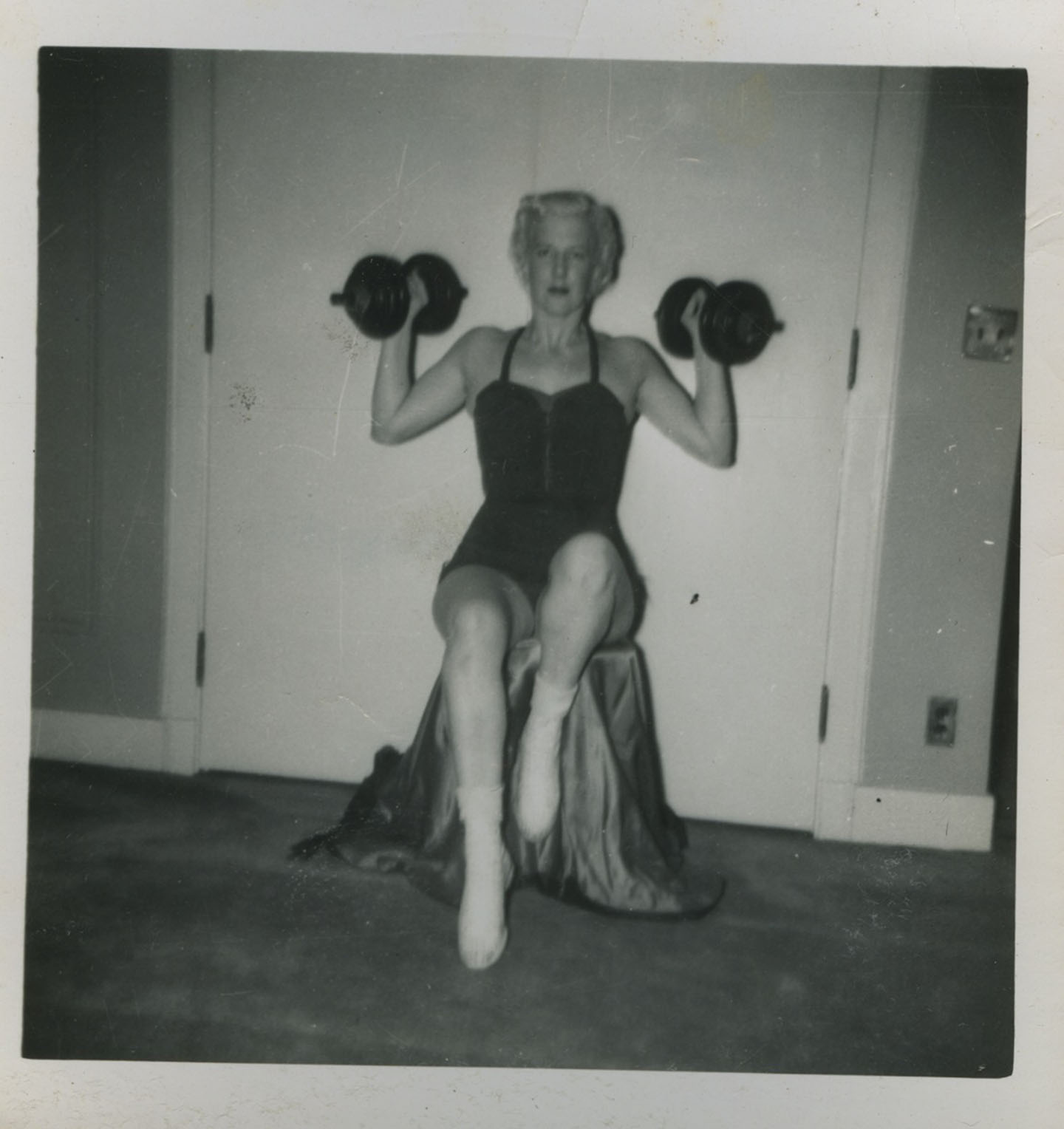
Aside from the little black book (volume 1; my sister still holds its sequel), the most enthralling objects in the box are the photos and newspaper clippings. So far, I can’t, with any certainty, identify anyone except my grandmother, but if the hairstyles and fashions are wonderful, the promotional materials for her stint as a lady wrestler are spectacular. Her competitors often have gimmicks – farm girls in pigtails and gingham rompers, dramatic beauties in capes and elaborate makeup. One particularly frightening-looking woman is billed as a “Lady Angel” who makes children cry.

scrapbook4 1

an undated newspaper clipping

But Grandmother is just herself, platinum blonde in a simple black one-piece. Up until the arrival of the Box, I’d assumed my sturdy build and strength were the results of my father’s genes – northern Greek mountain dwellers and herders of flocks, but my grandmother’s thighs and broad shoulders were immediately recognizable as my own.

lenos_FS11 Each of us creates a story of our lives, a narrative that casts us each as the protagonist of an ongoing serial. By necessity, we design conflict and, inevitably, a mythology that explains who we are and why we are who we are.

The narrative of my life splits with the arrival of the Box. Up until that point, I thought my story was a showstopper. A rural girl from humble beginnings – working class roots and a shy childhood that exploded into what I thought of as a series of defining – and terrific – adventures in my early 20s: working my way through college with a variety of weird jobs, partying with A- and B- list indie rockers and artists. Then scrabbling my way through a Master’s degree, then a PhD program, still occasionally having the odd run-in with celebrities and the stories with them that I collected like pretty stones. The first of my siblings to finish college, the only in my family to obtain this level of education; a woman who achieved her goals and now holds the life of her dreams: the college professor, the author, the scholar.

aggropose

The author’s grandmother challenges all comers

The Box shattered my self-made mythology; my life is so unbelievably dull compared to Grandmother’s, so lacking in adventure and danger and glamour. My stars are pale lights next to Lana Turner, my adventures child’s play beside mobsters, national politicians, actual federal agents.

spycostume

The author’s grandmother was not, as far as the author knows, a secret agent herself

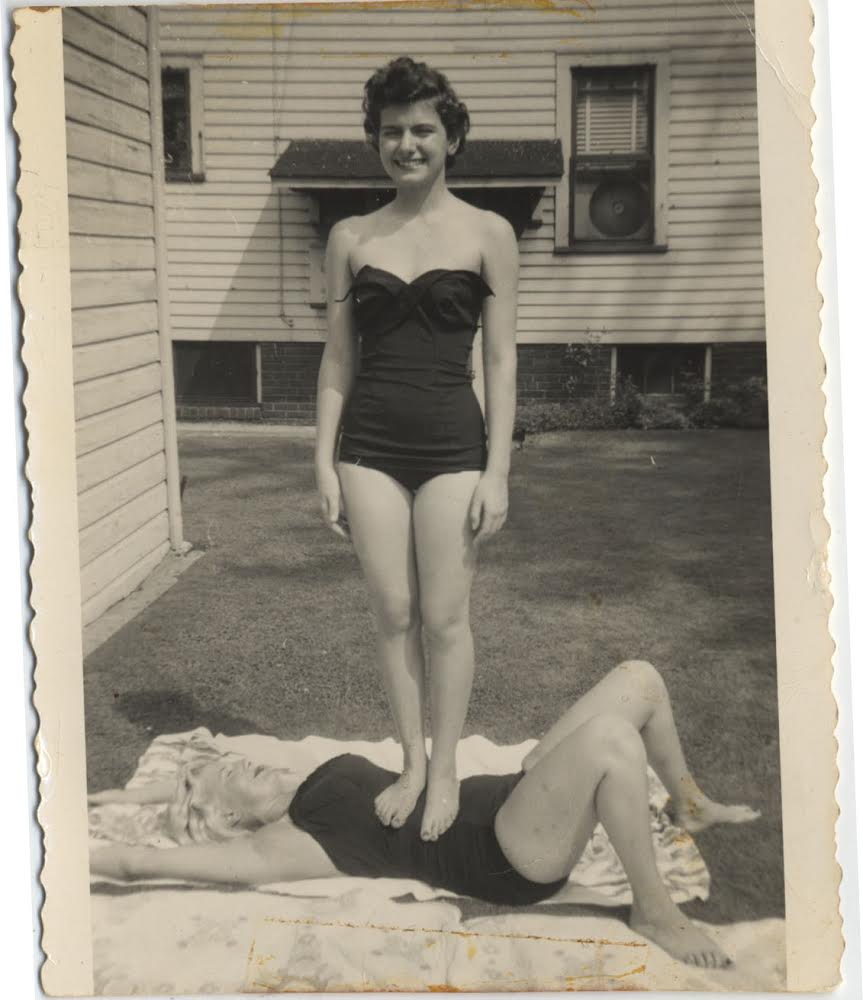
By all accounts, Grandmother was a disengaged and unenthusiastic mother. My own single maybe-memory of her is of a perfectly-coiffed bottle blonde in a red bathing suit and sunglasses standing beside a Florida swimming pool. She is holding a tall glass of something clear, and has a rigid 1970s facelift (her recovery is documented in the Box – meticulously in daily, bloody color Polaroids, carefully dated; they are like horror movie stills). The memory is also a still in my mind; I am wearing jelly shoes and everything has the tint of the late 1970s. She is not looking at me.

About the author

Melissa Lenos is an Assistant Professor of English at Donnelly College where she teaches English, cultural studies and film studies. She is co-author of An Introduction to Film Analysis: Technique and Meaning in Narrative Film, and is currently editing a collection on uses of classical fairy tales in contemporary popular culture. Melissa lives in Kansas City, Missouri with artist Corey Antis and one small cat. Those interested in following her Box research can do so here:  http://cargocollective.com/flyover/The-Box-Project 

Survival (Part I)

Editor’s note: When William Masters first submitted “Survival” to us several weeks ago, we were naturally shocked by its content. Was the author really confessing to murder? And why do so on our little blog? In the interest of full disclosure, in the weeks to come we will publish our lengthy correspondence — with the author, the San Francisco police department, with bottled water experts (oh yes!), with friends, and each other — about the claims made in this story. But for this week, we present you the original story without comment.

by William Masters

The author as a young man

The author as a young man

At sixteen, my older brother Mike was tried as an adult and sentenced to a year in the lock-me-tight for splitting from the Scottish fast food joint without paying for his order. After a month’s incarceration, he gained 11 pounds. For the first time in two years, he no longer went to bed hungry each night.

At eleven, as soon as the cast came off my younger brother Sam’s left arm, he hopped a freight train to St. Louis. After a month, most of his cuts and bruises healed and faded enough so that he could wear a short-sleeved shirt without having to answer questions or attract unwanted attention.

At fourteen, panicked at being left the sole target for my parent’s attentions, I drained the brake fluid from their car on Thursday night. Desperate, and hoping to survive until Friday morning, I locked the door and barricaded myself in the empty pantry.

The next morning, I heard my parents shout obscenities, blaming each other for the empty coffee canister. One of them threow the canister against the pantry door… followed by an uncanny silence, during which my body shook as I watched the pantry doorknob move from right to left.

“Oh Steve… come out, come out so I can punch you good-bye,” my father said.

“Oh Sweetie… come out, come out and give mother a kiss good-bye before the house burns down.”

I climbed up on the canning table that stood beneath a port sized window and waited… I waited until I saw my parents finally leave the house and climb into the car.

As soon as I saw the car drive away, I released myself from the pantry and rushed through the great room, which reeked of the beer my parents had substituted for the missing coffee , walked out the front door, sat down on the porch swing, and watched the car drive past the first turn.

With sober anticipation, I imagined my father’s surprise as he tried to apply the brakes to the first hair-pin turn as he drove down the steep mountain road. As soon as I heard the explosion, I took a deep breath and exhaled. A few minutes later, too far away to see any flames, I watched a plume of smoke appear, straighten out and rise vertically into the sky. The smoke congealed into a single, dark grey mass, split in half into a pair of clouds, then floated together along the line of the horizon until the November breeze snuffed them both out.

It wasn’t until late in the afternoon when two cars arrived, one from the sheriff’s office and one from Child Services. Still hungry, after eating a can of tomato soup and a small packet of saltine crackers, the only food left in the house, I asked the sheriff if he had a candy bar. His deputy pulled a tootsie roll out of his jacket pocket and tossed it to me. I thanked him.

Child Services looked at both the policemen, then scanned a file folder, and then looked at me. “You don’t want to spoil your dinner with that candy bar, do you… Steven?” Then Services blandly informed me that both my parents had been killed in a car crash that morning.

My body twitched as I concealed my joy in the confirmation.

Then Child Services gave me an empty box with a lid. “You have fifteen minutes to pack one suitcase and fill the box with your belongings before I transport you to a temporary holding area pending your assignment to another location.”

Ten minutes later, I stood silently, holding all my clothes and possessions in my mother’s suitcase. Standing absolutely still in the main room and kitchen area, I felt trapped between the empty frying pan on my right, and the sight of Child Services I saw through the window on my left.

As I touched the back pocket of my Levis to make sure I had my tiny address book, I gripped the suitcase and moved through the front door which Child Services held open for me, and headed to the police car. Like an act of telepathy, the deputy opened the car’s trunk for my suitcase.

Child Services vigorously protested and waved a paper at the two policemen, demanding that they move my suitcase into its trunk and escort me to the backseat of its car.

Silently I stood my ground. I looked the sheriff in the eye, belligerent and pathetic. The sheriff opened the back door of his car for me and told Child Services, “I’m just following protocol.”

Apparently, though still a minor, I needed to make a formal statement at the station and had the right to make calls to anyone I chose to ask for assistance before Child Services could claim me.

As I sat in the backseat, my muscles relaxed and my respiration returned to normal. Ignoring further protests from Child Services, the policemen got back into their car. As the deputy started the engine and shifted the car into gear, the Sheriff offered me a bottled water.

“Here kid, you look like you could use a drink.”

About the author

After the incident, the author spent four years in a group home, then received a scholarship to UCSB, and lived happily ever after, so to speak. No one ever found out about the brake fluid. He lost the copies of the death certificates that were given to him when he reached 18yrs old. “Survival” is part of William’s unpublished anthology, Portraiture: A San Francisco Story Cycle. About 14 stories from the anthology have been previously published in various magazines.
***
So, readers, what do you think? Please weigh in in our comments section below…